Christopher Nolan’s films are largely characterised by their narrative ingenuity and epic scale, but with the (sometimes unfair) impression of a clinical, impersonal approach, of an inability to dig into the hearts of his characters. Based on Kai Bird and Martin J. Sherwin’s American Prometheus, Oppenheimer features all the hallmarks of Nolan’s style, from the non-linear narrative to the use of practical effects. However, it’s also a departure from Nolan’s usual fare – much more character focused, grounded film than he has ever attempted before. It is a film of vaulting ambition and imagination, but in service to a character study of J. Robert Oppenheimer, one of the most fascinating figures of the 20th century.

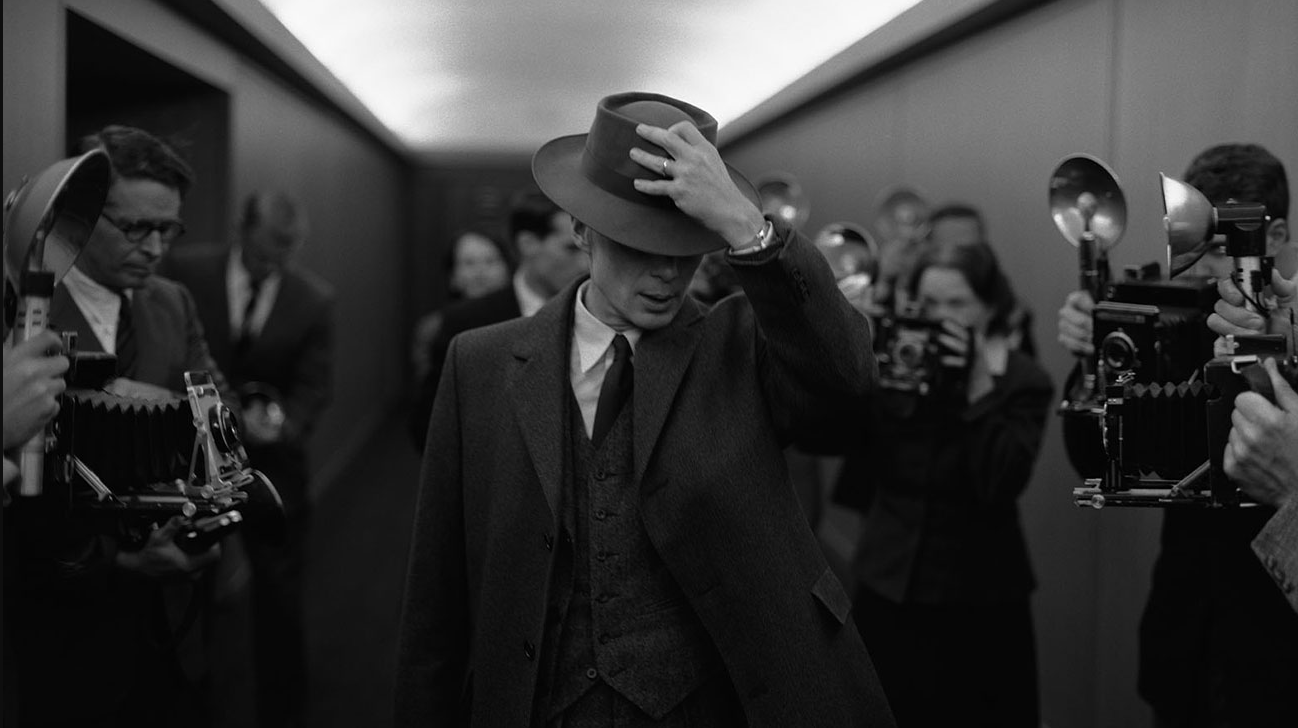
Of course the success of a film like this largely depends on the actor playing the central character, and Cillian Murphy takes the film on his narrow shoulders and gives a towering yet subtle performance. He seems to do so little but accomplishes so much, bringing an appropriately enigmatic quality to his role, and nailing each beat of his arc. He infuses Oppenheimer with an arrogance, charisma and an emotional vulnerability that makes him an endlessly engaging figure. He’s a conflicted, paradoxical character, and Nolan and Murphy never shy away from his less appealing traits. He is naive, he is a lothario, but he’s also brilliant. It’s a perfect story of an imperfect man.
Nolan manages to deploy the narrative tricks he honed with films like Memento,The Prestige and even Batman Begins, often to dizzying effect. The leaps in time and perspective are clearly signposted but can still catch you off guard. The different timelines are differentiated with varied film-making techniques, in particular Hoyte Van Hoytema’s stunning cinematography – crisp, colour film, crackly black and white documentary style, and crisp, beautiful monochrome – making history by using the first black and white film stock ever created for IMAX .
The film suffers from a severe case of celebrity casting early on, as an apparently never-ending series of famous actors playing famous scientists breeze through Oppenheimer’s orbit. The entire cast (Which includes Kenneth Branagh, Benny Safdie, Josh Hartnett, and a couple of surprises) are great in their roles but hardly any are given any real depth, and most amount to little more than cameos – Jack Quaid and Rami Malek get particularly short shift.
Sadly this also extends to both Emily Blunt and Florence Pugh as the only two female characters in the film. Blunt at least gets a real moment to shine as Oppenheimer’s long-suffering wife, making the role infinitely more interesting than the cliche it could be. It’s a real tour-de-force moment, beautifully delivered by Blunt. Pugh is less fortunate, essentially there to demonstrate Oppenheimer’s fallibility and youthful naivete before exiting the film – she’s as great as you might expect but ill-served by the script.
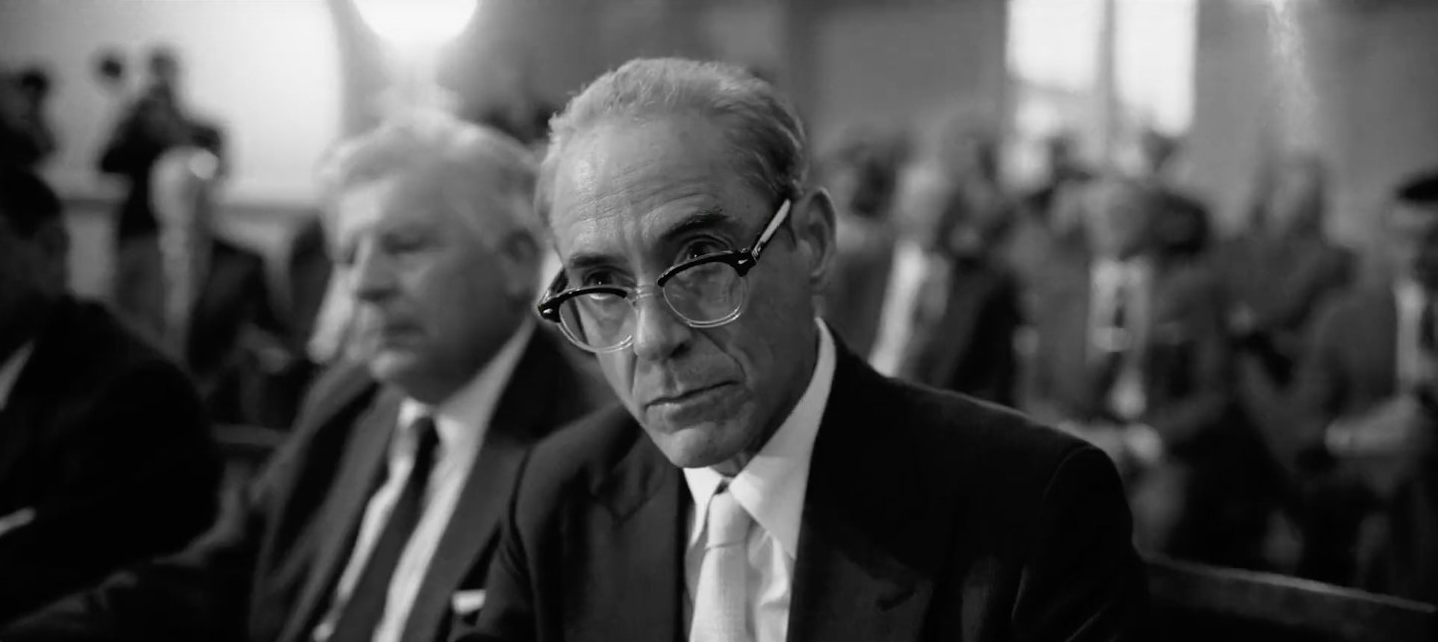
The exception to this is Robert Downey Jr, who gives a performance just about as far removed from Iron Man as possible as the thin-skinned and vindictive Lewis Strauss. It’s a beautifully observed, precise performance and a timely reminder of what a great actor he can be when given the opportunity. Matt Damon also makes an impression as the no-nonsense General Leslie Groves, who eventually warms to Oppenheimer’s quirks, and Tom Conti is dependable as ever, making his Albert Einstein a warm and principled confidante, understanding the implications of Oppenheimer’s creation early on.
The pivotal, much anticipated Trinity test is an exceptional set-piece, an assault on the senses in every way, made even more potent when viewed in IMAX. A famous advocate of film and IMAX in particular, calling it “the gold standard of motion picture technology.” Nolan clearly intended his film to be viewed on the biggest screen possible, and constructs this scene in such an immersive way that you really need to see it in an IMAX cinema. Nolan drowns the sequence of all sound, while flooding it with beautifully disturbing visuals – a wall of flames that envelopes the screen, while all we hear is Oppenheimer’s heavy breathing. The silence drags out for an almost unbearable length of time before the soundtrack explodes with a barrage of sound effects – it’s genuinely awe-inspiring.
Even more impressive than this though, is Oppenheimer’s speech in the wake of the fateful bombing of Hiroshima, where he is confronted with visions of the desolation his creation has wrought. It’s a dizzying, disorienting, often overwhelming moment, both breathtaking and horrifying in it’s reach and scale, and which sums up the conflict of his character perfectly. The point is made late in the film that Oppenheimer never publicly expressed regret for the weapon he unleashed on the world. But the range of complex, often contradictory emotions he feels in this moment – a macabre combination of pride and shame – are beautifully conveyed through Murphy’s non-verbal performance and Jennifer Lame’s masterful editing.
After blowing his audience away with the spectacle of the Trinity sequence, Nolan deftly switches into an equally compelling post-war narrative that recalls Oliver Stone’s JFK in its use of frenetic yet scalpel precise editing; Switching back and forth between the board hearing into Oppenheimer’s security clearance and the confirmation hearing preparing to initiate Strauss into the senate. This may be my most controversial statement, but I found this segment the most engaging of the film, as Oppenheimer’s knowledge and experience informs his decision to oppose testing of the hydrogen bomb, while his political naivete when it comes to his friends paints a target on his back in an era when rubbing shoulders with a communist was seen as a capital offence.
The cloak and dagger elements of this segment recalls the allegory deployed by Oppenheimer earlier in the film. The idea of mutually assured destruction, of two scorpions unable to work together, applies just as much to the personal animosity that exists between the key players as it does to the global conflict of the nuclear arms race.
Nolan doesn’t hold our hand through all the physics talk, but he also never treats his audience like idiots. He trusts in his audience to understand the implications of precisely why Oppenheimer submits himself to this ritual humiliation at the hands of his detractors, aside from one brief line from Blunt. There are also subtle hints in the meticulous sound design. The incessant, rhythmic pounding that plays in Oppenheimer’s head throughout – often at times of extreme stress – and the source of this, while never explicitly revealed, is a telling character beat.
There is a line from Josh Hartnett’s Ernest Lawrence early on about Oppenheimer’s naivete, where he angrily says that he’s not self-important, but actually important. I think in the past the criticism of self-importance could be leveled at Nolan, but with Oppenheimer it feels like he has achieved something approaching genuine importance. It’s a breathtaking experience, a character study on an epic scale. Sometimes intimate, sometimes overwhelming, but always incredibly compelling.


![Unquiet Guests review – Edited by Dan Coxon [Dead Ink Books]](https://criticalpopcorn.com/wp-content/uploads/2025/10/ug-reddit-ad-e1761690427755.jpg?w=895)
![Martyrs 4K UHD review: Dir. Pascal Laugier [Masters Of Cinema]](https://criticalpopcorn.com/wp-content/uploads/2025/10/image-1-e1761586395456.png?w=895)

![Why I Love… Steve Martin’s Roxanne [1987]](https://criticalpopcorn.com/wp-content/uploads/2016/11/roxanne.jpg?w=460)

 Critical popcorn
Post your thoughts