
Martin Scorsese’s filmography in just the last decade would mark him out as one of the greatest American directors to ever step behind the camera. But with Killers of the Flower Moon, he has crafted another masterpiece whose scale in visual craft and character dynamics (and its indictment of the American Way) is equalled only by his own illustrious career. Somehow at the age of 81, the great master has given us another film to add to any debate over his career peak.
Excluding his own cameos, only two people have appeared in more Scorsese films than Leonardo DiCaprio: Robert De Niro, and the director’s own late mother Catherine. It’s fitting then that a work so grand in its ambition should feature both of the director’s most frequent dysfunctional muses. DiCaprio is cast against type, his hunched shoulders and permanently furrowed brow creating a very different physical space for the actor, while De Niro is playing to his strengths, a cattle rancher who’s the most significant white man in an area dominated by Native Americans.

Based on the nonfiction book by David Grann, Scorsese’s screenplay (written with Eric Roth) excises some of the book’s detail about the formative days of the FBI to focus on what the nascent bureau were called upon to investigate. Set in a post-Western, post-WWI America, Ernest Burkhart (DiCaprio) is the nephew of wealthy landowner William Hale (De Niro). Ernest becomes involved with a member of the Osage tribe, Molly (Lily Gladstone) after giving her lifts in his car and the two eventually marry. Her tribe have head rights to the oil found on their land, but soon come under a series of attacks; Molly’s mother and sisters have all met their end in sinister ways and Molly is now struggling with her own diabetes. But is Ernest caring for her, or are there ulterior motives at work?
Scorsese has always been a visually gifted director, creating both stunning images within the frame and incredible movement with his camera, understanding the geography of a scene as much as its immediate power better than almost anyone. He’s once again paired with long time editor Thelma Schoonmaker, and his cinematographer of the last decade Rodrigo Prieto, and they begin weaving magic almost from the first frame. A shot of the locals dancing, in slow motion, in the newly erupting oil is a moment of innocence to contrast with what comes later. From Goodfellas to The Irishman, Scorsese and Schoonmaker have combined carefully to show the staccato brutality of violent crime, and those tools all get a thorough workout here. And there’s a tracking shot for good measure, the camera wheeling through the rooms of a house but here the director ups himself by finishing the shot staring into a mirror.
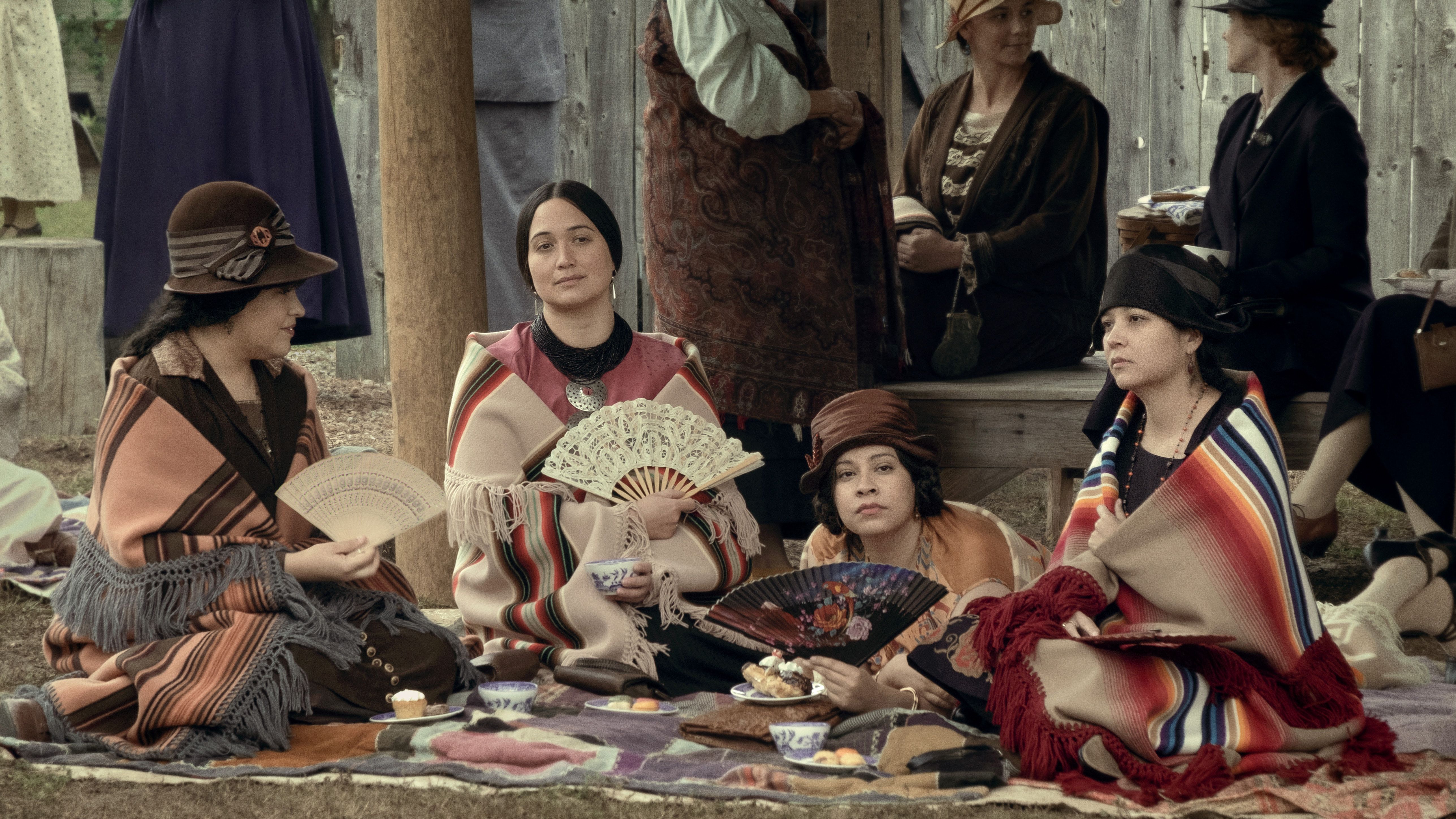
The film is reported to have a budget of around $200 million and thankfully much of that is evident on screen in Killers’ scale of set building and sense of place. From journeys through the developing oil fields to the 20s township which forms much of the more expansive films in the director’s filmography. But that sense of expanse also extends to the narrative, which feels broad without ever sprawling. Seemingly random events, such as the rise of the local KKK, are gradually drawn together and the three-hour-plus running time never feels a burden. There is so much that needs to be told about the abuse and injustice meted out to the Osage tribe, and Scorsese is here to tell it; while he sifts through many of the events in forensic detail, it’s to his continual credit that every moment feels essential, not a moment superfluous in this damnation of American history and values.
While there’s a deep rooted sense of anger, there are also moments of comedy, a black humour creeping from the sheer ineptitude of some of the conspirators. That extends to Ernest, and it’s to DiCaprio’s credit that he rejected the role of Bureau investigator Tom White (instead Jesse Plemons fills that role) for the snivelling, pliable nephew. Carrying the burden of internal conflict and indecision, DiCaprio is less morally ambiguous and more morally vacuous, a perfect contrast to the benign grace in the face of mounting hopelessness of Lily Gladstone’s Molly. She retains a dignity while her oppressors denigrate her, both physically and mentally, which becomes agonising by the final act. At the centre of it all is arch manipulator Hale, gently requiring Ernest to call him King while pitching himself as a friend to all. He’s as two-faced as Janus, but De Niro is never required to dig into histrionics, his measured authority twisting the town and its inhabitants increasingly into his grip.

They’re all players on an unfolding stage which plays into the themes which Scorsese has gravitated towards throughout his career: money and power, the class struggle, violence, but also the sense of spirituality that binds the Osage, and putting Ernest under a microscope to examine for any trace of guilt in his actions. That sense of guilt permeates every fibre of the film, even to the finale: rather than a series of title cards explaining the fate of each character in white text on black, we join the end of a radio play which has seen events unfold, and Scorsese’s cameo within this is as clear a sign as any of his view of the collective guilt that modern America still needs to bear for these sins past.
Flowers of the Killer Moon is, as so often with this peerless director, a monumental film which stands as testament to a period of history with its dark heart and violent tendencies. But somewhere, in the dignity and resilience of the Osage people, there remains that one other elusive element, a hope that we can do better, that future generations may be able to come to some form of acceptance of the true nature of the lives of previous generations.


![Unquiet Guests review – Edited by Dan Coxon [Dead Ink Books]](https://criticalpopcorn.com/wp-content/uploads/2025/10/ug-reddit-ad-e1761690427755.jpg?w=895)
![Martyrs 4K UHD review: Dir. Pascal Laugier [Masters Of Cinema]](https://criticalpopcorn.com/wp-content/uploads/2025/10/image-1-e1761586395456.png?w=895)



![Why I Love… Steve Martin’s Roxanne [1987]](https://criticalpopcorn.com/wp-content/uploads/2016/11/roxanne.jpg?w=460)


 Critical popcorn
Post your thoughts