
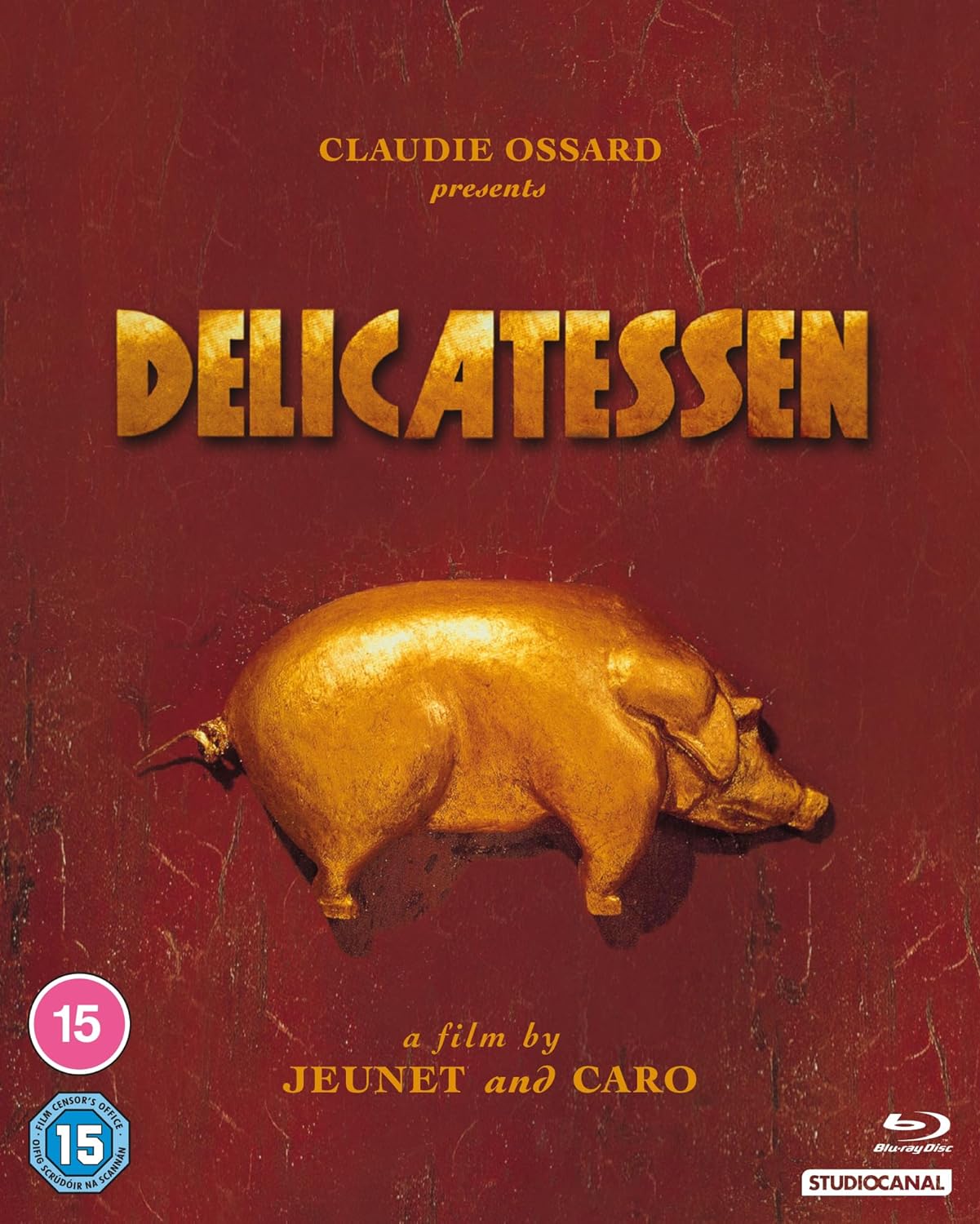
Following on from the stunning remaster of The City Of Lost Children, StudioCanal have released (for the first time on Blu ray) the first feature collaboration of directors Jean Pierre Jeunet and Marc Caro, the macabre and endearing Delicatessen. A surreal masterpiece, it’s perhaps the most wholesome film to feature cannibalism.
Set in the future, an undisclosed apocalyptic calamity, has wiped out all animals which leads to humanity turning on itself. The only currency is corn, postmen carry guns and vegetarians hide in the sewers. Unlike more modern post-apocalyptic settings though, this is a very small scale dystopia set entirely in a dingy apartment building above a butcher’s shop. A butcher’s shop where there’s only one kind of meat available.
The tenants are a gallery of var, from a rich woman plotting Rube Goldberg suicide attempts, to a military type who uses his flooded apartment to breed and eat slugs and frogs. Into this environment comes Louison (Dominique Pinon), a former clown looking for work. The Butcher (Jean-Claude Dreyfus) takes him on, with an eye to serve him up to the residents of the block when he outlives his usefulness.
Considering it was their first feature film, Jeunet and Caro have a startlingly assured sense of identity, a refreshing inventiveness and a blacker-than-black sense of humour which is evident from the very first scene. Their subsequent films built on this, with idiosyncratic characters, a stock cast of supporting actors, and increasingly elaborate set-pieces. However Delicatessen remains the most satisfying example of their style – not as schmaltzy as Amelie, but not as inaccessible as The City Of Lost Children. There are some truly indelible images and sequences, from the now iconic bed-squeaking scene (a beautifully edited sequence that briefly brings all the disparate apartment residents together) to the touching duet between Louison and Julie (one on the cello, the other on the saw). Another sequence in the climax was seemingly lifted wholesale for the first Paddington film.
Pinon gives an effortlessly endearing performance as Louison, and believably performs a variety of circus routines. I’d previously only seen him as the punky, walkman obsessed hitman from Jean Jacques Beneix’s Diva, and as this was maybe the second French film I’d ever seen I assumed he was a big star. He would go on to be something of a good luck charm for Jeunet, referred to in the commentary as “our old accomplice” and appearing in The City Of Lost Children, Amelie, A Very Long Engagement and Alien: Resurrection. I will forever associate him with this film though. It’s one of the rare times he plays the lead, and he’s a genuinely warm, charismatic presence. It’s an almost Chaplin-esque performance – sweet-natured and oblivious, with a great sense of physical comedy, without ever falling into overt sentimentality. His optimistic outlook and cheery demeanour discomfits the other residents, who would prefer to just view him as food, and it challenges some of them to change their own attitude on eating one of their own.

Delicatessen might sometimes veer a little too far into whimsy for 21st century audiences, but any saccharine feelings in the scenes involving Louison’s romance with the Butcher’s myopic daughter Julie (Marie-Laure Dougnac) are quickly countered by the overwhelmingly cynical tone and gallows humour that permeates every scene. Dougnac herself is brilliant in her role – the scene where she carefully sets the table and memorizes where everything is, so to avoid wearing her glasses for a date, is wonderfully conceived. There are also numerous set-ups and pay-offs that Jeunet and Caro pepper throughout the film. In one subtle detail, when one tenant is fixing the one condom he owns, we can see it has two holes in it – appropriately enough he has two children.
If the film has a drawback, it’s that it often feels like a series of comic vignettes rather than a fully coherent narrative. In this way it feels very similar to Roy Andersson, although stylistically it’s more reminiscent of Terry Gilliam and Guillermo Del Toro. There is also a slight lack of depth in places, particularly concerning the supporting characters. It’s suggested that the butcher is reluctant to kill Louison because he likes him and this is further complicated by his blossoming relationship with Julie. However this is conveniently forgotten in the final showdown, where the butcher turns into a dastardly cartoon villain. It would have been interesting to explore this in more depth, as Dreyfus is much more compelling in his quieter moments, although there is something to be said for the brevity of the runtime – the 99 minutes just breeze by and ensure that the pace never lags.
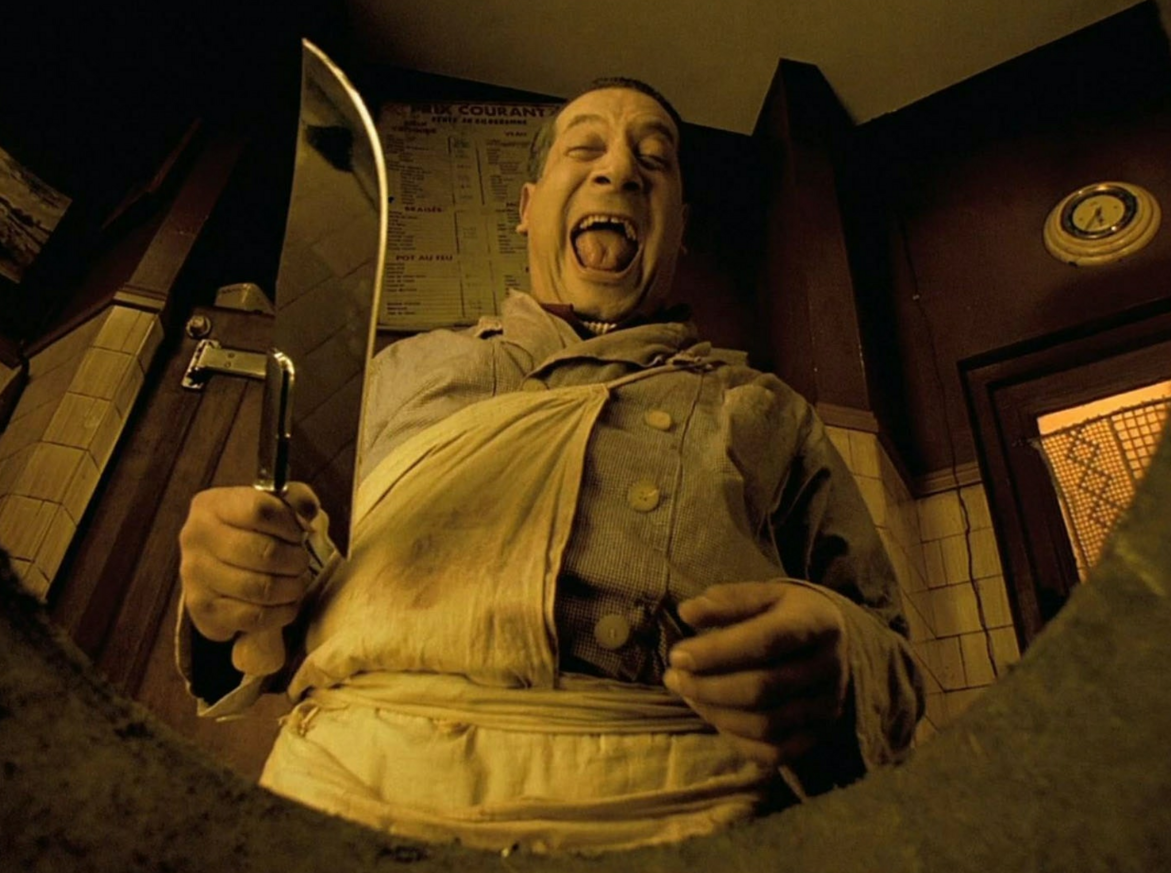
There’s a nicely judged dissonance that exists between the vibrant, rich cinematography and the desolate, depressing setting, which is even more striking in this release from StudioCanal. The 4K restoration, supervised by Jeunet, is a thing of beauty, with Darius Khondji’s beautifully barren cinematography looking better than ever. The yellowy green, almost sepia colour palette adds to the murky dystopian feel, and the wide angle lenses used in extreme close-ups exaggerate the facial features of its cast to dizzying effect. Khondji would go on to bring his distinct style to later films like Seven, Okja and Uncut Gems, and it’s incredible to see it so fully realised early in his career. While it’s a shame this release doesn’t include any new special features, it’s worth getting for the restoration alone.
“Charming” is an incredibly subjective term, and one that differs from person to person. Whatever it may say about me, this film is my kind of charming. Other people might differ but there’s a sweetness to Delicatessen tempered by the dark, dystopian feel and the result is a near-perfect black comedy: charming in all the best ways.
Special Features
The extras are pretty much replicated from the previous DVD release, consisting of a commentary from Jean-Pierre Jeunet, a Making Of documentary, interview with Jeunet and Caro and a Jeunet archive.


![Unquiet Guests review – Edited by Dan Coxon [Dead Ink Books]](https://criticalpopcorn.com/wp-content/uploads/2025/10/ug-reddit-ad-e1761690427755.jpg?w=895)
![Martyrs 4K UHD review: Dir. Pascal Laugier [Masters Of Cinema]](https://criticalpopcorn.com/wp-content/uploads/2025/10/image-1-e1761586395456.png?w=895)

![Why I Love… Steve Martin’s Roxanne [1987]](https://criticalpopcorn.com/wp-content/uploads/2016/11/roxanne.jpg?w=460)


 Critical popcorn
Post your thoughts