The name of Tod Browning is probably best known to the average moviegoer as the director of the original Dracula, starring Bela Lugosi. For others though, he will forever be linked to some of the most subversive horror films of early cinema.
He carved out a niche as one of the most unique voices in horror cinema, with a clear preference for the macabre. This release from Criterion combines three of his most interesting works, all centered around his fascination with the world of the circus – two of his most notorious works and one previously unobtainable film.
The main event is undoubtedly Freaks, a story of a travelling group of sideshow performers that proved controversial upon release due to Browning casting real sideshow performers. When the dwarf Hans (Harry Earles) becomes enthralled by the beautiful trapeze artist Cleopatra (Olga Baclanova) she takes advantage of him, seducing him and agreeing to marry him, while secretly plotting to kill him and inherit his vast fortune with her accomplice, the strongman Hercules (Henry Victor). When the Hans’ friends learn of her deception, they plan a grisly revenge.

This is one of my all-time favourite horror films of the classic era, a genuinely unnerving, discomfiting film that treats its subjects with compassion even while leaning into some pretty nasty territory. Browning resolutely refuses to treat the performers as victims, and is instead more interested in the bonds that exist within the community of the travelling circus; contrasting the loyalty shown by the “freaks” of the title with the venal cruelty of the outwardly beautiful characters.
Browning spends most of the runtime encouraging us to identify and relate to the performers as they go about their everyday lives. There’s a lot of innocent charm to these scenes, such as the comedy of manners with conjoined twins Daisy and Violet Hilton dealing with their new husbands, or all the acts coming together to celebrate the birth of the bearded lady’s baby – “What is it?” wryly asks Phroso the clown (Wallace Ford). Even the most quoted scene in the film is an attempt by the performers to include Cleopatra in their community, trying to make her “one of us” – a refrain that takes on a gruesome prescience by the films end.
That being said Browning manages to have his cake and eat it too. While they are depicted sensitively for the most part, there are hints at a more menacing side to the “freaks.” Indeed the film is both ahead of its time in the way it challenges the preconceptions of the audience when it comes to the performers, and simultaneously a product of its time, shown when Browning plays on those same preconceptions for the shocking finale. In his excellent series on horror Mark Gatiss described the climax as “a shameless case of double standards.” and it’s hard to disagree. It’s a shocking ending regardless, and the sight of the performers crawling through the mud to exact their revenge on the villains is still deeply disturbing today.
There remains a mixture of exploitation and celebration of these characters – certain scenes are blatantly constructed to demonstrate the performers unique skills. When Prince Randian “The Living Torso” performs his act of rolling a cigarette despite having no arms or legs, he caps it off by looking just off camera and shouting “I can do anything with my mouth!” For him the scene, even the film, is just an excuse to showcase his unique talents.
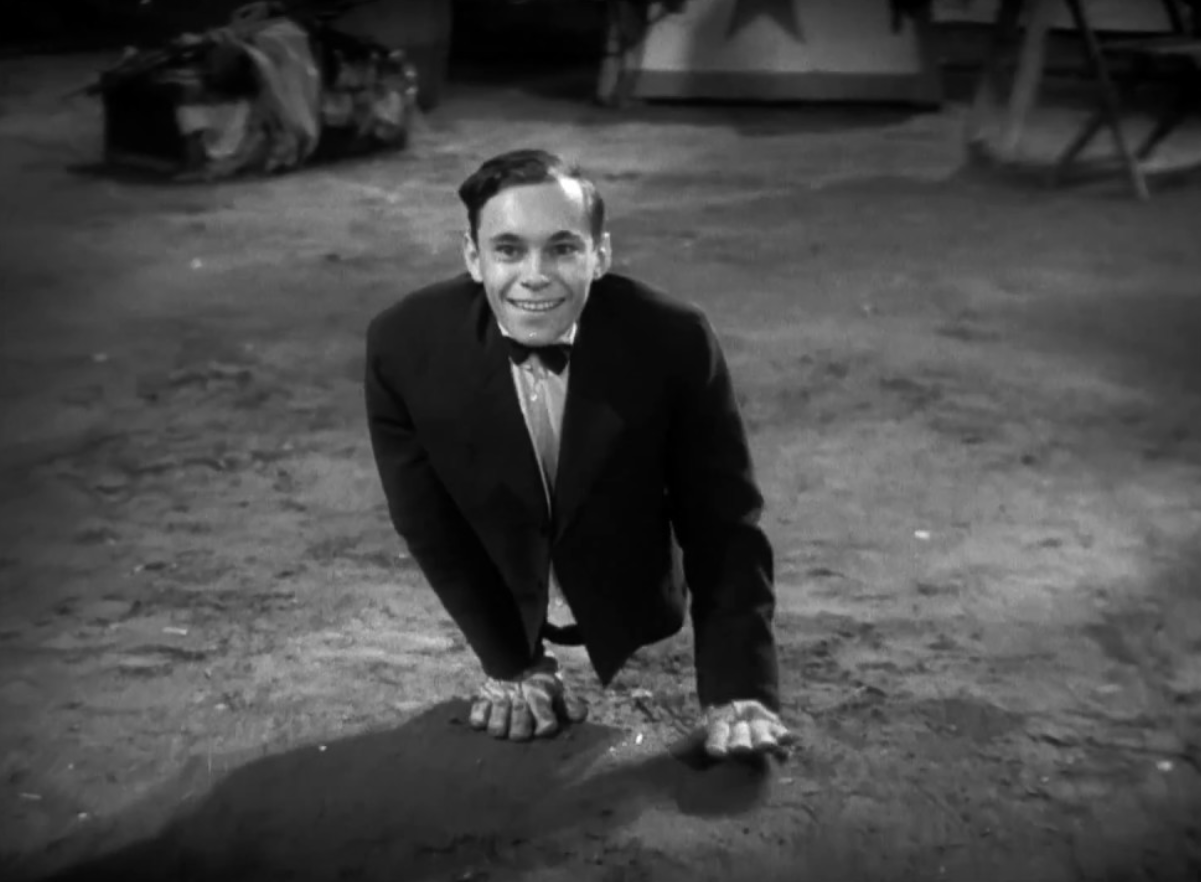
Heavily edited upon its release, with a whopping 30 minutes now lost forever, what remains is nonetheless a coherent and disturbing cautionary tale. It had an overwhelmingly negative reception, with many dismissing it as trash, which does an injustice to Browning’s considerable skills as a director. Aside from anything else it’s still an incredibly striking film to look at, even today – there’s a fluidity to the camera movement that adds a sense of momentum to the film. One particularly effective tracking shot follows the silhouette of Johnny Eck the “half-boy” walking on his hands underneath the trailers during a storm (incidentally, Eck would go on to be the inspiration for the adorable robots in Silent Running).
Also included in this boxset is The Unknown, a film I had heard about but never seen, a truly macabre tale starring Lon Chaney in one of his most ambitious roles. Renowned for his grotesque physical transformations in films like The Phantom Of The Opera, London After Midnight and The Hunchback Of Notre Dame, here Chaney plays Alonso, the knife thrower, a knife thrower with no hands. Chaney throws himself into the role with his characteristic commitment, using his feet to do such mundane actions as opening a bottle of wine, smoking a cigarette or even playing a guitar (he did employ a double for certain scenes but it’s still impressive!). It’s a wonderfully dark film for its time, with a bitterly ironic twist that wouldn’t be out of place in an episode of The Twilight Zone or Inside No.9.

The final film in the boxset is The Mystic, available for the first time. It’s another disturbing carnival tale, a clear scion of Robert A Wiene’s The Cabinet Of Doctor Caligari and an antecedent on both the book and the film of Nightmare Alley. The story of a medium (Aileen Pringle), recruited for a major heist by a canny con artist (Conway Tearle), The Mystic is a nuanced, bittersweet pre-noir film, and a welcome addition to this collection. Compared to the other two it might seem a little lightweight, but it’s full of disturbing imagery and showcases Browning’s empathy for seemingly unsympathetic protagonists.
Freaks remains one of the most disturbing, iconoclastic films of all time, and it remains a crime that Dracula would prove to be Browning’s most popular film, while his most subversive and interesting film would be butchered by the studio and effectively end his Hollywood career. This collection serves as a brilliant showcase for Browning’s talents, and a much more fitting tribute to the director than the staid, creaky Dracula.
Special Features
It is somewhat disappointing that this release focuses more on the sensational sideshow aspects of Freaks than its more progressive side. More importantly, its admittedly problematic status in film history with regard to the representation of the disabled community is all but ignored – a critique best summed up in Angelo Muredda’s excellent essay. There isn’t really any new perspective on this contained here, aside from a hastily added special feature from Kristen Lopez‘s podcast on this subject.
As ever with Criterion though, this release is full of some of the most incisive extras you can get. This one includes two commentaries from David Skal, an interview with Megan Abbott on Tod Browning and pre-code horror, a documentary on Freaks, and brilliantly evocative new scores for the two silent films.


![Unquiet Guests review – Edited by Dan Coxon [Dead Ink Books]](https://criticalpopcorn.com/wp-content/uploads/2025/10/ug-reddit-ad-e1761690427755.jpg?w=895)
![Martyrs 4K UHD review: Dir. Pascal Laugier [Masters Of Cinema]](https://criticalpopcorn.com/wp-content/uploads/2025/10/image-1-e1761586395456.png?w=895)
![Why I Love… Steve Martin’s Roxanne [1987]](https://criticalpopcorn.com/wp-content/uploads/2016/11/roxanne.jpg?w=460)


 Critical popcorn
Post your thoughts