
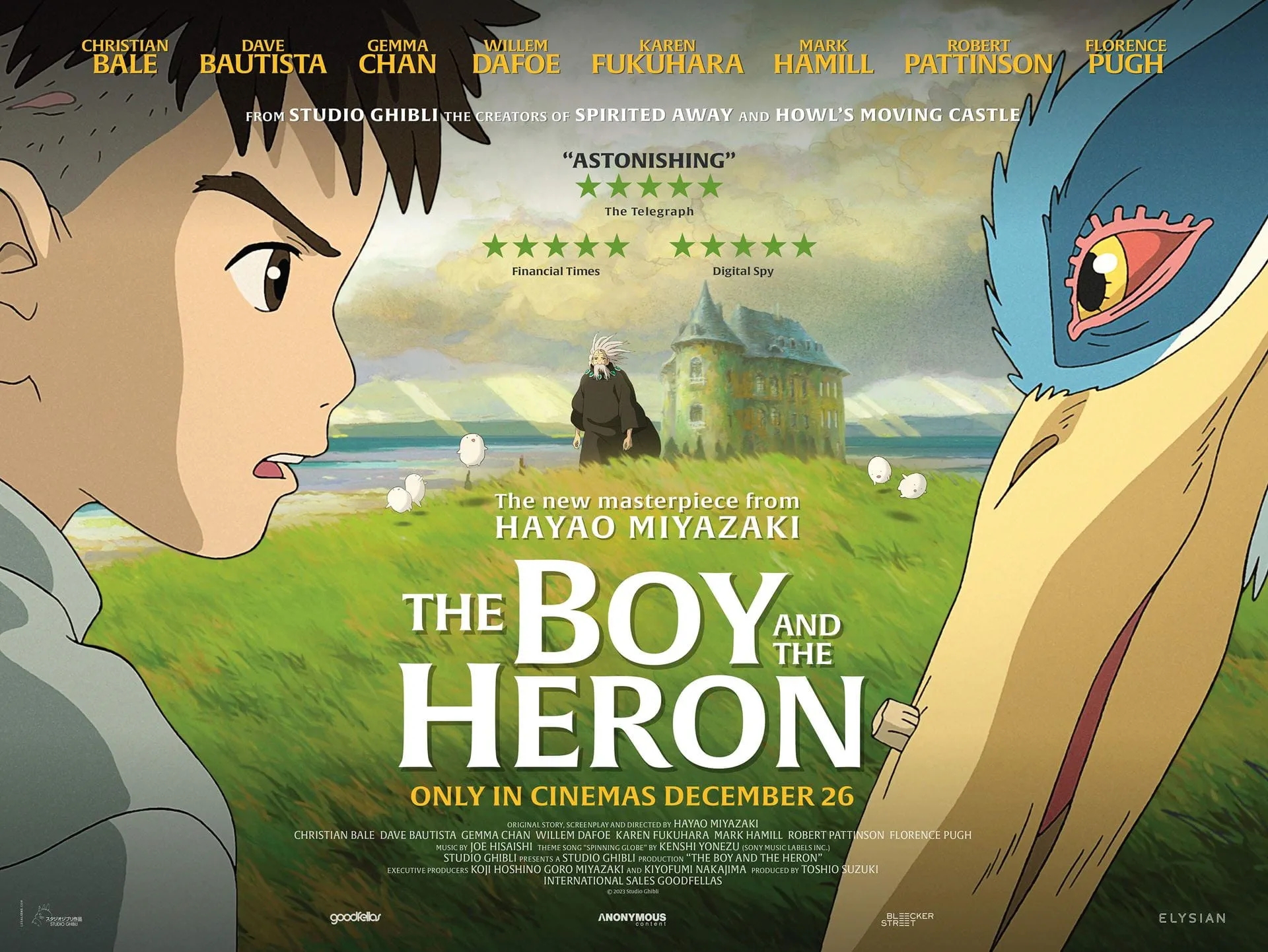
Having announced his retirement no fewer than six times, Hayao Miyazaki’s latest final film is a visually sumptuous, nostalgic return to the delights of his best work. After the potent yet somewhat esoteric appeal of The Wind Rises and the questionable style of Earwig And The Witch, it’s an immense relief to see a Studio Ghibli film that instantly feels like it belongs among the studio’s best films.
After losing his mother in a tragic fire, Mahito (Soma Santoki) and his father take up residence with his new stepmother Natsuko, who is also his mother’s younger sister. The new family dynamic is fraught from the off, as no sooner has Mahito met his aunt than she announces that she is pregnant. Living in the childhood home of his mother and her ostensible replacement, in a town that he doesn’t know, Mahito is a quiet ball of misplaced anger and grief. Things come to a head when Natsuko disappears into the woods near the house, and Mahito resolves to bring her back, embarking on a journey through a mysterious tower, guided by an enigmatic heron.
We have seen numerous film-makers in the last couple of years essentially serving up either wistful semi-autobiographical films (Steven Spielberg and The Fabelmans) a greatest hits of their recurring themes (David Cronenberg with Crimes Of The Future) or a bit of both (David Fincher with The Killer) Similarly, The Boy And The Heron doesn’t exactly break new ground narratively speaking, but instead feels like a culmination of all Hayao Miyazaki’s previous films. There’s the visceral violence and brutal nature of Princess Mononoke, the Alice In Wonderland-esque fantasy elements of Spirited Away, the mechanical workings of the tower, straight from Laputa: Castle In The Sky , the absurdly anthropomorphized animals from The Cat Returns, and the absent mother figure from My Neighbour Totoro. Mahito’s father even has an occupation producing munitions and cockpit shields, reminiscent of the aviation designers from The Wind Rises.
Despite these callbacks though, The Boy And The Heron never feels like a retread, and is never predictable. The central premise draws on ideas of putting away childish things, and the necessity of suffering in the journey to adulthood. It’s a bittersweet, immensely beautiful film that’s all the more powerful for the subtlety of its message.
The plot is almost Neil Gaiman like in places, particularly the Sandman-like visage of the wizard who rules the fantasy realm, and the irascible quips from the Heron of the title. Rather than the elegant bird you might imagine, he is revealed to be a grotesque, unashamedly crude and selfish little man who is entirely out for himself. He’s a wonderful creation, and ranks alongside No-Face, Totoro, and Jiji as one of Ghibli’s most memorable characters. In fact this film is densely populated with the most indelible Ghibli characters since 2008’s Ponyo. There’s the Heron, the unbearably cute Warawara, the absurdly sinister Parakeets, and the formidable little old ladies who look after Natsuko’s home, all of whom make an impression.
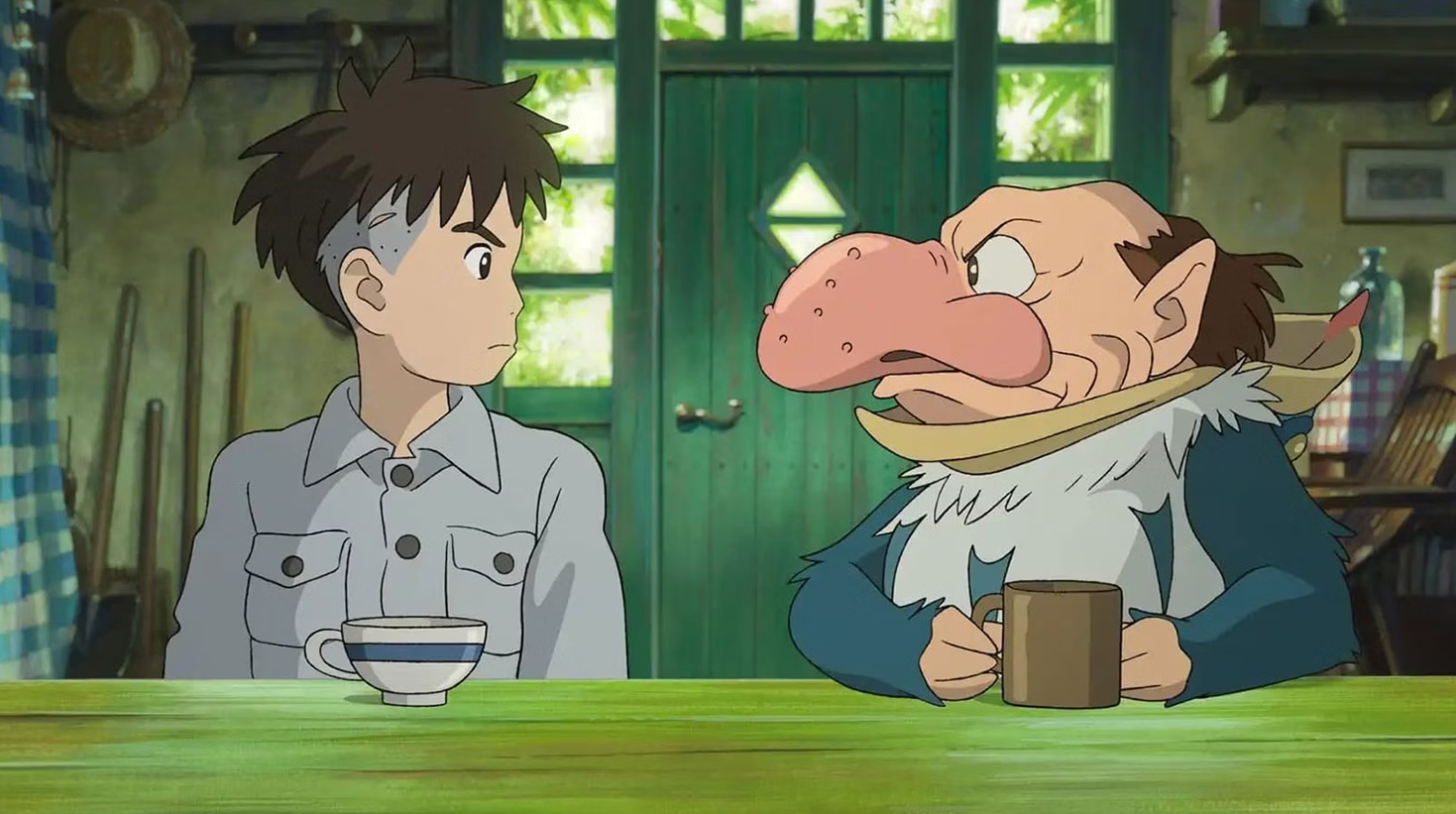
The tone, style, characterisation and artwork are phenomenal, with Miyazaki returning to the beautiful illustrations that make Studio Ghibli so unique. The Boy and The Heron has several indelible images that stick with you long after the film has ended. So why did I come away feeling not entirely satisfied? Part of this is due to the length. Normally you don’t notice the duration of Miyazaki’s films, so it’s a bit of a problem when you check your watch. It’s not a massively long film, but the pacing, especially in the first half, means it does feel a little too long. There is very little time spent with Natsuko, before the story proper kicks off, and as such her character feels like a bit of an enigma, and one late scene involving her lacks the weight it should probably have. The overarching story is just a touch too slight to bear the weight of the sheer breadth of imagination on display.
Visually and conceptually though, it is an incredible achievement. The choices in editing, in framing, the indelible imagery, all are methodically constructed. It might be Miyazaki at his most cinematic, in the purest sense of the word. There’s a great sense of scale, and some incredibly surreal imagery, that recalls the thought provoking work of Satoshi Kon, especially in the more disturbing scenes. The image of Mahito being slowly submerged in frogs, or the crowd of fish emerging from a lake, howling mournfully are especially reminiscent of the reality-bending Paprika, assisted by a wonderfully evocative score.
Joe Hisaishi’s beautiful score is haunting and memorable in just how distinct it feels from his previous work with Studio Ghibli. It begins with a melancholy piano leitmotif that slowly gives way to an eerie choral score as the more overt fantasy elements seep into the film.

If The Wind Rises was the elegiac film Miyazaki made principally for himself, then The Boy And The Heron is his final crowd-pleasing encore. It has all the features of the more adventurous romps in Miyazaki’s back-catalogue, with some exhilarating sequences and memorably cute creatures. However for all the marketable features, it’s a much darker, more mature coming-of-age film than something like the superficially similar Howl’s Moving Castle (signified most dramatically in the grisly fates of those aforementioned Warawara!) It remains on the whole a surprisingly muted, thoughtful, profoundly moving film.
The Boy and The Heron is a delight from start to finish, poignant and funny in equal measure. It feels like something of a greatest hits for Miyazaki, touching on several themes that have been present in his previous work, and any shortcomings in the pacing are more than made up for by his sheer visual inventiveness. It’s a touching swan (or heron) song to Miyazaki’s career, and a fitting tribute to the house that Totoro built.


![Unquiet Guests review – Edited by Dan Coxon [Dead Ink Books]](https://criticalpopcorn.com/wp-content/uploads/2025/10/ug-reddit-ad-e1761690427755.jpg?w=895)
![Martyrs 4K UHD review: Dir. Pascal Laugier [Masters Of Cinema]](https://criticalpopcorn.com/wp-content/uploads/2025/10/image-1-e1761586395456.png?w=895)

![Why I Love… Steve Martin’s Roxanne [1987]](https://criticalpopcorn.com/wp-content/uploads/2016/11/roxanne.jpg?w=460)


 Critical popcorn
Post your thoughts