A tale of colossal blundering from vainglorious military minds, Paths Of Glory is perhaps the first proper Stanley Kubrick film. Released in 4K UHD for the first time, this is the definitive physical release of what is for my money, the greatest war film of all-time.
It’s a blisteringly anti-war film that has lost none of it’s power, and which compliments the wartime poetry of Siegfried Sassoon and Wilfred Owen perfectly. The film takes its superficially rousing title from a Thomas Gray poem: “The paths of glory lead but to the grave.” In First World War France, the opportunistic General Mireau (George Macready) plans a suicidal attack over the front lines to take a key German position. When the attack inevitably fails and his men retreat, he is tasked with picking three men at random to answer for the platoon’s perceived cowardice. Assigned to defend the soldiers at the court martial is the idealistic Colonel Dax (Kirk Douglas) who takes the case despite knowing that he is doomed to fail.

This might sound like a bit of a slog, but the acerbic script (co-written by Kubrick, Calder Willingham, and Jim Thompson) is so tight, and the pacing so brisk, that it never drags at all. At a concise 90 minutes, Kubrick wisely wastes no time in establishing his characters and the film’s premise before getting stuck in.
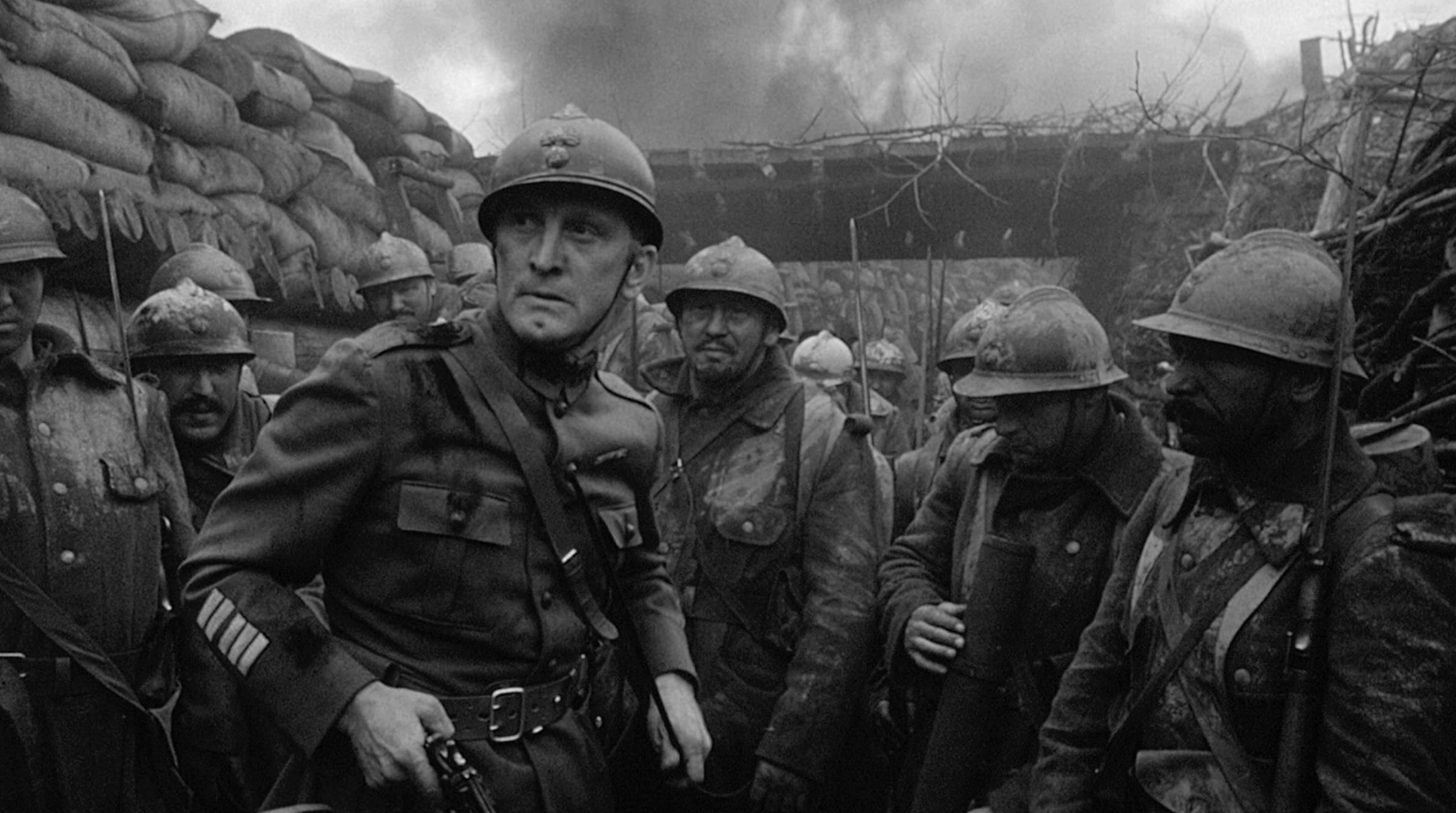
It’s also a visual marvel. This might be early Kubrick but it’s still identifiable as a Kubrick film. His use of lighting is especially evocative, and his style is reminiscent of German expressionism in the way he frames the various soldiers faces. The battle scenes are breathtaking, but even more impressive is his sense of composition, even at this early stage. He makes a stark visual contrast between the Generals’ opulent headquarters and the bleak, dirty trenches where the soldiers reside. The famed sequence of Colonel Dax pacing through the French trenches in a beautifully executed dolly shot is something to behold, as the French artillery explode all around the trenches, adding to the feeling of terror as the moment for the big push gets closer and closer. The subsequent march over the top is terrifying in it’s scope and the implications therein. The second half of the film gives way to the kangaroo court martial of the three soldiers, and this is shot in a beautiful old building, with unnatural close-ups and wideshots emphasizing the grandeur of the officer’s location, dwarfing the three defendants.
Kirk Douglas has never been better than as Colonel Dax, aside from maybe his phenomenal turn in Ace In The Hole. He’s both wryly sardonic in his early scenes and genuinely warm with his subordinates. He sells the hell out of his big speeches, full of vitriol, and it might be the most painfully humane performance of his career. Even better is the supporting cast. George Macready gives a brilliant depiction of the blustering Generals in charge during the war. His visit to the trenches recalls Sassoon’s The General in the way he strides past soldiers, full of pomp and circumstance but caring little for their well-being. Macready plays Mireau as pompous and jingoistic but not entirely unsympathetic. The flashes of panic that pass across his face make it clear that he is an insecure man, not an evil one. More ruthless is the outwardly genial General Broulard, played by legend of the silent era Adolphe Menjou. While both are shown as corrupt, Kubrick allows a sliver of sympathy for each of them, and even allows the possibility that callous and cruel as they are, they may have a point.
As the three condemned soldiers, each actor brings a distinct personality to their roles. Joseph Turkel is probably best known today for his role as Lloyd the bartender in The Shining and Tyrell in Blade Runner, but he is great here, as the intellectual whose logic slowly gives way to desperation. Timothy Carey is one of cinemas genuine renegades, a troublemaker who was fired from this film for his offscreen shenanigans, but who gives a wonderfully offbeat performance – his sardonic scene with the cockroach is my favourite in the film. He reportedly improvised his character’s breakdown at the end, which is why the actor playing the priest (Emile Meyer) looks so taken aback. Rounding out the trio is Ralph Meeker, who I’d only really seen in hyper masculine roles in Kiss Me Deadly and The Naked Spur. Here he underplays his role as the every-man Corporal to perfection – his last moment with his cowardly commanding officer (Wayne Morris) is incredibly subtly depicted, and incredibly touching.
The final scene is one of those little epilogues that makes a film great. After witnessing the cynical nature of the court martial, and the positively mercenary attitudes of the two Generals, Dax wanders through a local French town, until he happens upon a tavern where the battle hardened soldiers are cruelly cajoling a young woman into performing a song for them. After she starts to sing shakily, the soldiers are shamed into silence and eventually join in. It’s a simple, yet profoundly moving sequence, granting the soldiers a glimpse of innocence amid the corruption and horror of the war, and abruptly reminding them of their own humanity.

Creator of The Wire David Simon once said of Paths Of Glory, that it’s a film for our time. A film about “that point at which human beings become worth less, not more.” Indeed, the way the Generals casually throw lives away feels especially prescient today, where the rise of artificial intelligence is laying bare the diminishing value of human beings, or at least the perceived value placed on us by those with power.
It might seem like a strange choice, but Paths Of Glory is my favourite Kubrick film. It’s not as visually sumptuous as 2001: A Space Odyssey, as as brutal as Full Metal Jacket, or as meditative as Barry Lyndon. However, in highlighting the value of a single life (or three) in the context of a war where lives were being thrown away daily, Paths Of Glory acts as a pointed rejoinder to those like Andrei Tarkovsky, who claim that Kubrick’s work is cold and sterile. Despite it’s pessimistic, often cynical nature, and the devastating ending, Paths Of Glory is full of passion and humanity, and remains the director’s most humane, painfully life-affirming film.
Special Features
These are largely transferred from the previous Eureka release but all are worth watching. There is a commentary from film scholar Adrian Martin, and several insightful interviews on the film with Richard Ayoade, critic/author Richard Combs, and Kubrick expert Peter Kramer.


![Unquiet Guests review – Edited by Dan Coxon [Dead Ink Books]](https://criticalpopcorn.com/wp-content/uploads/2025/10/ug-reddit-ad-e1761690427755.jpg?w=895)
![Martyrs 4K UHD review: Dir. Pascal Laugier [Masters Of Cinema]](https://criticalpopcorn.com/wp-content/uploads/2025/10/image-1-e1761586395456.png?w=895)


![Why I Love… Steve Martin’s Roxanne [1987]](https://criticalpopcorn.com/wp-content/uploads/2016/11/roxanne.jpg?w=460)


 Critical popcorn
Post your thoughts