
The last in James Cagney’s series of gangster roles that began eight years earlier with The Public Enemy, The Roaring Twenties is a great film in and of itself, but also a signifier that the actor was quickly outgrowing the genre that made him a star. Despite this, The Roaring Twenties remains one of the strongest gangster films of the 1930s, and fully deserves this lovingly restored release.
It’s a shame though, because by most metrics, The Roaring Twenties is a step up from most of Cagney’s gangster films – it’s a sprawling tale of the rise and fall of war hero turned gangster Eddie Bartlett (Cagney) as he partners up with speakeasy owner Panama Smith (Gladys George) during the emergence of prohibition.
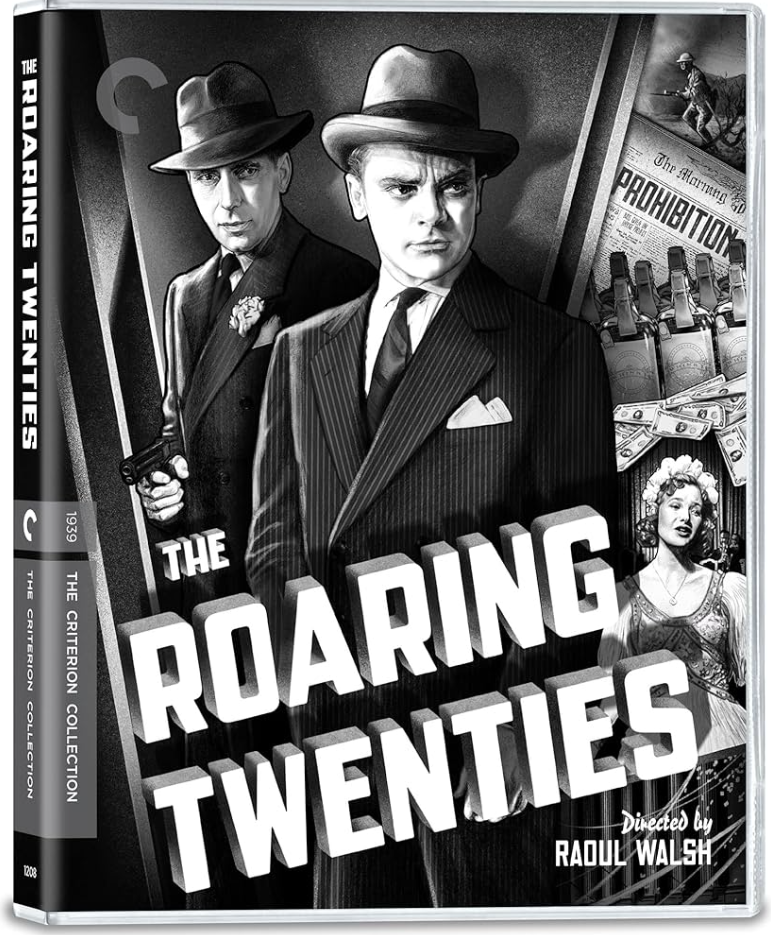
Eddie might be a less showy role than Tom Powers or Rocky Sullivan, but Cagney’s charisma and sheer magnetism is apparent the second he appears onscreen. This might be Cagney at his most vulnerable, especially evident in his close-ups. He still has that tough facade but there’s a naivety to him, particularly in his relationships with the women in his life. Walsh’s use of close up shows some quite nuanced character beats for an actor who is often reduced to quite big, over the top moments. Cagney does so much without words, particularly in the scene where he realises his friend Lloyd (Jeffrey Lynn) has been carrying a torch for his paramore Jean (Priscilla Lane). Where previous Cagney characters would have murdered his former friend instantly, Eddie is utterly defeated. There’s such a potent combination of expressions that pass across Cagney’s face in an instant. Pain, regret, resignation. It’s a beautiful moment, and shows that he was a great instinctual film actor. His non-verbal performance here, combined with his physicality in the thrilling shootout scenes, demonstrates why he was such a star.
Gladys George is a great foil for Cagney as the world weary Panama, but Priscilla Lane is less successful as the young ingenue and centre of the love triangle that forms between Eddie and Lloyd. Lane’s character doesn’t sit particularly well with me. Her moral objections to Eddie’s exploits don’t prevent her from benefiting from his attentions, giving her a job and lavishing her with gifts. However Lane’s performance has subtleties that show how uncomfortable she is being a gangster’s moll, with little expressions that Eddie clearly doesn’t pick up on until it’s too late.

Accompanying Eddie on his way to the top are the perennial devil and angel on his shoulders; gleefully malevolent petty criminal George (Humphrey Bogart) and upstanding lawyer Lloyd (Jeffrey Lynn). Defined as “Tall dark and boring” on Lincoln Hurst’s commentary, Lynn gets the thankless role of law-abiding romantic lead in a gangster film, something that was deemed necessary in the emergence of the Hays Code, which stipulated that criminals had to pay for their crimes.
Bogart is a lot more fun. He’s established as a wrong ‘un early on when he is shown gleefully shooting down a young German soldier seconds before the armistice is announced. Bogart was a wonderfully weaselly villain before he transitioned into leading roles, and this and Angels With Dirty Faces might be the best examples of this. He’s alternately sadistic and sniveling, and a great foil for Cagney. This proved to be one of his last bit parts though, as Raoul Walsh clearly had him pegged for greater things, casting him in High Sierra a couple of years later, a film that draws comparisons with this one, particularly in it’s fatalistic ending.

Where The Roaring Twenties falters slightly is in Walsh’s preoccupation with the times changing. Walsh uses voice over and striking visual effects to show the shifting global dynamics in post-war America, the introduction of the Volstead Act and the stock market crash, but a side effect of this is that the characters are often kept removed from the audience. Pivotal moments, such as Cagney’s arrest and Bogart’s ascent to the big boss of the underworld take place off-screen. This prevents the film from having the coherent narrative of something like Angels With Dirty Faces, and means that characters aren’t explored in all that much depth. This is why the big personalities like Cagney, Bogart and George stand out, as the film is more reliant on the actors’ own charisma than anything on the page – Walsh’s preference for rewrites and ad libbing compliments the breezy pacing, but it means that the shortcomings of the less accomplished actors is even more evident.
With the emergence of the Production code and Film Noir on the horizon, the mythic gangster film was coming to an end, and Cagney wouldn’t explore the genre again until the incendiary White Heat ten years later, again directed by Walsh. Today, The Roaring Twenties isn’t as celebrated as The Public Enemy, Angels With Dirty Faces or White Heat, perhaps because it doesn’t have any of those iconic moments that stick in the memory, such as the melon to the face or that final fateful walk to the electric chair. For my money, the film-making on display here is much more mature and impressive than Cagney’s previous films, and the final valediction of Eddie here, that “He used to be a big shot,” is so much more damning and bleak than the celebrated “I ain’t so tough” from The Public Enemy. It’s a great pessimistic elegy to both the character and Cagney’s gangster persona.
Special Features
The extras a little sparse for this release, especially given the new high price of Criterion releases. The special features include a full audio commentary from film historian Lincoln Hurst, an interview with critic Gary Giddins, a clip of an interview with director Raoul Walsh, and a new essay from critic Mark Asch.


![Unquiet Guests review – Edited by Dan Coxon [Dead Ink Books]](https://criticalpopcorn.com/wp-content/uploads/2025/10/ug-reddit-ad-e1761690427755.jpg?w=895)

![Martyrs 4K UHD review: Dir. Pascal Laugier [Masters Of Cinema]](https://criticalpopcorn.com/wp-content/uploads/2025/10/image-1-e1761586395456.png?w=895)


![Why I Love… Steve Martin’s Roxanne [1987]](https://criticalpopcorn.com/wp-content/uploads/2016/11/roxanne.jpg?w=460)


 Critical popcorn
Post your thoughts