
Dot and Bubble is probably the biggest gamble of Doctor Who‘s 2024 season so far. It’s an episode in which the Doctor and Ruby hardly appear, following an unlikable lead character and ending on a (seemingly deliberately) unsatisfying note. Russell T Davies‘ script has shades of Black Mirror (particularly the episode Nosedive) as well as 60’s Who adventure The Macra Terror (a clear favourite from Davies who also penned loose sequel Gridlock in 2007), but manages to craft a tale that feels unique in the series, albeit for very different reasons to last week’s 73 Yards.
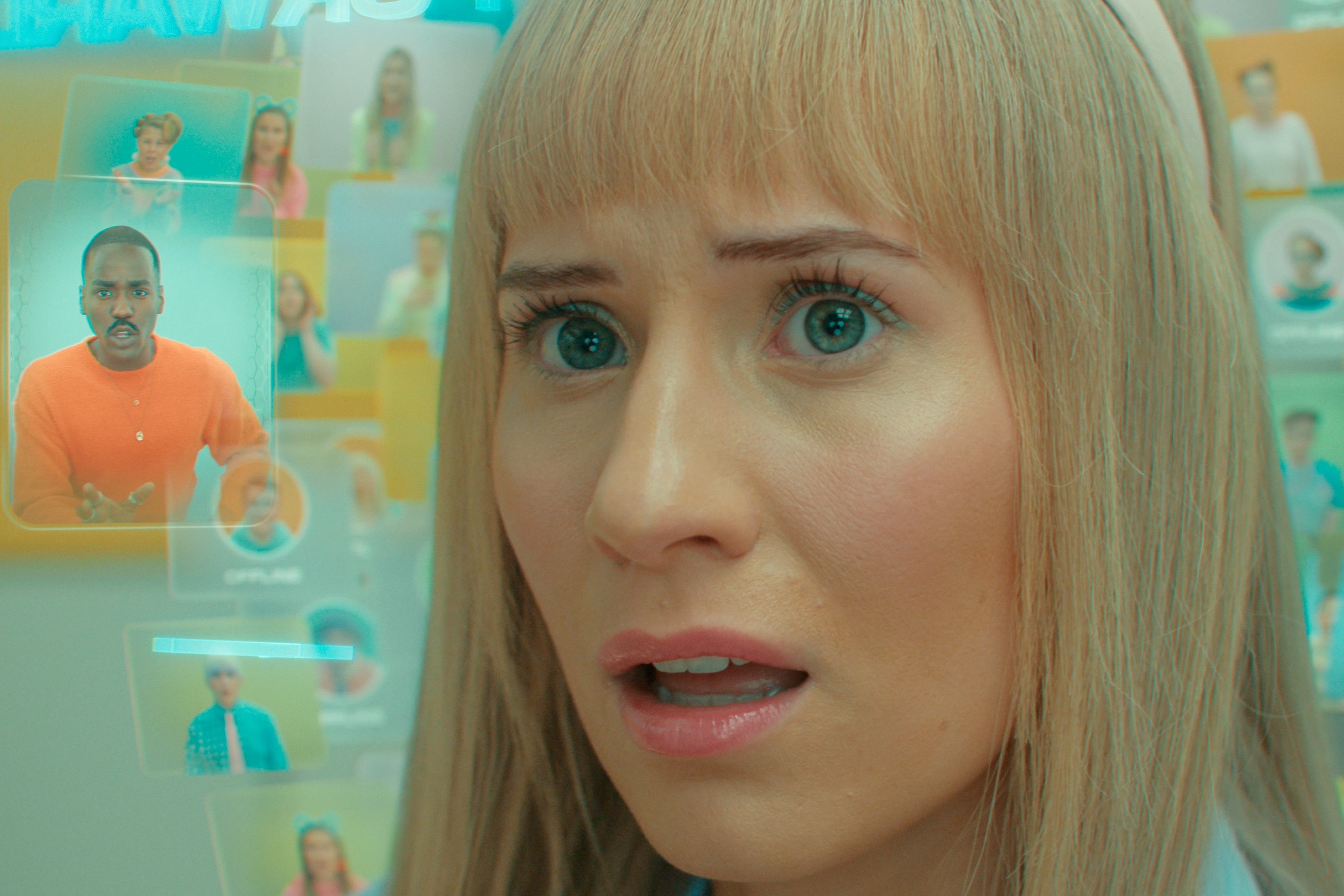
The bulk of the episode sees the Doctor (Ncuti Gatwa) and Ruby (Millie Gibson) trying to help Lindy Pepper-Bean (Callie Cooke) to escape Finetime, which has been overrun by people-devouring slug monsters. So far, so Who. Lindy is an insufferable, self-obsessed character with quite literally a narrow worldview, influenced by the titular dot and bubble circulating her head all day (in what initially seems like an obvious social media satire). The episode almost feels like a videogame at points as we follow Lindy evading the creatures with the occasional help from the TARDIS duo, although the pacing starts to drag as the character finds every opportunity to stop and whinge rather than do anything. There’s an element of the ‘companion that wasn’t meant to be’ as seen with Adam in The Long Game, but revolving the entire episode around such an irritating character as Lindy – and without a likeable secondary protagonist – only makes the character’s journey more frustrating to watch.
It doesn’t help that the monsters – dubbed the Man Traps in the accompanying Doctor Who Unleashed – are rather static obstacles (albeit comically grotesque, and not as evil as first thought). There’s a suggestion that they’re natives to the planet who reside outside of Finetime in the Wild Woods (with the implication that the Dots let them into the city), although this is mentioned so offhandedly so that it’s easy to miss on a first viewing. Even the reveal of the Dots gaining sentience and going rogue is dismissed as soon as its raised with little in the way of an explanation (although the Doctor suggests that they “learned to hate” the residents in an ironic twist). The alphabetical murders are a potentially interesting idea, but it doesn’t make much sense (why aren’t the Dots aware of Ricky’s real name, for instance) and primarily serves to remove any suspense as Lindy tries to evade them without any issues. Lindy almost walks into one in the lift and it…doesn’t eat her for some reason. If the Dots can easily kill people (as demonstrated in the episode) why do they need the Man Traps, and why hang around waiting to kill the residents in alphabetical order? There’s a lack of clear world-building which makes it harder to invest in the narrative.

The episode is predominantly focused on Lindy, an immensely unlikeable character from her first moments on screen. Cooke’s performance is very good, but Lindy as a character is so entitled, narcissistic and antagonistic towards the Doctor that it’s hard to invest in her journey across the episode. In Unleashed, the production team talk about Lindy as a character the audience are supposed to like and root for until the end, but it doesn’t work quite as well as intended. Her betrayal of Ricky September is totally in-character and unsurprising (perhaps the biggest surprise was how violent Ricky’s death was), while her attitude towards the Doctor makes the audience crave a fitting ending…that never comes. “I keep getting lucky, don’t I” says an incredibly smug Lindy later on in the episode, making the audience long for a Man Trap to come along and devour her.
The script even pushes Lindy’s unlikable nature one step further to root her antagonism towards the Doctor in racism, making earlier lines about “he is gonna be so disciplined” feel even more uncomfortable on repeat viewings. It’s an idea that’s seeded throughout the episode (compare Lindy’s attitude towards the Doctor offering his assistance to Ruby helping her), on top of her xenophobia and upper-class snobbery. There’s even a colonial theme when the residents talk about the “untamed world” outside of the city which they seek to “own”. All of this served to make the sudden and ambiguous ending – in which Lindy and her awful friends escape to the outside world – feel infuriating. It’s a strangely pessimistic view of humankind’s future from a show that usually offers some level of hope.
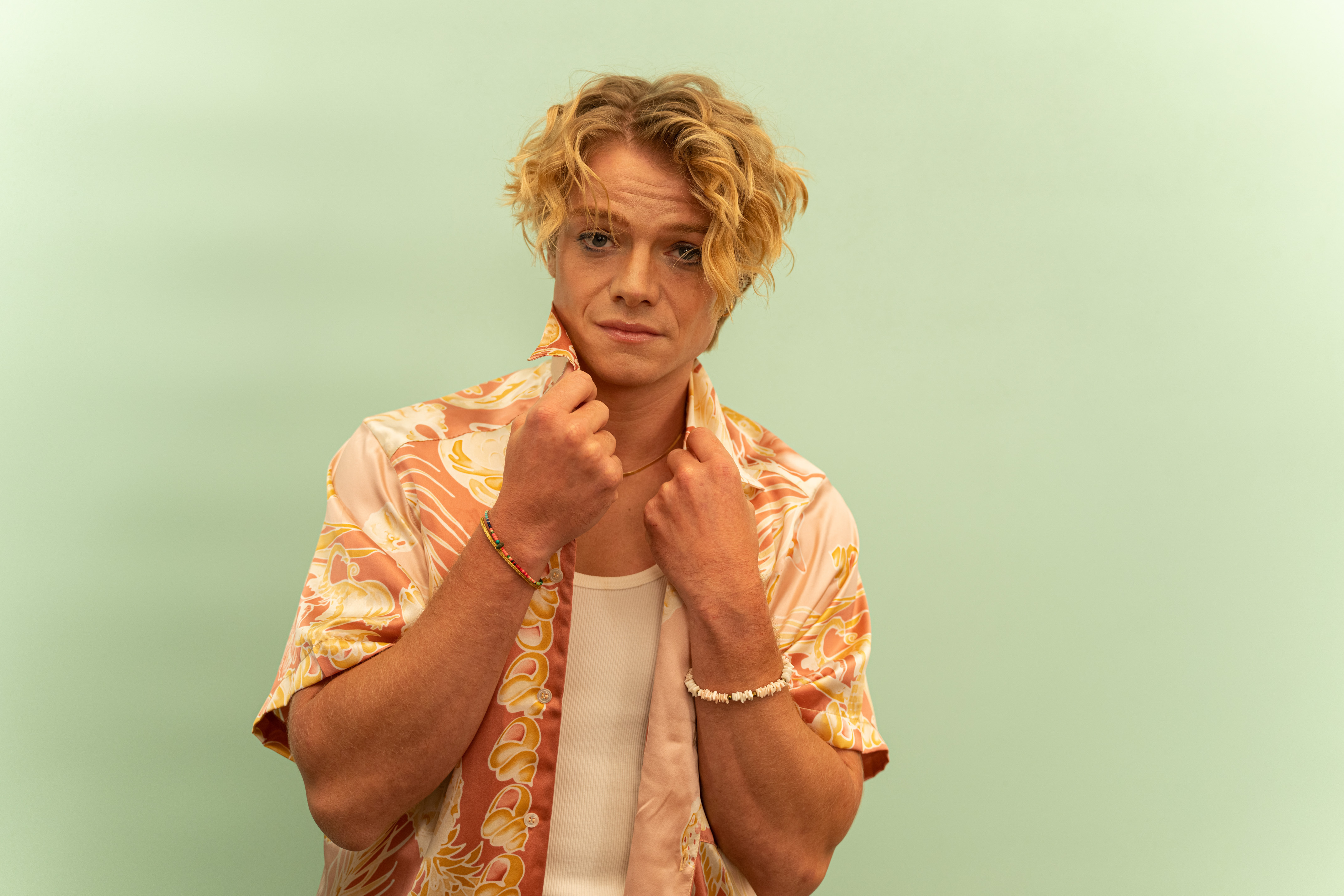
On the plus side, when he finally does appear (in his initial reveal costume no less), Ncuti Gatwa pours his heart and soul into the final scene by the river, playing a Doctor who doesn’t have the same authority over the situation as his predecessors because of how he looks. The way Gatwa transitions from an almost sarcastic laugh to a cry of anguish makes for a tragic ending, his pleading with the residents of Finetime ignored. It’s a pity the episode ends before it can explore this idea further, but the anti-climactic nature of Dot and Bubble seems to be a deliberate creative choice – albeit a frustrating one.
All in all, Dot and Bubble is an episode with some bold and interesting themes that are sure to keep fans talking about it for some time to come, even if the plot itself feels lacking. The ending packs a punch though, and the budget is on full display, with some extensive and impressive visual effects work throughout. The Doctor and Ruby’s absence is keenly felt, especially in such a short season (and only a week after the Doctor disappeared for most of 73 Yards), but given the circumstances of the production, it’s difficult not to admire Russell T Davies for going for something a bit different. It is Doctor Who does Black Mirror, even if it does lean quite far into the cynicism of the latter.



![Unquiet Guests review – Edited by Dan Coxon [Dead Ink Books]](https://criticalpopcorn.com/wp-content/uploads/2025/10/ug-reddit-ad-e1761690427755.jpg?w=895)
![Martyrs 4K UHD review: Dir. Pascal Laugier [Masters Of Cinema]](https://criticalpopcorn.com/wp-content/uploads/2025/10/image-1-e1761586395456.png?w=895)
![Why I Love… Steve Martin’s Roxanne [1987]](https://criticalpopcorn.com/wp-content/uploads/2016/11/roxanne.jpg?w=460)

 Critical popcorn
Post your thoughts