
Fede Álvarez‘s Alien: Romulus takes a ‘back-to-basics’ approach for the long-running franchise (which arguably shouldn’t be a franchise in the first place), returning to the horror roots of Ridley Scott‘s original Alien in what feels like a deliberate course-correction after the divisive response to Scott’s own prequels Prometheus and Alien: Covenant. In some respects, this is Alien’s answer to Star Wars: The Force Awakens — a sequel coming off the back of a divisive prequel series from the original director, which re-treads familiar ground with a new, younger cast. If Alien gave us truckers in space and Aliens gave us marines in space, Alien: Romulus presents teens in space, gearing the franchise towards a younger generation of horror fans, without forgetting the older fans in the mix too.

Set between Alien and Aliens, Romulus follows Rain (Cailee Spaeny, who seems to be on a roll this year after Priscilla and Civil War) and her synthetic adopted brother Andy (David Jonsson) as they join their friends on a mission to salvage cryo pods from a derelict space station. Inevitably, the space station is derelict for a reason and events spiral from bad to worse pretty much until the credits roll.
David Jonsson is the standout of the cast as Andy, an instantly sympathetic portrayal of a synthetic character that undergoes an interesting arc across the film. Every movement, facial expression and line of dialogue feels incredibly deliberate, enough to seem almost human. It’s a performance indebted to the likes of Ian Holm, Lance Henriksen and Michael Fassbender but Jonsson very much makes it his own. Cailee Spaeny makes for a strong Ripley-esque protagonist, and while comparisons to Sigourney Weaver are inevitable, Spaeny very much approaches the role her own way and is all the better for it. As for the rest of the ensemble cast, they all feel a little thinly-sketched and unmemorable, often leaning into horror clichés in order to keep the plot moving. Ultimately, it’s just a case of waiting to see who gets picked off first and in what specifically horrible way (and just how many of them will survive).

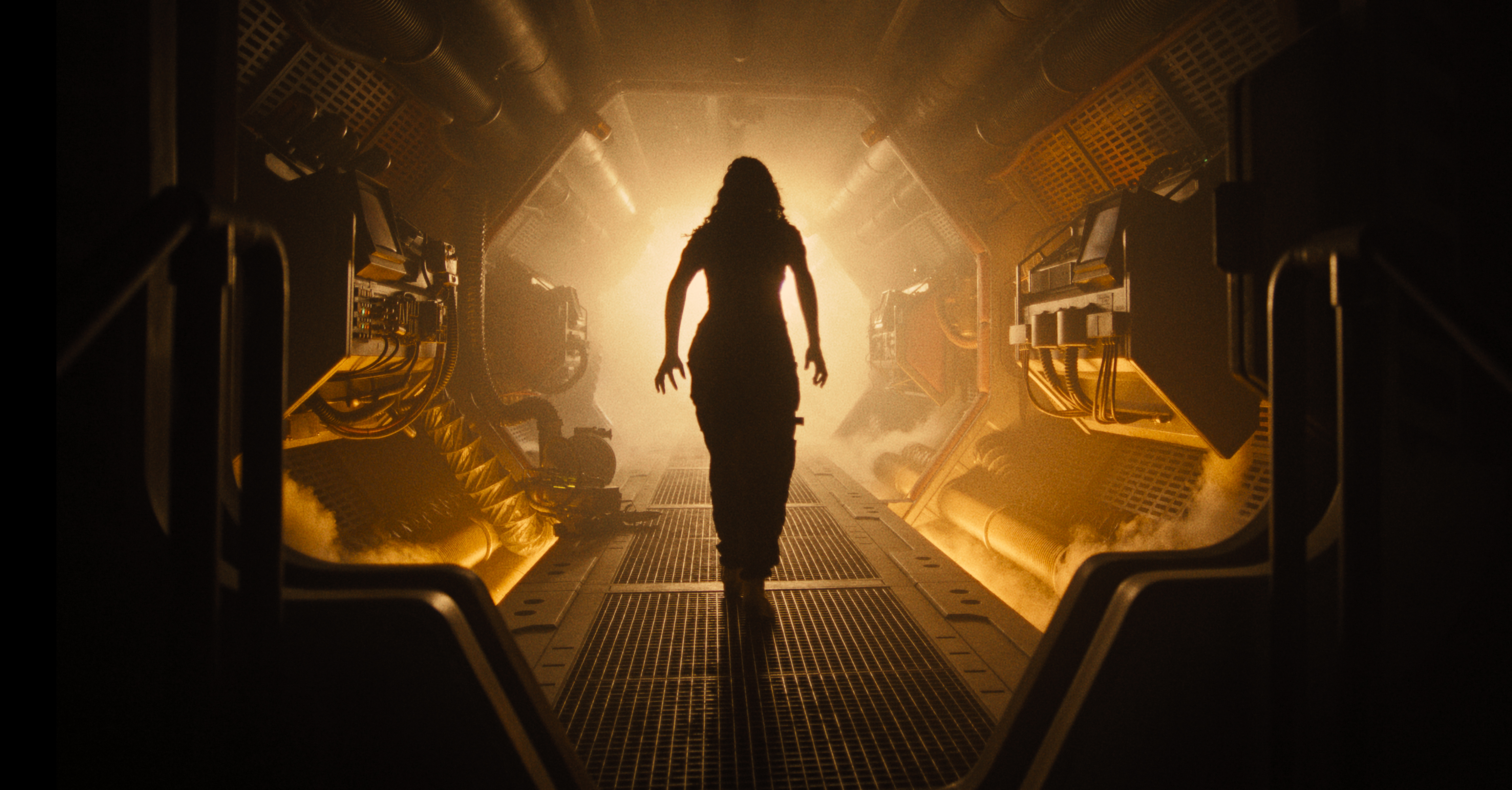
What’s clear throughout is that Álvarez understands why Alien and Aliens work, keeping the xenomorph shrouded in darkness, it’s slimy body glinting in what little light there is, and never fully showing it off. Inevitably, after eight movies of xenomorphs terrorising audiences, the scares just aren’t there any more, and the attempts to explain the creatures in later entries has only served to diminish them in the long run. The real monstrous highlight of Romulus are the face-huggers, which this time feel incredibly animated and more scary because of it. One particular sequence sees the creatures bursting out of a pool of water to attack the protagonists in what feels like the natural extension of the medical bay scene in Aliens.
It’s also great to see a blockbuster that has such a tangible quality to it. From its rich, weathered and retro-futuristic production design to the practical creature effects, everything feels real. Galo Olivares‘ cinematography is appropriately dark and murky, and a fine layer of film grain has been added to emulate the look of the original films. The visual effects work is astonishing throughout, whether it be practical or digital (or a combination of the two), even if there is one notable exception. Benjamin Wallfisch‘s score is atmospheric and right at home with Jerry Goldsmith and James Horner‘s compositions, and while the overall sound mix is a bit overbearing (some of the dialogue felt drowned-out at my screening), it is incredibly immersive. Despite initially being intended as a straight-to-streaming release, Alien: Romulus is a terrific big-screen experience.
Unfortunately, the film can’t help but tread familiar ground. There’s very little new here, although Álvarez captures everything with such passion and energy that it’s easy to forget that so much of it has been done before. The third act threatens to push the film into new(ish) territory, but it’s too little too late. One particular aspect of the plot is just shallow fan service in an attempt to please long-time Alien fans, ultimately proving to be completely superfluous to the rest of the story (even the main characters seem distinctly uninterested), whilst also being a bit ethically ambiguous on the part of the filmmakers. On the plus side, Romulus doesn’t lean into any sequel-baiting, resulting in a satisfying standalone piece. Some fans may have been expecting a Prey equivalent, but Romulus is too interested in nostalgia for it’s 45-year-old originator to craft something truly unique.
It might not be a gnarly as some audiences will be expecting from director Fede Álvarez but Alien: Romulus succeeds in atmosphere, crafting a suspenseful sci-fi horror with some fun, gory moments and terrific set-pieces (the zero gravity scenes are excellent). As a production, it’s astonishingly good, looking and sounding incredible, but the plot is forgettable and plays it far too safe for its own good.

![Alien: Romulus – Footage Presentation and Q&A with director Fede Alvarez in London [Report] – Critical popcorn avatar](https://criticalpopcorn.com/wp-content/uploads/2021/12/thumbnail_critical_popcorn_logo.jpg?w=48)




![Unquiet Guests review – Edited by Dan Coxon [Dead Ink Books]](https://criticalpopcorn.com/wp-content/uploads/2025/10/ug-reddit-ad-e1761690427755.jpg?w=895)

![Martyrs 4K UHD review: Dir. Pascal Laugier [Masters Of Cinema]](https://criticalpopcorn.com/wp-content/uploads/2025/10/image-1-e1761586395456.png?w=895)


![Why I Love… Steve Martin’s Roxanne [1987]](https://criticalpopcorn.com/wp-content/uploads/2016/11/roxanne.jpg?w=460)



 Critical popcorn
Post your thoughts