
No creature more than the canine has been utilised as a source of redemption for onscreen antiheroes. Whether they’re accompanying Will Smith through a post-apocalyptic wasteland (I Am Legend) or helping Tom Hanks fight crime (Turner & Hooch), dogs are regularly used as the ultimate voice of understanding for the painfully misunderstood and rejected by society. As inherently trusting as dogs naturally tend to be, it stands to reason that this is the animal we’ve picked for this task – to see through those bitter exteriors to the real person underneath. Their loyalty makes them easier for us to win over than other humans, easier to impress, so it’s no wonder the concept appeals to us. (Occasionally, another animal like a kestrel is used – I’m looking at you, Kes – but that’s another review.)

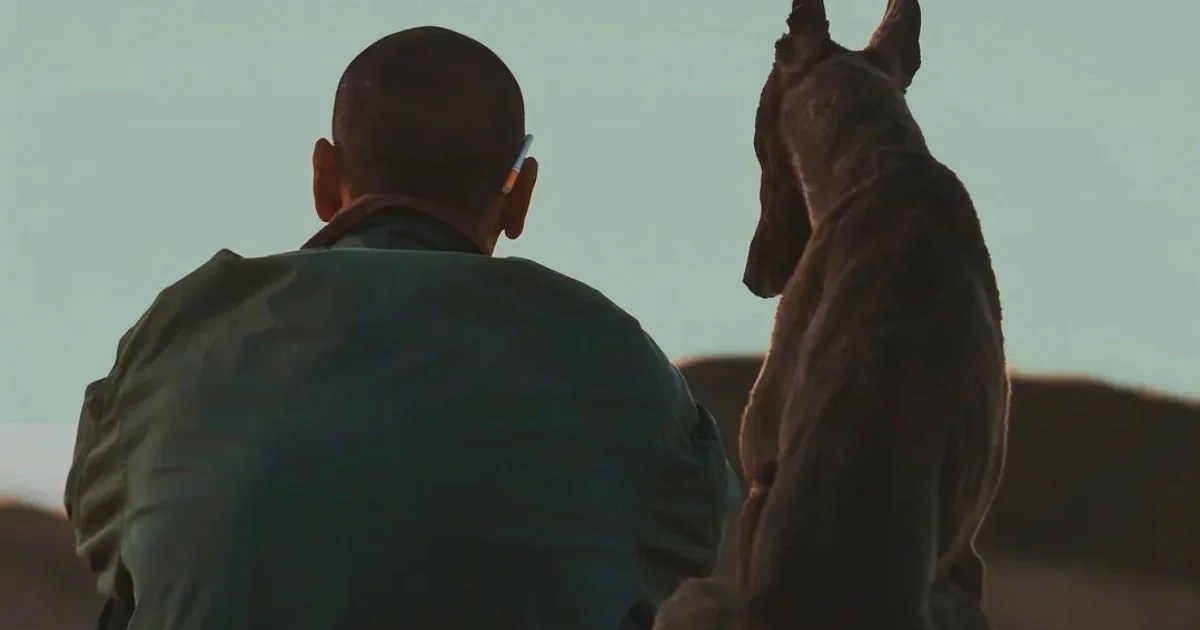
Guan Hu’s Black Dog is no exception. Telling the tale of Lang (Eddie Peng), a former rock star and recently released convict. Lang is the ultimate antihero, and we’re unsympathetic from the start as she slopes onto the screen. On the hunt for a job as his parole ends, he’s swiftly recruited for a dog-catching patrol carrying out the sadly very real task of removing stray dogs from the Gobi Desert ahead of the 2008 Olympics. Hearing reports of a possibly rabid canine loose in the surroundings, he finally encounters the abandoned mutt, and after some preliminary mistrust between them, the two form a tight bond. (It’s inevitable – Lang and the eponymous dog, named Dog, are kindred spirits, both society’s rejects.) Meanwhile, Lang’s withering alcoholic father lingers in the remnants of the world’s most depression zoo, and local kingpin Butcher Hu seeks revenge for the death of his nephew, whose murder is the aforementioned crime Lang was initially imprisoned for his involvement in.
Well-trodden though this path might be, Hu is a seasoned storyteller and manages to bring a uniqueness to it. His impressively extensive CV shows he’s accustomed to large-scale cinematic feats – two war films in a single year in 2020 alone – though he’s clearly able to adapt his vision to the slimmer scale this story requires. Black Dog has snapped up a series of awards of late, most notably, the Un Certain Regard at Cannes, where it also bagged second prize in the Palm Dog, deservedly so since it’s the best performance by an onscreen pup since Snoop in Anatomy of a Fall. The film continuously exceeds expectations, punctuated by captivating set pieces from the get-go, where in a particularly gripping opening, a bevy of canines tears through the desert towards an upturned bus, from which passengers are clambering unharmed via a shredded windshield. Later, as exotic animals escape the soon-to-be-demolished zoo where Lang’s dad resides, we’re treated to shots of peacocks and giraffes strutting past the dereliction in a style that’s undeniably memorable. The scenes where Lang and Dog first encounter each other, followed by a vividly cold nighttime scene with wind whipping about the desert plaza where they strike their rapport, are similarly impactful.
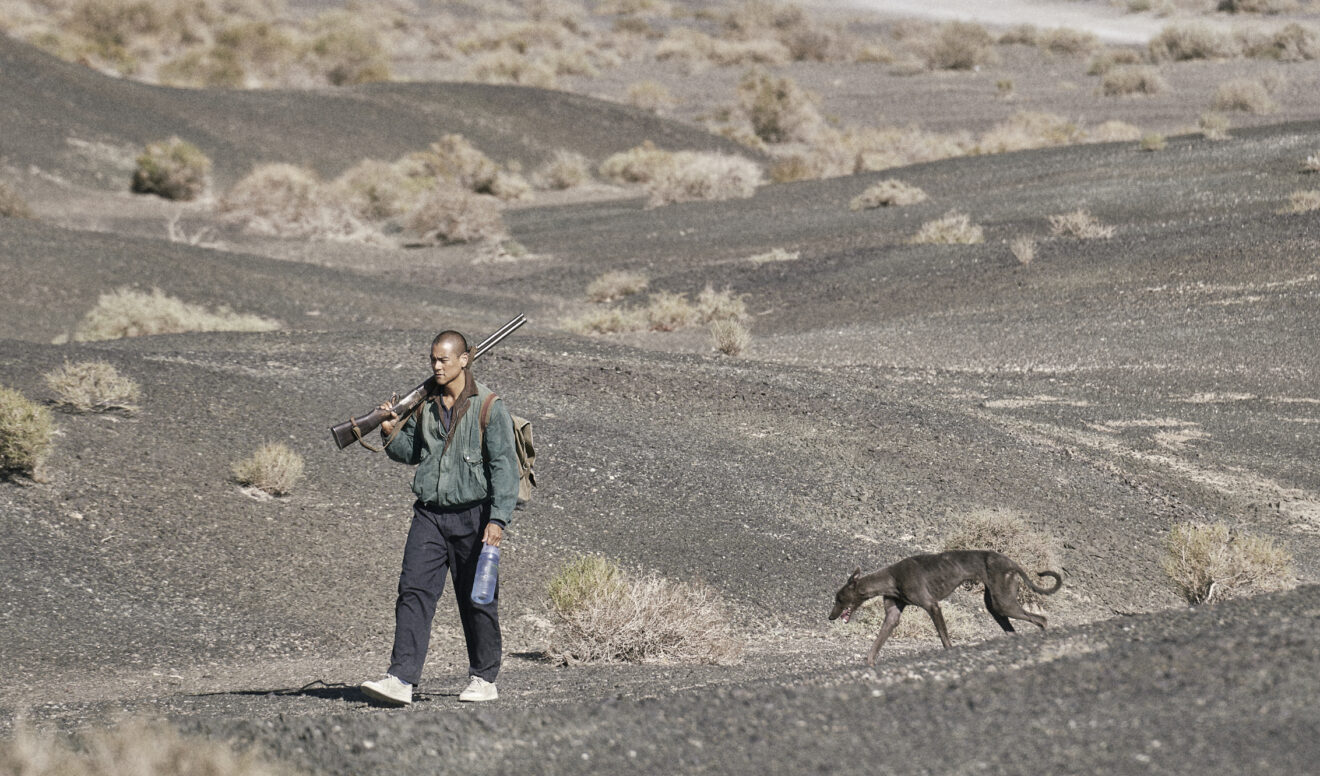
The timing of Black Dog’s release feels tactful too. Set around one Olympic Games as we recently closed off another, it’s impossible not to view the two side-by-side. Wherever they’re held, the Olympics are the host country’s opportunity to showcase their best selves. With the whole world’s attention on you for a month long roster of festivities, you get the chance to paint that outsider’s perception in your own vision. Fresh from the camaraderie of Paris’s Games, Black Dog removes us from any of that, replacing it with the starkness of the outskirts looking in. There are no shots of ceremonies or street parties, just the blighted Gobi wasteland, the occasional threadbare poster tacked to a wall and the sinister task of “removing” dogs. By toying with our perception of this major world event, Hu is able to present a wider picture of his homeland, transforming this small story into a state-of-the-nation dissection. Seeing Lang traipse through the charred desert fringes lends an eerily sobering realism to it all, and suggests a wider message about the country at large.
Despite a third act that slightly drags, Black Dog succeeds. It’s sentimental but not garishly so, knowing when to employ its emotional heartstring-pulling, and there’s something effortlessly charming about seeing the winning chemistry of a man and his dog unfurl onscreen. Cliché is skilfully avoided, but regardless, a film about finding anyone who understands us, whatever their species, is always a story worth telling.


![Unquiet Guests review – Edited by Dan Coxon [Dead Ink Books]](https://criticalpopcorn.com/wp-content/uploads/2025/10/ug-reddit-ad-e1761690427755.jpg?w=895)
![Martyrs 4K UHD review: Dir. Pascal Laugier [Masters Of Cinema]](https://criticalpopcorn.com/wp-content/uploads/2025/10/image-1-e1761586395456.png?w=895)


![Why I Love… Steve Martin’s Roxanne [1987]](https://criticalpopcorn.com/wp-content/uploads/2016/11/roxanne.jpg?w=460)


 Critical popcorn
Post your thoughts