
My first experience of Director Robert Harmon’s The Hitcher was in the early 2000s, and there’s little doubt it left an inedible mark on my 20-something brain. So, upon hearing that Second Sight Films were curating a brand-new restored 4K version, from the original camera negative supervised and approved by Harmon, I’ve been eager to see what the experts in the field have recreated for this seminal eighties’ thriller.
First things first, a long overdue re-watch does not disappoint, in fact, it still holds the same curious and freaky tension it had when I first saw it and – even better – it looks magnificent with this restoration as well, crisp, clean and visually engaging, not forgetting a mention of the Dolby Atmos and original stereo audio mixes options, in a film where sound is vital. If you don’t know, The Hitcher (written by Eric Red) stars the late, great Rutger Hauer as a shadowy hitchhiker from hell, terrorising unsuspecting motorists on deserted Midwestern roads. And, let it be said, he gives a performance that certainly achieves the same intensity levels as the unpredictable Roy Batty from Blade Runner.

Opening the film on a long, dusty drive from twilight to night, we track C. Thomas Howell’s Jim Halsey driving to some destination, of which we haven’t yet learned. It’s a minimal instigation, and the monotony of the journey, and the desert surroundings, noticeably do nothing to keep him focused on driving and – worst still – he’s failing to stay fully awake or keep his eyes on the road. As the blackness of night descends, a mighty storm lingers in the sky above, which is signalling Jim’s involvement to come, which begins after he picks up passenger John Ryder (even though Jim’s mother told him ‘never to do this’) during the first rain storm; and his new damp traveller is deathly quiet, and simple dialogue between the pair lingers with mysterious unknown that twitches uncomfortably, yet purposefully awkward, in those early scenes.
What transpires is Hauer’s Hitcher telling Halsey that he’s going to kill him, and that he shouldn’t have picked him up, but now it’s too late – “I’m gonna sit here. You’re gonna drive.” – but when Jim ends up fighting back and pushing the man with murderous intentions out of his car (which offers an iconic tracking shot) , the game actually begins – which is suggested by just a look from Hauer, who is some type of psychopath and takes his actions as a challenge – but what that will be? We’ll have to wait and see.


Harmon’s The Hitcher plays a blinder in atmospherics, there’s a comparable outdoors creature vibe to the likes of An American Werewolf in London which, for me, is a feeling captured in these intense thrillers through the 70s and 80s. The sound and lighting all coherently combine to tell the story, and the most compelling narrative trait is the lack of reason, the mystery of why it’s all happening – which only adds to the fear elements, but in the deepest psychological sense.
The film is unsettling, but in one of those ways where you can’t take your eyes off the screen – helped by shrewd tracking shots timed to perfection, revealing the wider scope of the smaller story, in a setting that’s so empty that you begin to question whether what you’re seeing is real, or a figment of a tired driver having a nightmare. After that initial time that Halsey pushes him out of the car, the Hitcher keeps returning and the escalation of story through each chase scene is always inventive and builds over time quite excellently.

If you enjoyed Steven Spielberg’s Duel, there’s also a lot of that here (which Eric Red admits in the extras), where the unknown is key and that’s fine by me. There doesn’t always need to be a reason, and nor do we need it, being the reality of life sometimes – mad things just happen. In its use of silence, alongside a subtle score, can often be underestimate, but the real-life noise of the desert setting, and the unusually eerie setup is fantastically created, and everywhere. It will get you hooked, and eager to know how it all plays out.
There’s so much at play in The Hitcher, even after all this time. From Rutger’s character beginning to take on an omnipotent existence in your own mind, there’s definitely a point where you – as the viewer – start considering whether what you’re seeing is a dream sequence, did Halsey crash early on? Did any of this even happen? The Hitcher character also holds that classic horror-trope of a strong and unkillable monster chasing you, from the moment his eyes light up after being pushed out of the car, right through to the final scene.

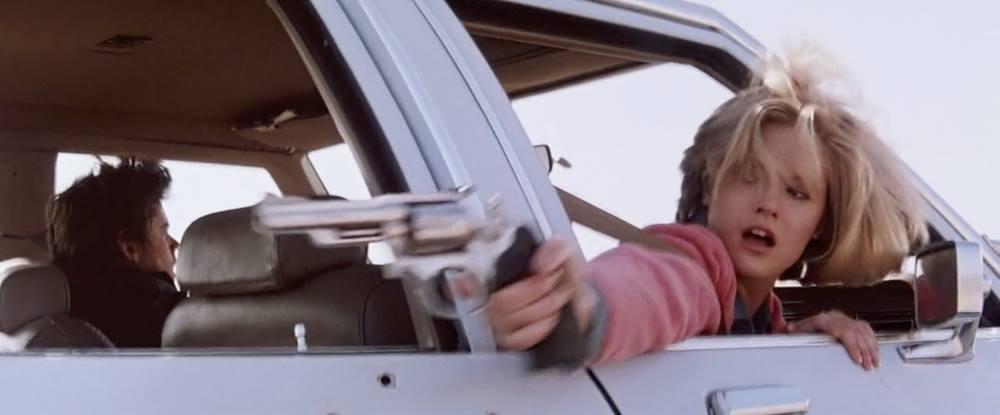

In all this, C. Thomas Howell gives an amazing performance in his gradual breakdown, sure he’s on the edge but he never falls to over-dramatic excess, he’s desperate and fearful, then he’s angry and focused – if anything, he’s an obsessed as the man on the road with him, and reportedly he was only 17-years-old when they made it. And then there’s Rutger Hauer, complimenting Halsey’s breakdown, and Rutger offers up a glorious balance of pure patience within his sociopathic and psychopathic behaviour, alongside so much calmness. Those facial expressions, that ease of madness is captivating and terrifying. The perfect onscreen baddie. And, of course, a small mention has to go to a young Jennifer Jason Leigh, a vital part of the story, and core to everyone’s story.
This is a wonderful restoration, and those wide-scope-scenes look excellent in 4K UHD, and there’s that gritty feeling to the visuals without the digital fears – that can be found in such older films – it’s been brought to life again via the original camera negative.
it was also highly entertaining to return to this shocking, superb thriller that caught the pure raw, early energy and talent of the director and writer, alongside two lead actors who commit to every scene. Which is why The Hitcher remains chilling, challenging and enduring.
Special Features
As hoped, the special features are radiantly in-depth, there’s new audio commentary by Alexandra Heller-Nicholas, Audio commentary with Harmon and Red, and also scene specific audio commentary with Harmon, Red, Exec Producer Edward S Feldman, Composer Mark Isham, Director of Photography John Seale plus actors Hauer and Howell.
For the rest, I’d say there’s over two hours+ of features which are thorough. I particularly enjoyed the The Projection Booth Podcast, with Harmon and Hauer, which was sharp and interesting. It talks of implied situations, the smart camera use and stylistically how good it stays, plus not forgetting that this this was Red and Harmon’s first feature experience – resulting in a timeless setup, as well as a whole host of intelligence.
In Bullseye: a new interview with Robert Harmon: the director discusses the reality of his lead character Halsey having a bad day, and considered how it could get worse and worse, to the point he considers killing himself before even killing the guy chasing him. And, the truth, was how completely unusual this was, even back then, for a leading character in that era, especially in a more mainstream sense, and how some people found that difficult to comprehend. He also discusses the low budgets, his own personal location scouting, and mostly how utterly ready he was to get going as a ‘green’ director with no distractions.
Penning the Ripper: a new interview with Eric Red: Eric is open about his process, about Texas and where he came from as well, how he wanted to write it and the clear Riders in the Storm influence, which is the song by The Doors. He also talks about the slight self-biographical elements – not the murders – but the driving routes coming as a city boy to the vast, open spaces and how unsettling he found that, which is interesting to me, because I love the country and that sense of endless openness. Red also talks about a very vital thing for films, and writing, and how he intended to capture the audience with a psychological approach through that first ten minutes setup. And boy, what a setup.

Doomed to Live: a new interview with C Thomas Howell: This is an entertaining interview with the man who played Halsey, it shows how much he loved it and reveals how young he was when they filmed it, 17-years-old is incredible considering his performance. He also talks about how in retrospect they’ve realised how much it made people think, especially after a screening where everyone was silent at the end, and how that contemplation meant they’d been taken away somewhere – spiritually and fearfully! This featurette is very much an actor’s insight, but it’s all positive, as he can see where he was, and where it eventually took him. And, also, his take is the same as Eric Red’s of where everything was at the time and what they wanted to do.
The Man from Oz: a new interview with John Seale: This is a proper 10-minute interview with the Director of Photography, the Australian who’d bring that sense of scale to life. He worked on this film on the back of the excellent Witness, starring Harrison Ford, and after meeting Robert Harmon was interested in taking on the job.
Although, he didn’t like the ‘gruesome’ deaths the screenplay spoke of, after he spoke to Harmon and watched the director’s short film China Lake, they discussed and agreed how it’d be filmed and left to the imagination, because that’s the thing that fills in the blanks of reality, and it works so well. He also talks of the energy of the frame, and how that can create what you need in the scene – so with Hauer and Campbell, they made this happen.
He also mentioned Rutger’s method acting, and how good it was to observe. They talk about the epic gas station scene because that was the actor involved and his actions on film. He also mentioned how that finale sent shockwaves through the American film world for a while. Oh, and listen out for his real-life story about ‘that’ scene with the trucks. It’s great to hear.


A Very Formative Score: a new interview with Mark Isham: The film composer talks about his training, and Silver Apples of the Moon, and how he wanted to use technology of the time to dive into the film composition world. He discusses that subtle sense of adrenaline, his use of early sampling methods as well, because (as some of us may know) as it didn’t really exist before then. It’s clear he really enjoyed the technological learning and electronic scores, fusing in orchestral session to make a futuristic sound via synths because – don’t forget – computers weren’t really a thing at that point. Oh, and not forgetting they implemented the systems at Skywalker Sound in San Francisco for some earlier scenes.
There’s also a 20-minute piece on Rutger himself from Leigh Singer, Duel Runner, which takes us through his work within The Hitcher to Blade Runner, and beyond! You can see these life and dreams haunting-connections if you know the films well enough, and the breakdown – in an essay-like approach – is one for the purists.
And, finally, there’s a few more extras to enjoy which includes Harmon’s short film China Lake, newly restores with a Hitcher vibe, plus the director himself on the film. Plus, a very watchable short called Telephone, made by Eric Red, and brings up some interesting situations between two initially unconnected characters and, finally, not forgetting the ever-present ‘trailers’ as your final little bonus. I would have liked to see The Room on here, as it was on the DVD, but you can click here to watch it, I promise it’s a good one – with a Rutger link!
The Hitcher limited set is presented in a stellar collector’s package with new artwork by Adam Stothard and a 200-page hardback book, plus Eric Red’s original screenplay book, and six collectors’ art card – I haven’t seen these final extras in person, but knowing Second Sight’s releases, I’d be confident they’d also be a quality addition.

The Hitcher is available to pre-order as Special Edition Dual 4K UHD and Blu-ray release on 30 September, alongside Standard Editions on 4K UHD and Blu-ray: secondsightfilms/the-hitcher-limited-edition




Leave a Reply