Edward Berger’s follow-up to the acclaimed All Quiet On The Western Front is a relatively faithful adaptation of Robert Harris’ 2016 novel of the same name, which explores the machinations of a group of cardinals charged with selecting a new Pope. Berger can expect more attention in awards season, having crafted a contained thriller which reflects on the Catholic church’s place in the world and the lure of power on mortal men.
When the Pope dies, peacefully but unexpectedly, Cardinal Thomas Lawrence (Ralph Fiennes) finds himself with a responsibility he never wanted or sought – leading the process of finding the late Pontiff’s successor. Over a hundred of the most senior cardinals from around the world gather in Rome to be sequestered, where they will vote on members of their number until one receives a two-thirds majority and wins the election, at which point white smoke will be released from the Vatican chimney and the new man will be revealed to the world.

The first vote reveals the strong contenders among the cardinals, including the more liberal Aldo Bellini (Stanley Tucci), who’s unwilling to moderate his progressive views in order to garner support. Cardinal Adeyimi (Lucian Msamati) could become the first black pope, but his conservative views on homosexuality are in stark contrast to Bellini. Tedesco (Sergio Castellitto) is even more to the right, and fears about among some of the cardinals that his election could undo decades of progress. Cardinal Tremblay (John Lithgow) might be the candidate who could unite all wings of the church, but doubts persist about a meeting he had with the former Pope on the day of his death.
To his surprise and disappointment, Lawrence also finds himself collecting a small but significant number of votes. He’d intended to step down, suffering a crisis of prayer and faith, yet finds himself navigating the increasingly tense deliberations while struggling to remain impartial, and having to examine what he is willing to do to uncover the truth behind each cardinal’s motives and desire to become the most powerful man in the Catholic Church. But perhaps the man most suited to lead is the man least willing to accept the mantle of authority?
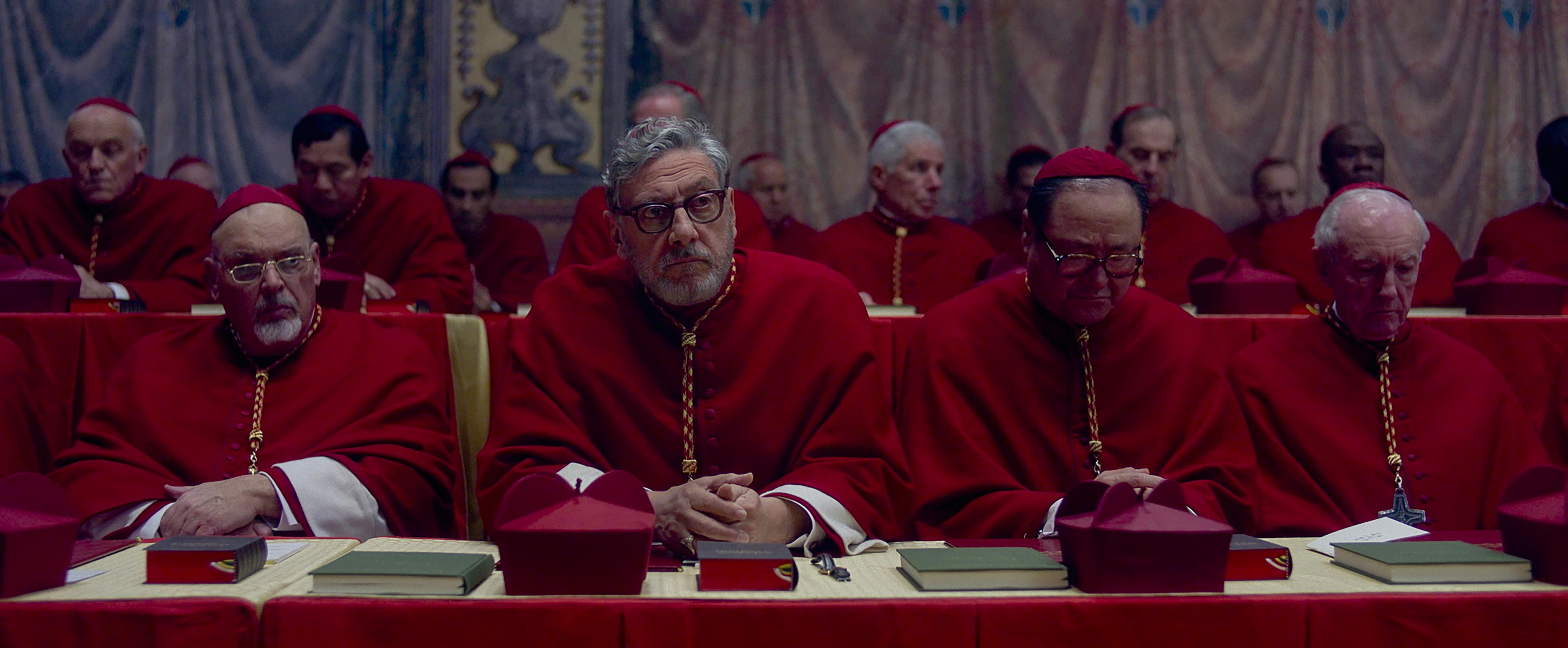
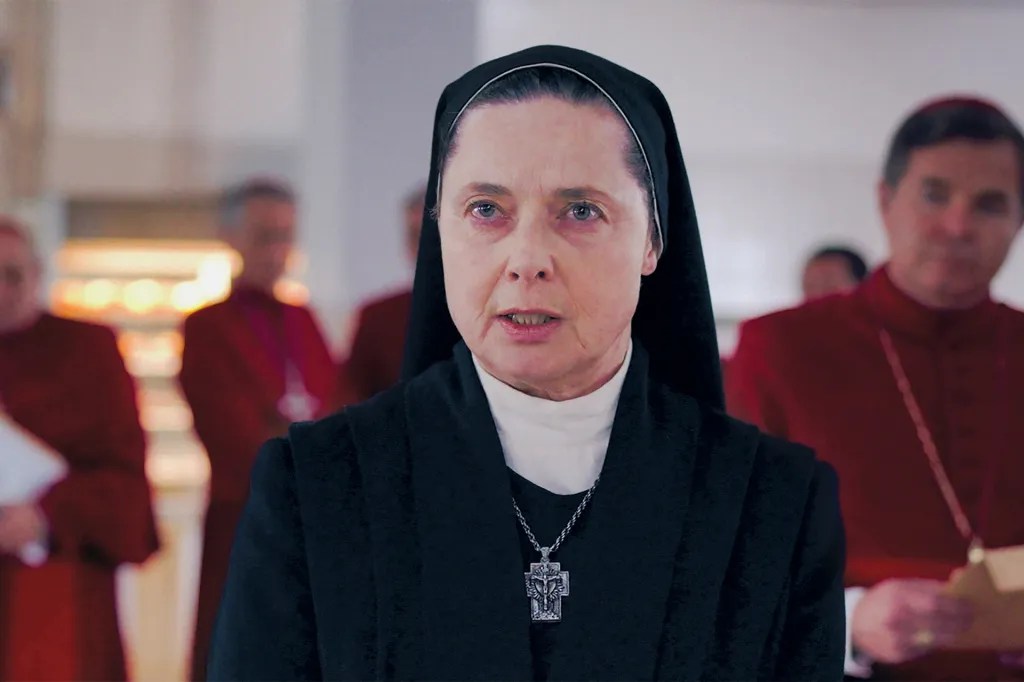
The cast is uniformly excellent, no surprise given the depth of talent that Berger has assembled. At the centre is Ralph Fiennes, his internal struggles with both his own faith and the Church in general etched over every inch of his face. He exudes a passive calm but reveals his internal conflict piece by troubled piece. Tucci acts almost as the voice of his conscience, his ire at his own struggle in the process vented in Fiennes’ direction, questioning everything about the process and the lead cardinal’s increasingly invested role. Each of the others gets their moment to grandstand in the hope of grasping the mantle, but possibly the most effective speech is left to Isabella Rossellini as the sister on the sidelines unable, like half of the church’s members, to take any part in the process.
It’s not just the director who has awards form – screenwriter Peter Straughan’s work on the 2011 version of Tinker, Tailor, Soldier, Spy and the TV adaptation of Wolf Hall have both been rightly lauded, and here he takes Harris’s novel and makes clean lines of the cardinals and sets the stakes clearly. Conclave goes beyond being a mere thriller with robes and incense, each of the key protagonists reflect a problem with the church’s relevance to an increasingly secular society and an acknowledgement that the wrong choice could doom the church or its members to further suffering. Past scandals and shame inevitably hover on the fringes of the discussion, but Straughan and Berger never allow them to dominate, making sure the key decision remains the focus while the themes can resonate once the dust has settled.

Dust, quite literally, has to settle, with a bombing providing an intrusion from the outside world and a reminder that the choice cannot be made in isolation, as much as Cardinal Lawrence would try to demand it. Berger has a gift for framing and uses the holy settings to conjure both the pomp and majesty that the process is wrapped in, while also allowing the two-handed dramatic moments to breathe and to propel the drama effectively. It doesn’t sound at face value like material for a thriller, but Berger keeps a tight grip on proceedings and the outcome is never less than compelling.
Conclave has a lot to say about the state of both the church and the world: the patriarchal nature of its structures, its refusal to embrace change (most of the proceedings are conducted in an acknowledged dead language) and its unwillingness to acknowledge sins of the past. That Berger’s film works through all this so effectively while keeping you invested in the election’s outcome is testament to the talents of all involved, especially Fiennes as its moral, conflicted heart.


![Unquiet Guests review – Edited by Dan Coxon [Dead Ink Books]](https://criticalpopcorn.com/wp-content/uploads/2025/10/ug-reddit-ad-e1761690427755.jpg?w=895)
![Martyrs 4K UHD review: Dir. Pascal Laugier [Masters Of Cinema]](https://criticalpopcorn.com/wp-content/uploads/2025/10/image-1-e1761586395456.png?w=895)
![Why I Love… Steve Martin’s Roxanne [1987]](https://criticalpopcorn.com/wp-content/uploads/2016/11/roxanne.jpg?w=460)


 Critical popcorn
Post your thoughts