
Payal Kapadia’s All We Imagine as Light is a reflective, thoughtful mediation on the lives of three nurses in modern-day Mumbai: Prabha (Kani Kusruti), Anu (Divya Prabha) and Parvaty (Chhaya Kadam).
Over the course of Kapadia’s film, we’re deftly acquainted with their individuality, all set within the frantic city. Their friendship however is unhurriedly paced and grounded, offering an authenticity to three women in different places in their lives, simultaneously at a crossroad of decision, trying to make the right choice with varying levels of strength and resolve – they’re quintessentially endeavouring to discover a new world that’s beyond the life they’ve been sold, or even been culturally confined by.

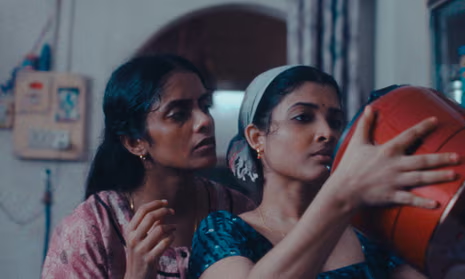
Prabha is our main focus, a lead Nurse in her local hospital, who feels abandoned in her personal life. She’s married but hasn’t seen her husband for some time, he supposedly works in Germany, although we never meet him, suggesting it’s a marriage of convenience but we never know why. The only reality to this relationship is when Prabha is sent a new rice cooker, and while it could help day-to-day culinary possibilities, she hides it under the counter – with her only encounter with it coming later in the film when one dark, rainy night, she wraps herself around it, almost offering a lingering for love that’s abandoned her in an oddly sensual second.
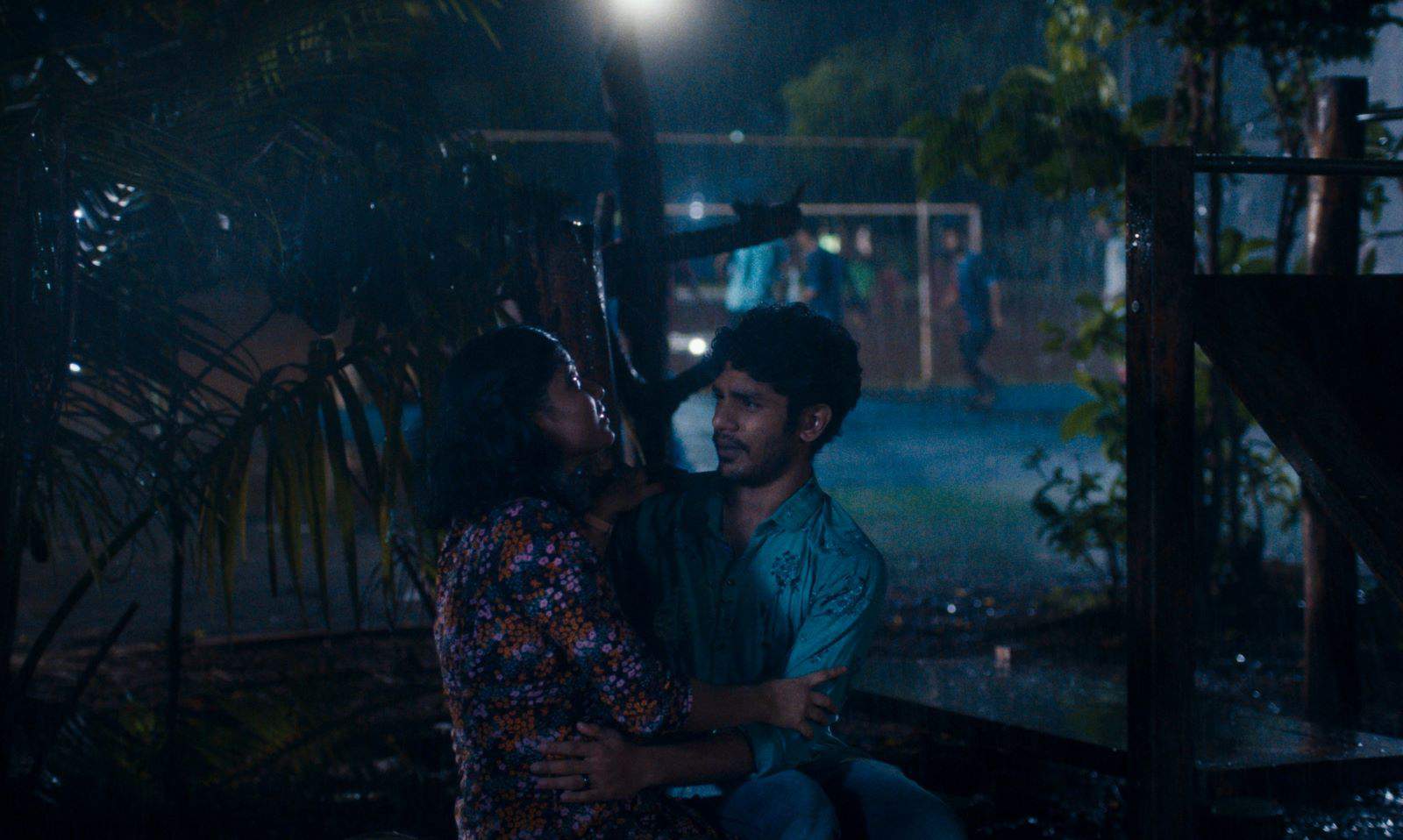
And then there’s 20-something Anu, pleasingly rebellious, wearied at work, always bending the rules trying to get anything good in her life; which includes a secret boyfriend (an excellent Hridhu Haroon), who she hooks up with incognito, away from the flat she shares with Prabha, meeting him in distant night-time places, obsessing in her young love, drifting happily in the romanticism and trying to do whatever she wants, even if she’s struggling to pay her side of the rent. But she remains eagerly far away from being tied into an arranged marriage, organised by her parents who send her possible suitors – pictures of which we witness during a particular entertaining scene.

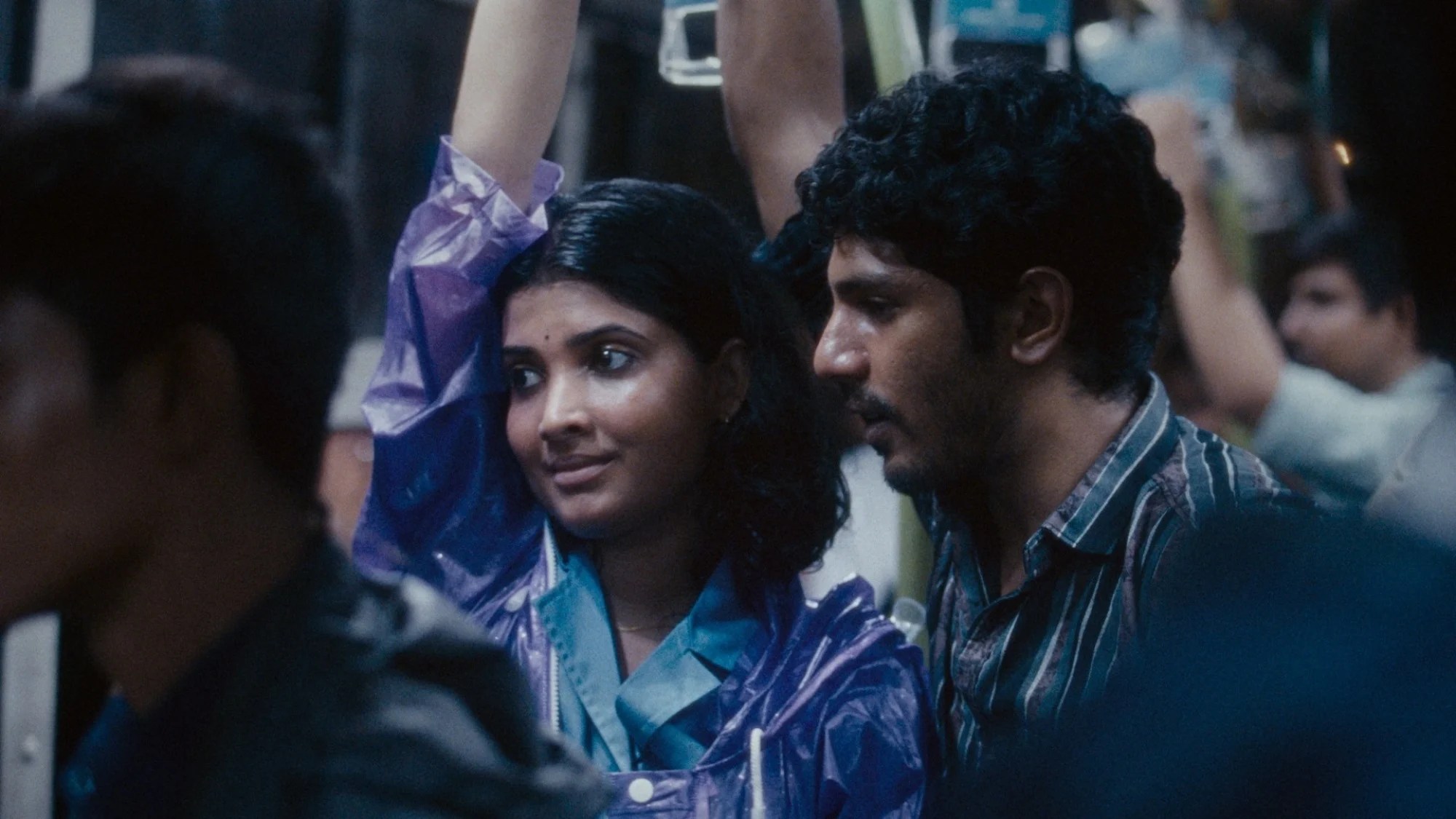
And there’s straight talking Parvaty, an experienced woman at work but outside she’s fighting for her home as building developers want to knock it down and construct blocks for richer cliental. Frustratingly, she can’t prove she owns the home she lives in, because her husband has died and she was never privy to the paperwork, or where he kept it – which can be a common situation – and obviously problematic for Parvaty… until one day when she starts to consider why she’s even bothered about keeping it. While her involvement in All We Imagine as Light is more important later, she’ll become vital for both Anu and Prabha, and the situation she finds herself in is certainly a not-so-subtle comment on driving out those in need of somewhere to live in Mumbai, which doesn’t sound too dissimilar to many major cities across the globe.
As this writer hasn’t yet visited Mumbai, and only subjected to the wider representation of the major Indian west coast city in Maharashtra, with all its bright lights and busyness, it was an education to live at night with these key characters, and be tangled in their existence – with beautiful cinematography from Ranabir Das. With themes of tedium, loss of ‘self’ and trying to find the real ‘you’ – these stories could occur anywhere. And this insightfulness is compelling, never pushing us outside their specific stories, but it’s juxtaposed with a demanding city of unerring noise and a claustrophobic lack of space, asking ‘where do you go to find yourself if you’re spiritually lost?’

As well the film being women telling women’s stories, as one significant characteristic of All We Imagine as Light, I’ve learned that this type of Indian story is less common, mixing cultures of Malayalam, Muslim and Hindu, whereas most films in Hindi would find a wider audience, it can be less likely with Malayalam creative output. So this makes it both an significant step forward, and a unique vision of cultures living side-by-side in Mumbai, yet like any major city, there’s clashes, and disparity and wealth gaps – even if you’re a Nurse and vital to the everyday functionality of keeping your fellow neighbours alive.
In the second half of the film, they all step outside of the city and return to a smaller village, situated by the sea, as a trio. This literal change enables them to consider life a little deeper, see the sky clearer, while the ocean air gives them an opportunity to see it all a little differently – and over time open up to each other. This is genuine hope of starting again without the constraints of everything come before, regardless of who they were in the past, or where they used to live – because after all home is really where you make it.

I can recognise why All We Imagine is Light would appeal to a western audience as well, it holds a European style with its characters and stories, presenting a candid insight to affairs that could be echoed in any culture or country. It also feels timely with its focus on the three women, finding themselves in a changing world, but with gradual empowerment that would once have been pushed down. There are terrific performances across the small ensemble, and particularly Kani Kusruti’s Prabha and Divya Prabha’s Anu, who at first are supportive but clash in their life views, but over time will learn from each other. Kusruti is reserved and troubled in her portrayal but will begin to rebuild her life, Prabha is excellently free as Anu but also has much to learn, and this comes through excellently.
There’s a comment in the film about Mumbai not being the city of dreams, but instead being ‘a city of illusion’, which mirrors the initial journey of Prabha, Anu and Parvaty. Alongside this, is fleeting measures of sensuality, and observations on the Malayalam and Hindu co-cultures, as well as moments that consider faith, urbanisation and patriarchy. Yet beyond all that is the persistent stories of three different women, and while it might occasionally drop the pace a bit too much, or shift between ideas that don’t always line-up, it’s carries a strong perception of a world we don’t always get to explore, and it’s done with a subtly vivacious appetite and excellent performances.

Director, Payal Kapadia, also said the following regarding the filming process, which I felt should be shared:
“Although All We Imagine as Light is my first fiction feature, it’s still very important to me that fiction and documentary can exist together. What I try to do is approach fiction in a non-fiction way. I find the juxtaposition of the two very interesting and I strongly believe that it makes the non-fiction more fiction and the fiction more non-fiction.”


![Unquiet Guests review – Edited by Dan Coxon [Dead Ink Books]](https://criticalpopcorn.com/wp-content/uploads/2025/10/ug-reddit-ad-e1761690427755.jpg?w=895)
![Martyrs 4K UHD review: Dir. Pascal Laugier [Masters Of Cinema]](https://criticalpopcorn.com/wp-content/uploads/2025/10/image-1-e1761586395456.png?w=895)



![Why I Love… Steve Martin’s Roxanne [1987]](https://criticalpopcorn.com/wp-content/uploads/2016/11/roxanne.jpg?w=460)



 Critical popcorn
Post your thoughts