Celebrating Alfred Hitchcock’s 125th birthday, this lovingly restored boxset from StudioCanal offers ten films from his early career, spanning the transition from silent cinema to sound. The central film in the set is Blackmail, Hitchcock’s first sound film and a remarkable showcase of his experimentation with the medium. A new documentary, Becoming Hitchcock, accompanies the films. It dives into Blackmail’s unique status as both a silent and talkie film, and demonstrates how it laid the groundwork for many of the directors most celebrated films.
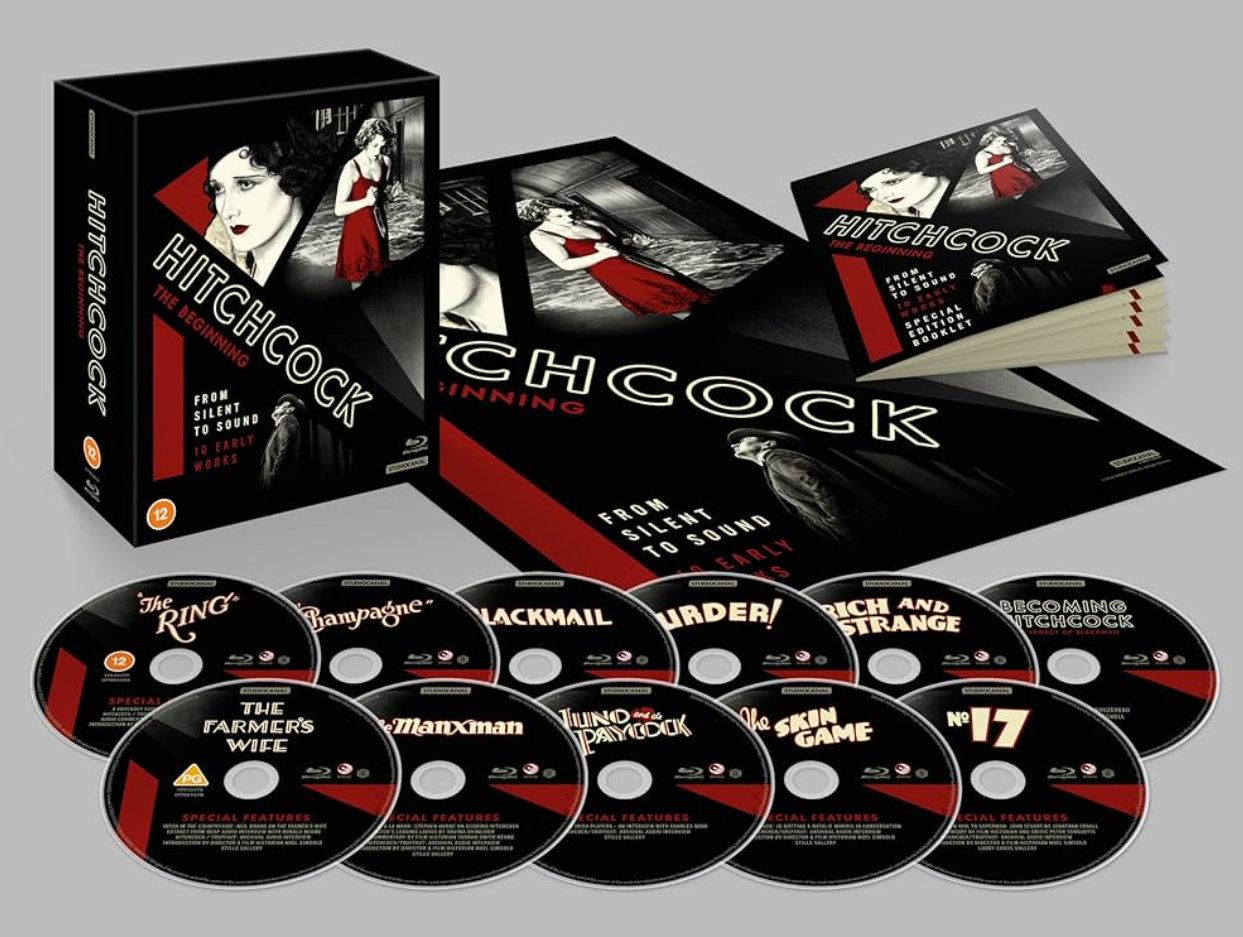
The collection itself is a curious mix of silent and early sound films, but all together it serves as an illuminating insight into Hitchcock’s evolution as a filmmaker. It showcases his early experiments with themes like voyeurism, black humour, and morally ambiguous characters—traits that would define his later masterpieces. The recurring collaborators who appear across multiple films also serve as a reminder that Hitchcock was always conscious of his own brand. His wife, screenwriter Alma Reville is a constant presence, but actors like Anny Ondra, Donald Calthrop, Gordon Harker and Carl Brisson turn up in multiple films, creating the feel of an acting troupe.
It is strange though, that his early efforts in sound are generally less engaging than his very first – it’s something he seems to acknowledge in an interview for The Manxman, as he talks with some regret about the change in filmmaking necessitated by the advent of sound, describing early sound films as “Pictures of people talking.” It’s a problem he managed to overcome quickly, but his early struggles are well documented here, and demonstrate an interesting stutter step for the master of suspense.
Below is my quick ranking of the films in this collection, from worst to best:
10. Juno & The Paycock
This film often languishes in last place on rankings of all Hitchcock’s work, and unfortunately there isn’t much to commend it. Sean O Casey’s play is much lauded, but Hitchcock just stages it as a play, and as such it’s lacks visual flair and momentum, making it one of Hitchcock’s least compelling efforts despite its intriguing source material. A couple of great performances from Sara Allgood and John Laurie (Frasier from Dad’s Army) can’t compensate for the plodding feel of the film. It’s both interesting and disappointing that while his late silent era films feel vital and full of life, this early foray into sound feels so flat. It’s not just because it’s a play adaptation either, as he would later make both Rope and Dial M For Murder, which are based on plays but great films in their own right.
9. Champagne
Lightweight and uninspired, this fluffy comedy is out of place in Hitchcock’s oeuvre, feeling more like a Clara Bow picture, with an air-headed but impulsive heiress at it’s centre. The most memorable sequence in the film comes early on, as an inebriated passenger on a cruise ship staggers around drunkenly until the ship hits choppy waters, when he manages to walk perfectly upright while everyone else struggles to stay on their feet. The rest of the film is a little inconsequential, while the resolution is much too contrived to really land properly.
8. Rich & Strange
In places this feels like a retread of FW Murnau‘s Sunrise, a story of a poor couple who are gifted money to go on an adventure, and find themselves growing apart along the way, only to reaffirm their love for one another when they find themselves at their lowest ebb. It’s a decent romantic drama, with a memorable performance from Joan Barry as the long-suffering wife, but the most memorable parts are scenes that feel distinctly un-Hitchcockian, such as the inventive Fritz Lang / Chaplin-esque opening sequence showing the dystopic commute home on the London Underground.
7. Number Seventeen
A confusing, overly complicated plot might hinder some viewers’ understanding of this Ghost Train styled story, but not their enjoyment. The looming shadows and rogues gallery of shady characters make for a creepy, atmospheric black comedy, and while it may go off the rails (literally) towards the end, there is still a lot to enjoy here, mainly in the supporting cast, particularly Donald Calthrop as a particularly sinister villain.
The Dick Barton / Bulldog Drummond feel of it might not appeal to everyone, but it worked for me! The final sequence on the train is a riveting set-piece that is often cited as the only good bit of the film. Despite the muddled plot, I enjoyed the eerie atmosphere, enigmatic performances and riveting action sequences.
6. The Skin Game
Another film based on a play, this one does at least have a bit of drive to it in the story of two feuding families, fighting for control of a small rural village. It’s still a little tonally inconsistent, but it has a handful of memorable sequences (particularly the central land auction) and does give a nice role to Edmund Gwenn (who would later work with Hitchcock on Foreign Correspondent and The Trouble With Harry) as a ruthless landowner. He manages a fine balancing act at initially appearing heartless with regard to his tenants but emerges as full of understanding when it comes to his own family.
This is notably the only one in the collection where it appears there hasn’t been a full restoration. However, the crackling screen only emphasises just how impressive the transfer has been on the other films.
5. The Farmer’s Wife
A gentle comedy, with some beautifully scenic landscape cinematography, and wonderfully observed characterisation, only slightly marred by the retrograde, misogynistic attitudes exhibited by the protagonist.
You can just about justify these as being part of his blunt, old-fashioned persona, and I’m inclined to do so because otherwise this is a charming film about a bullish widower (Jameson Thomas) searching for a new bride.
The comedy is on point, with genuinely laugh out loud lines (“This is a nightmare!” – “Your hat is!”) and his exaggerated reactions of outrage at being turned down by every potential bride. It’s not a stylish film, but there are subtle moments of visual inventiveness, (such as each of his potential matches materializing in his wife’s old chair) and an undeniably sweet, touching resolution,
4. The Ring
Hitchcock himself said of this love story, “After The Lodger, The Ring was the first Hitchcock film.” It’s easy to see why – this is a stylised, vibrant and atmospheric story of a love triangle between two rival boxers and the woman they love.
The story is fairly simple, but it brims with visual inventiveness, particularly during its climactic fight scene. Hitchcock employs numerous editing and camera techniques to convey the heightened drama of the fight, including one beautifully executed slow zoom on the face of the heroine.
Gordon Harker is a standout as a boxing coach who is hilariously nonchalant early on. When a potential challenger carefully folds his jacket and hangs it up, then hands the coach his hat, he carefully takes it and unceremoniously drops it in the dirt.
3. Murder!
This dry run for Hitchcock’s many “wrong man” thrillers plays out a lot more methodically than his more successful variations, but it’s a definite highlight in this collection. Like Blackmail, Hitchcock takes his audience through the process of arrest, trial and conviction, but this time from the perspective of a jury member rather than a policeman. The deliberation scene in the jury room is a standout, as is the moment where the hero tries to entrap the villain, with the pretence of casting him in his new play, based on the murder.
As with all the films in this collection, there are some outdated attitudes on display, but interestingly, it seems that the racist overtones here are being used as a euphemism for the villains homosexuality, making it problematic in two ways at once! If you are able to overlook this though, it’s an effective (if sometimes uninspired) procedural / mystery, with excellent performances from Herbert Marshall as the actor hero, and especially Esme Percy as the villain, who brings nuance to what could be a two-dimensional role.

2. The Manxman
Hitchcock’s last fully silent film is also one of his best, rivalling The Lodger for the title of his best work of the silent era. A moody, almost expressionist silent film about a small fishing town in the Isle Of Man, and a love triangle that ends in devastation. It’s a melodrama, and everything is heightened as you might expect, but it’s also surprisingly nuanced. There are no villains here, and in the end everyone loses.
Hitchcock demonstrates some sophisticated filmmaking in his use of symbolism, striking visual compositions and witty editing techniques (he demonstrates the passage of time by showing the pages of a diary turning with entries in each day filled). It also marks his first film with Anny Ondra, here giving a by turns spirited and melancholy performance as the woman caught in the middle.
More importantly than the stylistic choices though, is the emotional maturity of the film – it represents a huge leap forward for Hitchcock, and is perhaps the most important silent film he made. The final few shots in particular, from the downcast tableau of the cottage to one of the men looking wistfully out to see on his fishing boat, stayed with me for days after.
1. Blackmail
The jewel in the crown of this collection, Blackmail was Hitchcock’s first sound picture, and a remarkable showcase of his technical innovation and storytelling prowess. Anchored by two strong performances, it’s the most complete and satisfying entry in the boxset.
Anny Ondra stars as Alice, a young woman who stabs a man in self-defence. Her policeman boyfriend covers up the crime, but slimy blackmailer Tracy (Donald Calthrop) threatens to expose them.

What makes Blackmail a deliciously subversive film, and uniquely Hitchcockian, is the morally complicated methods employed by the erstwhile heroes. The eponymous blackmailer is obviously the villain, but the way the heroes outwit him is to essentially frame him for murder, a crime he is wholly innocent of. Calthrop gives an excellent, nuanced performance as a villain who somehow engenders sympathy from the audience.
A precursor to Hitchcock’s later masterpieces, it features many elements which are now associated with Hitchcock films. It features his first blonde lead (Ondra), a thrilling climactic chase through through a iconic landmark, this time The British Museum, an obvious precursor to the famous final scenes of Saboteur and most famously North By Northwest.
This collection features both the silent and sound version of Blackmail. Both are worth watching, but I would give the slight edge to the sound version, as this features the iconic “Knife” scene. As Alice sits at breakfast, haunted by guilt, Hitchcock heightens her trauma by amplifying the word “knife” until it utterly dominates the soundtrack. It’s a deft demonstration of Hitchcock’s innovative approach to filmmaking – with his first sound film, he was already playing with the medium, testing how he could use it to further the story.
Though uneven, this boxset provides a fascinating lens into Hitchcock’s formative years, tracing the seeds of his genius. I doubt anyone will walk away from this boxset with a new favourite Hitchcock film, (pretty much every one comes with a warning at the start for outdated attitudes for a start) but it does provide an endlessly fascinating look at his beginnings, at the elements that were always there and the development of his talent behind the camera. It’s a collection that is definitely more than the sum of it’s parts, but for Blackmail alone, it’s worth the investment—and for Hitchcock enthusiasts, it’s essential viewing.
Special Features
While this isn’t a definitive “Best Of,” the set provides an illuminating glimpse into Hitchcock’s development, complete with pristine restorations and a wealth of special features, including alternate cuts, commentaries, and archival interviews. Each film comes with an introduction and a brief assessment from Hitchcock himself, clipped out from his renowned interviews with Francois Truffaut.


![Unquiet Guests review – Edited by Dan Coxon [Dead Ink Books]](https://criticalpopcorn.com/wp-content/uploads/2025/10/ug-reddit-ad-e1761690427755.jpg?w=895)
![Martyrs 4K UHD review: Dir. Pascal Laugier [Masters Of Cinema]](https://criticalpopcorn.com/wp-content/uploads/2025/10/image-1-e1761586395456.png?w=895)
![Why I Love… Steve Martin’s Roxanne [1987]](https://criticalpopcorn.com/wp-content/uploads/2016/11/roxanne.jpg?w=460)


 Critical popcorn
Post your thoughts