
Anthony Mann has always been my favourite director of westerns. He has a unique blend of John Ford’s mythic heroes and the fatalism of Sam Peckinpah, plus the sparse aesthetics and moral ambivalence of Budd Boetticher and Samuel Fuller. Unlike some of his contemporaries, Mann wasn’t exclusively a Western director – he made his name with some of the most quietly impressive film noirs of the classic era, such as Raw Deal, Side Street, He Walked By Night and T-Men. However, of the 19 films he directed in the fifties, 11 of them were Westerns, and it’s for these he’s best remembered today. His films are hard-boiled, cynical, sometimes reaching biblical proportions (especially Man Of The West and The Man From Laramie) but my favourites are his stripped back, lean westerns – particularly the ones he made with James Stewart.
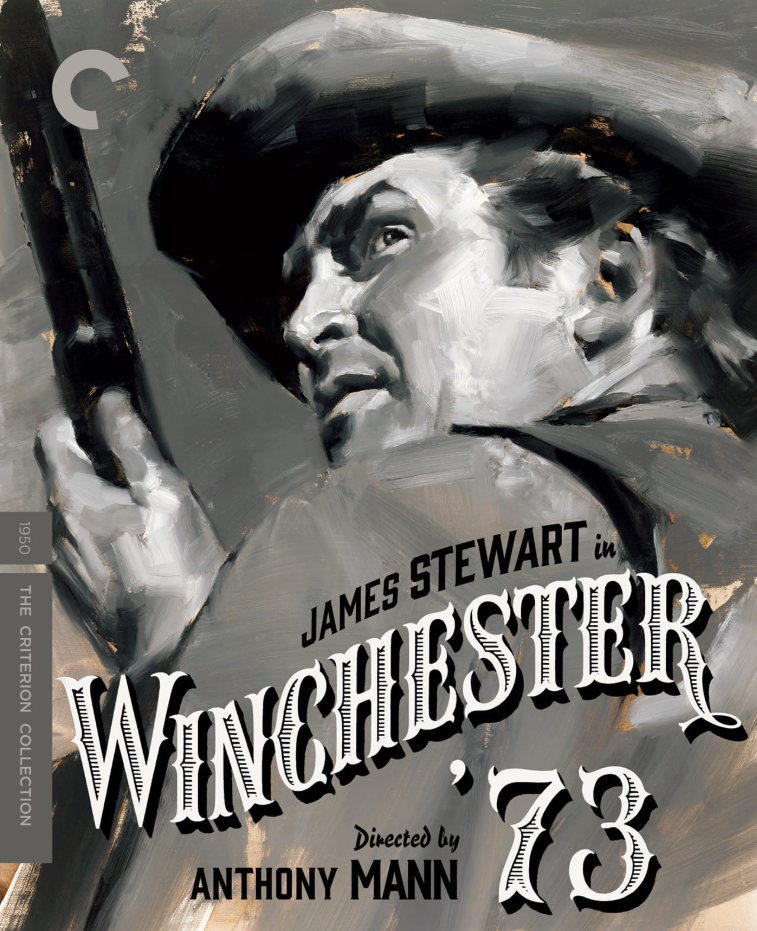
Winchester ’73 is the first of these collaborations, following the journey of the invaluable rifle of the title, as it’s passed from disreputable character to disreputable character – almost like a pulpy, Western version of L’Argent. The narrative centers on Lin McAdam (James Stewart), a sharpshooter pursuing his nemesis, the volatile outlaw Dutch Henry (Stephen McNally), across the country. After winning the prized rifle, Lin loses it almost immediately, yet their fates remain intertwined as the rifle changes owners, leading to a fateful, climactic confrontation in the mountains.
Stewart delivers an exceptional performance, shedding his familiar mannerisms to portray a character with a palpable darkness and grim determination, a stark contrast to his earlier, more wholesome roles. You get the sense that Mann recognized and drew out this deeper, more intense side of Stewart. moving away from the “aw shucks” persona of his pre-war films. There’s none of the “aw shucks” flustered everyman or the warmth of his roles in It’s A Wonderful Life or The Philadelphia Story in Stewart’s performance here. Lin is a heroic character for sure but there is a palpable darkness to him . He has a hard edge and a grim determination that is completely anathema to the wholesome persona he had cultivated in his pre-war films.
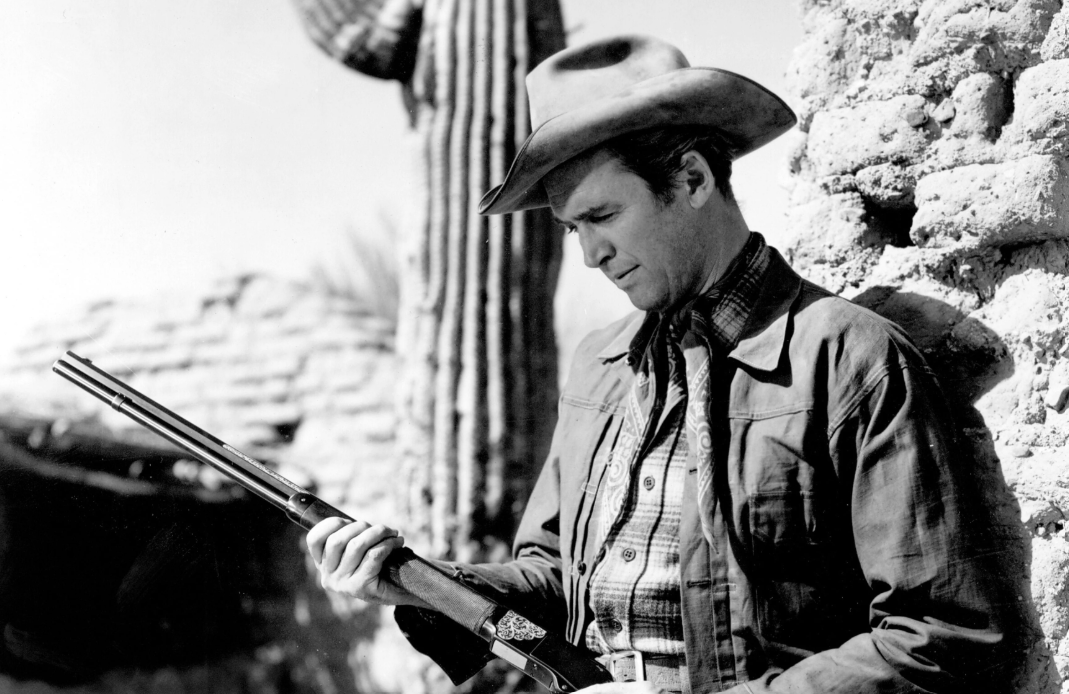
By its very nature the film has an episodic structure, as we track the rifle from owner to owner, but there’s a momentum to the story that prevents it feeling repetitive or too disjointed. Lin’s relentless pursuit of Dutch brings a continuity, and a throughline to the story. It all culminates in an epic shootout on a rocky mountainside, a harsh, jagged landscape that mirrors the stark, unsentimental tone of the film. There are moments of light to compliment the darkness though – the initial sharpshooting contest is a riveting sequence, as Lin and Dutch pick harder targets in their attempts to win the rifle.
Among the excellent supporting cast are Shelley Winters as a saloon girl hoping for a new start, and Millard Mitchell as Lin’s loyal partner High Spade, as well as early appearances from the likes of Tony Curtis as a young cavalryman. Less successful is Charles Drake, who doesn’t quite capture the nuance of Winters’ cowardly but well-meaning fiancé, while the film’s only misstep comes in the shape of Rock Hudson, cast as the leader of the Native Americans.
Stephen McNally gives a decent performance as the object of Lin’s obsession, but he’s less villainous than impulsive, and he ends up being upstaged by the more colourful antagonists the film has to offer. First by the cardsharp Indian trader played by John McIntyre – he’s introduced in profile, doing impressive sleight of hand tricks before taking the villains for all their worth. Even more impressive is the sublimely named Waco Johnny Dean (Dan Duryea). In any other film, Duryea would be the main villain. He’s full of sadistic menace, and makes Dean a truly loathsome baddie – he’s responsible for the films darkest moment, where he coaxes Winters’ husband into drawing on him, so he can kill him and claim the Winchester for his own. Dean is such a great character; and distinct from the volatile, more traditionally villainous Dutch – he’s a lot more subtle, knowing how to bide his time, making him even more dangerous. His brief confrontation with Stewart in the bar is one of my favourite moments, so well observed from both actors – the way Duryea deliberately spills whiskey on his hand, so he can feint and draw with his left, while Stewart never takes his eyes off him.

Mann’s westerns have a distinctly noir sensibility, a likely holdover from his earlier work in that genre. He creates a murky world, more ambiguous than just white hats vs black hats (although admittedly, in this one the hero does wear a white hat and the villain wear a black hat!) The dialogue is pared back and punchy, almost Elmore Leonard in style – not cliched but still memorable, and serves as further proof of the films influence on the genre. Lin’s line: “Some things a man has to do, so he does them” is a clear antecedent of that quote from Budd Boetticher’s Ride Lonesome: “There are some things a man can’t ride around.”
Unlike Ford’s Westerns, Mann doesn’t lionize his heroes; instead, he presents them with complexity and moral ambiguity. Lin is a decidedly more heroic character than those he plays in The Far Country and The Naked Spur, but there is nonetheless a harshness and an intensity to his performance in Winchester ’73 that audiences hadn’t seen before.
While my favourite of his collaborations with Stewart is probably the pitch black The Naked Spur, their first film together is still a stand out. Winchester ’73 is the perfect introduction to Mann’s directorial style and Stewart’s more hardened screen persona. Today, it stands out as an important milestone in the classic era, redirecting the American Western into more complex moral themes, away from the the clear-cut good versus evil narratives that preceded it. Don’t let the modest scale and simple narrative fool you, it’s one of the greatest Westerns ever made.
Special Features
Extras include an older audio commentary featuring James Stewart and film historian Paul Lindenschmidt, an interview with film programmer Adam Piron on the portrayal of Native Americans in westerns (perhaps a necessary corrective to the casting of Rock Hudson), a featurette on Anthony Mann’s work at Universal; a 1951 Lux Radio Theatre adaptation of the film, and an essay by Imogen Sara Smith


![Unquiet Guests review – Edited by Dan Coxon [Dead Ink Books]](https://criticalpopcorn.com/wp-content/uploads/2025/10/ug-reddit-ad-e1761690427755.jpg?w=895)
![Martyrs 4K UHD review: Dir. Pascal Laugier [Masters Of Cinema]](https://criticalpopcorn.com/wp-content/uploads/2025/10/image-1-e1761586395456.png?w=895)


![Why I Love… Steve Martin’s Roxanne [1987]](https://criticalpopcorn.com/wp-content/uploads/2016/11/roxanne.jpg?w=460)


 Critical popcorn
Post your thoughts