
When it originally came out, Punch-Drunk Love was a box office bomb, with many thinking Paul Thomas Anderson had made his first misstep as a director. After the virtuoso masterpiece that was Magnolia, what on earth was he thinking of, making an Adam Sandler film?
Watching it today, it’s clear that the film signaled a pivotal change in pace for the director, a foray into the intense, focused character studies that would later define works like There Will Be Blood and Phantom Thread. Anderson essentially set out to make an Adam Sandler film grounded in reality, stripping away his usual exaggerated comic persona and revealing the hidden depths of a deeply troubled outsider, surrounding him with natural performances unlike the heightened caricatures that usually populate his films.

The film follows Barry Egan (Sandler), a socially withdrawn and emotionally volatile entrepreneur whose life is dominated by his seven overbearing sisters. Barry is childlike, predominantly meek and introverted but prone to outbursts of rage and violence. His profound loneliness drives him to desperate measures – calling a sex line not for gratification, but in search of some semblance of human connection. His monotonous life is changed forever when he encounters Lena Leonard (Emily Watson), leading him on a journey of unexpected romance and self-discovery.
Sandler’s portrayal of Barry is nothing short of a revelation. Roger Ebert summed up Sandler’s talents perfectly in his review, one of the few that really got it:
In voice and mannerisms he is the same childlike, love-starved Adam Sandler we’ve seen in a series of dim comedies [but] given a director and a screenplay that sees through the Sandler persona, that understands it as the disguise of a suffering outsider, Sandler reveals depths and tones we may have suspected but couldn’t bring into focus.
Sandler is so good, and what’s is particularly impressive is the way he really isn’t all that different to his usual persona, if you look at him in The Wedding Singer or Happy Gilmore, you see the same mix of vulnerability and barely contained fury – the only difference is in these films it’s played for laughs. When guided by Anderson’s assured direction, Sandler’s persona becomes the mask of a deeply suffering outsider. A particularly striking moment occurs right after the car crash that sets the film in motion. The look of genuine fear and shock on Barry’s face is both funny and instantly endearing, a moment that immediately captures Sandler’s untapped dramatic potential.
Barry’s anger and violent outbursts might seem unrealistic, but it never feels contrived (unlike the wish fulfilment violence in something like After Life) because of the toll it has clearly taken on his life. His sisters’ reaction when he smashes a window in anger is not one of shock but of irritation. They’re used to this, and in their quieter moments they are shown to be concerned and protective of their brother. The anxiety and stress Barry’s sisters provoke is relatable to anybody who has siblings, the way they get under your skin more than anybody, yet also defend you against the vaguest perceived slight.


Lena is a softly spoken but confident character, played subtly by Emily Watson – she is drawn inexorably to Barry, and it is suggested a few times that the two are more similar than they initially appear. While he is neurotic and riddled with anxiety, there are hints she is obsessive, and has been stalking him more than she admits – in the first supermarket scene you can see a red blur in the background that seems to be following him.
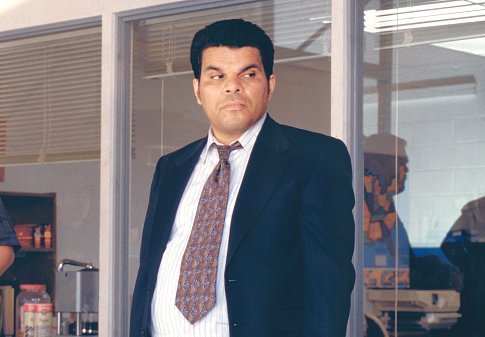
Philip Seymour Hoffman is as reliable as usual playing a gloriously callous petty criminal – he was obviously better in more nuanced, developed roles, but I don’t think I’ve ever enjoyed a Hoffman performance as much as this. He’s almost a mirror of Barry in his explosive rage, though while Barry is at core a good person, Hoffman plays his character with a pure unadulterated scuzziness that is a joy to watch. Meanwhile, Luis Guzman provides a genial counterpoint – embodying just the sweeter side of Barry. There’s something so heartwarming about a character so understanding of his friend’s quirks, and Guzman plays it beautifully – he never mocks Barry, or acts bemused. He simply accepts him for who he is. I especially loved the little touch of him wearing a suit the day after Sandler starts wearing one – as nice as he is, he’s still a bit of a sycophant.
Anderson’s direction amplifies Barry’s internal struggles through every available means. As in Magnolia, his constantly moving camera mirrors Barry’s restless energy, building a suffocating sense of anxiety that permeates every scene. The garish, over saturated colours and score emulate the No-Sex Sex Comedies of the 1950s, but this is contrasted with the low-key performance style of the actors and the awkward, quite seedy nature of the details. Even the most joyous moment in the film, when they all but run into each others arms in a glorious silhouette, is undercut by the fact they are off-centre and kind of awkward about it – Watson tries to do the heel kick thing and it never quite comes off. It’s even more charming for this though, and the film works because the pair are both a little bit off-kilter.


The picture on this restoration is beautifully done, and even more impressive is the sound, the way the soundtrack sometimes overwhelms the dialogue feels like a musical. I heard someone say once that in musicals, people start singing when the emotions become too intense to express with dialogue alone. In the special features with this release, the film’s composer Jon Brion refers to this explicitly, describing Anderson’s vision as “a musical [where] nobody ever breaks into song” and that’s the overriding feeling that you’re left with. This is most clear in the beautiful “He Needs Me” sequence, where Barry decides on an impulse to drop everything and fly to Hawaii to see a woman he just met. It feels like this should be a song and dance number, and the whole sequence is infused with an almost overwhelming energy. Similarly, there’s a brief moment when everything is going right for Barry and he breaks into a spontaneous, joyous little jig at the supermarket.
There’s also a playful layer of meta-textual humour at work – with theories abounding that Barry might be either Popeye or Superman. The film toys with these ideas through subtle details: Barry’s unexpected superhuman strength, the initials of Lena Leonard echoing those of Lois Lane, and even the final shot where Lena, clad in red, hugs the blue suited Barry from behind, evoking the image of Superman with a cape
A change of pace after the multi-stranded narratives of Boogie Nights and Magnolia, Punch-Drunk Love remains a bit of an outlier in Anderson’s filmography. It’s an unassuming, off-brand film for Anderson, and yet one that perfectly encapsulates his evolving sensibility. It’s a focused, intimate portrait of a man on the edge, a raw exploration of loneliness, rage, and the desperate human need for connection. Anderson’s direction, coupled with Sandler’s understated yet explosive performance, offers a raw, unfiltered look at the cost of isolation and the yearning for redemption. It’s not as ambitious as his later work, but remains one of his most focused, vital films.
Special Features
The extras in this director approved release include Blossoms & Blood, a short 2002 piece by Anderson featuring Sandler and Watson, along with music by Jon Brion; The aforementioned interview with Brion; Program featuring behind-the-scenes footage of a recording session for the film’s soundtrack; Conversation between curators Michael Connor and Lia Gangitano about the art of Jeremy Blake, used in the film; Additional artwork by Blake; NBC News interview from 2000 with David Phillips, the “pudding guy” and perhaps most fun of all, the fake Mattress Man commercial, replicating a real commercial, pretty much word for word.


![Unquiet Guests review – Edited by Dan Coxon [Dead Ink Books]](https://criticalpopcorn.com/wp-content/uploads/2025/10/ug-reddit-ad-e1761690427755.jpg?w=895)

![Martyrs 4K UHD review: Dir. Pascal Laugier [Masters Of Cinema]](https://criticalpopcorn.com/wp-content/uploads/2025/10/image-1-e1761586395456.png?w=895)
![Why I Love… Steve Martin’s Roxanne [1987]](https://criticalpopcorn.com/wp-content/uploads/2016/11/roxanne.jpg?w=460)


 Critical popcorn
Post your thoughts