
Joan Macklin Silver’s proto romcom is a supremely odd film. It’s not really funny enough to be called a comedy, and the romance is problematic in all manner of ways, but it has a distinctly unconventional charm of its own, specifically in its depiction of the main characters’ cultural identities.
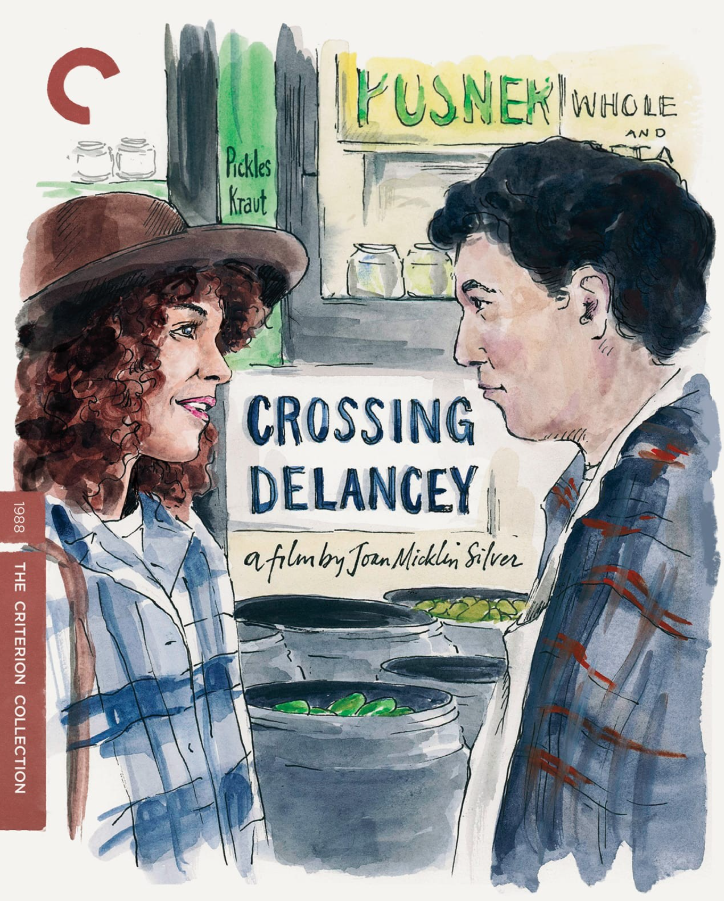
Izzy (Amy Irving) is the manager of a WASPy bookshop in New York and enjoying an pseudo-bohemian, boujee existence of book launches and literary talks – decidedly not searching for romance. She lives on the Upper West Side, but regularly takes the subway to visit her grandmother (Reizl Bozyk) on the Lower East Side, in a far more diverse, buzzing neighborhood. Convinced that Izzy needs a good Jewish husband, her “bubbie” enlists a local matchmaker (Sylvia Miles) to set her up with Sam (Peter Riegert), a quiet but kind-hearted pickle vendor. At first, the gap between them seems insurmountable, especially since Izzy has also fallen for Anton (Jeroen Krabbé), a charming but self-absorbed novelist and frequent patron of her bookstore. What unfolds is a proto-romantic comedy about a woman discovering exactly where she belongs.
The film’s greatest strength lies in the personal, authentic perspective that Micklin Silver brings to the story, particularly in its depiction of Jewish culture. It paints a vibrant portrait of New York’s Jewish community in the 1980s. Both New York locations are depicted vividly, but it’s the scenes in the Lower East Side that feel the most authentic – the scene of a performer singing “Some Enchanted Evening” in a hot dog stand, could be comic in another film, but here it’s an almost spiritual moment, as all the customers are entranced by the performance. This restoration by Criterion does a beautiful job preserving the film’s rich textures—the grainy cinematography and striking teal color palette of the city look fantastic. However, while the film is well-crafted, the characters often feel more like archetypes than fully fleshed-out individuals.

Peter Riegert gives a restrained performance as Sam, but he’s at his best when playing more jaded, cynical roles (He’s played plenty of these, but for me he will always be the ever exasperated detective from The Mask: “Those pyjamas are impossible, this actually happened.”) He underplays his role here almost too much, and is strongest in subtler moments. His most effective scene comes when Izzy’s casual lover unexpectedly crashes their date. Sam immediately recognizes the situation but, instead of reacting with jealousy or indignation, he simply offers the man a place to stay. When Izzy calls it an act of kindness, Sam responds dryly, “No, it’s not.” It’s a moment of subtlety that the rest of the film doesn’t always match.
That said, there’s something frustratingly retrograde about the film’s attitude towards Izzy. It seems to argue that she should “know her place” and almost punishes her for daring to step outside her cultural bubble—as if she deserves to be misled by Anton for trying something different. This aspect of the film hasn’t aged well. If Crossing Delancey were made today, you’d think Izzy’s independence would be celebrated – she knows what she wants, and you’d think the film would see this as a virtue rather than something to be snuffed out.
Amy Irving is effortlessly charming, and it’s a shame her career never quite reached the heights her talent deserved. She brings warmth and comedic timing to Izzy, making her an intelligent, engaging protagonist, even as the script occasionally forces her into frustratingly obtuse, sometimes callous behaviour. Roger Ebert, in his fairly scathing review, criticized the way both Izzy and Sam are written to serve the film’s genre conventions rather than behaving like real people, and you can see Irving and Riegert working hard to inject life into their somewhat constrained roles. That they both emerge as sympathetic anyway speaks to their talent as actors rather than the often confounding script.
At the same time though, there’s something about Sam that never sits right with me. It’s his smug expectancy that she will pick him, based solely on one meeting. His two speeches are expertly delivered by Riegert, but his character often comes off as smug, and his dismissive, sulky demeanour in their subsequent encounters often smacks of petulance. Irving has herself admitted in later interviews that she had concerns about how underplayed his performance was. His patience and quiet confidence are endearing at times, but they sometimes feel presumptuous. Thankfully he and Irving have enough chemistry that the ending just about works, and the final scene between them is one of the sweetest in the film, with both actors playing the situation beautifully.

The supporting cast is a highlight, particularly Sylvia Miles as the delightfully over-the-top matchmaker and Reizl Bozyk as Izzy’s lovable, scheming grandmother. In her first and only film performance, Bozyk creates an endearing character, and it’s clear that she brought out the best in her co-stars. She grounds the story in something real, and her presence is one of the film’s most memorable aspects.
Anton, on the other hand, never feels like a true romantic rival (maybe it’s just because I only know Jeroen Krabbe from The Living Daylights and The Fugitive but he never seems a viable lead). He’s clearly a sleazy, self-serving womanizer, making it obvious that Izzy won’t end up with him. He’s almost a prototype for characters like Daniel Cleaver in Bridget Jones’s Diary—too good to be true, except, of course, he isn’t. The audience can see through him long before Izzy does, making her brief infatuation with him feel more frustrating than tragic.
By the end of the film the person I felt most for Irving’s friend Marilyn (Suzzy Roche), who is treated abominably by both Izzy and Sam – first used as a pawn when Izzy doesn’t want to see Sam, then seemingly strung along by him until he inevitably returns to Izzy. The film glosses over this detail but it’s pretty appalling. But then again since Roche is also responsible for the grating score I don’t feel that bad!
It’s also difficult to shake the feeling that Izzy settles for Sam in the end rather than making a definitive choice. We know Anton is a sleaze, but Izzy is just as questionable in her actions—agreeing to sleep with him while Sam is waiting for her. Yes, she leaves before anything happens, but that’s only because she realises he has ulterior motives, not because she has consciously chosen Sam. It makes the romantic resolution feel somewhat unearned.

Beyond the romantic plot, Crossing Delancey carries a condescending and actually fairly offensive message about class. The film seems to frame the idea of a bookseller dating a pickle vendor as something radical, almost expecting the audience to find it unthinkable. It reminded me of the Mitchell And Webb sketch about the Good Samaritan, in its tone deaf approach. This outdated attitude undercuts what should be a simple love story about two people from different worlds finding common ground.
Despite its flaws, the film remains an engaging, well-crafted piece of work. Its depiction of Jewish culture is rich and nuanced, never feeling exaggerated or performative, as seen in later films like My Big Fat Greek Wedding. Instead, the cultural elements are woven naturally into the story, much like Moonstruck, lending the film a sense of authenticity, and grounding the story in the real world.
Crossing Delancey is ultimately a product of its time for good and for ill, reflecting the social constructs and gender dynamics of the late ’80s. While its core story remains charming, certain elements feel outdated and problematic by today’s standards. Still, with strong performances and a unique cultural perspective, it remains a worthwhile watch, even if it doesn’t quite achieve greatness.
Special Features
A bit of a light release in terms of extras, which include a new making of featurette with Amy Irving, Peter Riegert and Screenwriter Susan Sandler; an audio interview with Joan Micklin Silver and more.


![Unquiet Guests review – Edited by Dan Coxon [Dead Ink Books]](https://criticalpopcorn.com/wp-content/uploads/2025/10/ug-reddit-ad-e1761690427755.jpg?w=895)

![Martyrs 4K UHD review: Dir. Pascal Laugier [Masters Of Cinema]](https://criticalpopcorn.com/wp-content/uploads/2025/10/image-1-e1761586395456.png?w=895)

![Why I Love… Steve Martin’s Roxanne [1987]](https://criticalpopcorn.com/wp-content/uploads/2016/11/roxanne.jpg?w=460)


 Critical popcorn
Post your thoughts