
Tony Hancock’s second and final cinematic outing as a leading man is a fascinating yet flawed film. In some ways, The Punch and Judy Man improves on The Rebel – its cinematography is more refined, its tone more introspective—but as a comedy, it falls short. What remains is a whimsical, often beautifully observed portrait of a seaside entertainer grappling with a changing world.
In a departure from his usual persona, Hancock plays Wally Pinner, a Punch and Judy puppeteer in the small seaside town of Piltdown. Wally enjoys his simple life, surrounded by fellow beach performers, but his socially ambitious wife Delia (Sylvia Syms) longs to be accepted by the town’s elite. Her ambitions take shape when Wally is invited to perform for royalty at the town’s anniversary gala, a prospect that horrifies both Wally and the pompous mayor (Ronald Fraser).
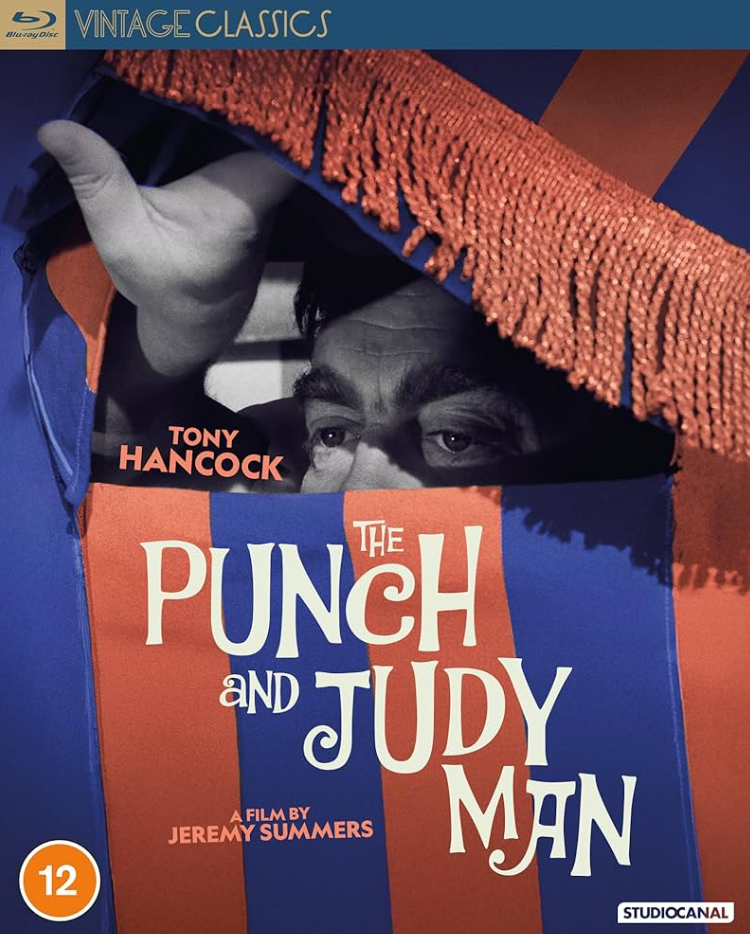
This was Hancock’s first major work without writers Ray Galton and Alan Simpson, and their absence is keenly felt. Whereas The Rebel was a sharp and witty satire, The Punch and Judy Man is much more muted, eschewing big laughs in favor of gentle observation and melancholy. Hancock had long expressed disdain for broad comedy, preferring character-driven humor over catchphrases and slapstick. However, his more subtle approach here results in a film that often feels more wistful than comedic.
One of the film’s biggest challenges is Hancock’s character. In The Rebel, he played an exaggerated version of his TV persona—pompous, self-important, yet perpetually downtrodden. Here, Wally is a quieter, more introspective figure, a working-class artist at odds with the establishment. Hancock is less convincing in this role, and seems less comfortable, and as a result the film feels less assured. The humour is subdued, and while the observational moments are well-judged, the comedic energy is inconsistent.
The film is at its best when it leans into its nostalgic charm. The depiction of seaside entertainment in the 1960s is a wonderful time capsule, and certain scenes capture a quiet beauty. Other times though, the film employs some quite contrived set ups, in particular the films most famous sequence, with the little boy played by Nicholas Webb. This seems like Hancock’s most overt attempt to emulate Jacques Tati, or at least to discard his misanthropic persona and appear more human. In the smaller moments between the two, this comes across nicely – the bit where the two are walking to the bus stop and the boy tentatively holds Wally’s hand is a beautifully judged, sweet little gesture.

However, the famous ice cream sundae sequence, while ambitious, feels self-indulgent and ultimately falls flat. By contrast, a slapstick scene in the pub—where Wally antagonizes a council official by repeatedly popping his head through miniature windows—lands much better, evoking classic silent comedy in a way that suits Hancock’s physicality.
In a supporting cast full of British comedy mainstays like Hugh Lloyd, Mario Fabrizi, John Bird and Hattie Jacques (in a very brief appearance), John Le Mesurier delivers a standout performance as the Sandman, a mild-mannered beach artist who creates intricate sculptures from sand. For my money it’s his best performance outside of Dad’s Army. His deferential, soft-spoken nature contrasts beautifully with Hancock’s more rebellious streak, and he gets a wonderful moment in the film’s climactic food fight.
Despite the film’s stunning black-and-white cinematography, the direction by Jeremy Summers lacks the comic precision of Robert Day’s work on The Rebel. Some scenes have strong comedic premises but suffer in execution, either through awkward framing or sluggish editing. For instance, one moment where Wally sarcastically bows to an applauding crowd—knowing full well they aren’t cheering for him—is diluted by unclear staging, stripping the moment of its full comic potential.

While The Punch and Judy Man was dismissed at the time of release—some unfairly dubbing it “the film Hancock did after sacking his writers that nobody really likes”—it holds more value today. It offers a nostalgic glimpse into a vanishing world of seaside entertainment, while also serving as an unintentional chronicle of Hancock’s own career decline. There’s an undeniable poignancy to its themes of artistic integrity versus social expectation, making it a fascinating, if not entirely successful, piece of British film history.
More a gentle character study than an outright comedy, The Punch and Judy Man is an intriguing but uneven film. It lacks the biting humor of The Rebel, but its wistful, bittersweet tone has an appeal of its own. For fans of Hancock, it’s worth a watch — not just as a film, but as a window into the man himself, caught between artistic ambition and the expectations of the world around him. Grouped together, the two films offer a fascinating insight into Hancock as a star, and as a person.
Special Features
Extras include a new interview with Paul Merton, an excerpt from ABC Series HANCOCK’S; BEHP Audio interview extract with Jeremy Summers, and Blackpool Show: Season 1 Episode 7 (1966)


![Unquiet Guests review – Edited by Dan Coxon [Dead Ink Books]](https://criticalpopcorn.com/wp-content/uploads/2025/10/ug-reddit-ad-e1761690427755.jpg?w=895)

![Martyrs 4K UHD review: Dir. Pascal Laugier [Masters Of Cinema]](https://criticalpopcorn.com/wp-content/uploads/2025/10/image-1-e1761586395456.png?w=895)



![Why I Love… Steve Martin’s Roxanne [1987]](https://criticalpopcorn.com/wp-content/uploads/2016/11/roxanne.jpg?w=460)



 Critical popcorn
Post your thoughts