
Bong Joon Ho’s Mickey 17 is a darkly comic sci-fi thriller that wrestles with themes of identity, mortality, and exploitation. While it carries the DNA of Bong’s previous films—Parasite’s social critique, Snowpiercer’s dystopian class struggle, and Okja’s ethical quandaries—it never quite reaches the incisive, subversive heights of those works. Instead, Mickey 17 is a fascinating yet somewhat scattershot entry in the director’s filmography: engaging, visually stunning, and brimming with strong performances, but ultimately less than the sum of its parts.
Robert Pattinson plays Mickey, a small-time crook on Earth who is roped into a scam by his friend Timo (Steven Yeun) and winds up with a sadistic gangster on his tail. Looking for any kind of escape, the two sign up for an off-world colonization mission to the icy planet Niflheim. There, Mickey is assigned the role of an “Expendable,” a crew member tasked with the most dangerous jobs, and simply reprinted every time he dies thanks to some nebulous cloning technology. While Timo secures a relatively cushy role as a pilot, Mickey is thrown into an existence defined by death and rebirth, his suffering treated with increasing indifference by the crew.
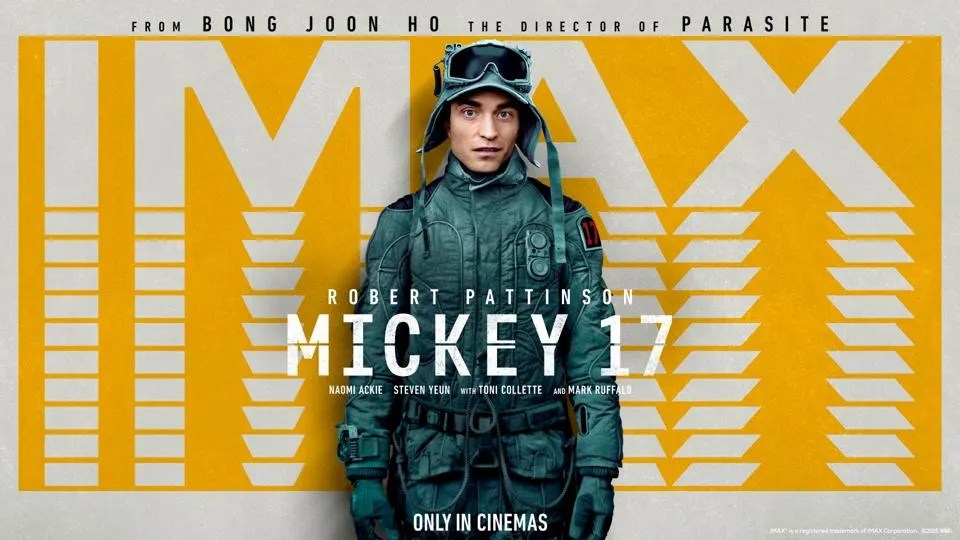
The film’s strongest in the first half, as Bong satirizes the dehumanization of labour and the moral implications of cloning. Each iteration of Mickey is treated with less care than the last, culminating in an apathetic cycle of death and rebirth where even his closest allies barely acknowledge his suffering. He’s introduced in a precarious position, where Timo, his supposed friend, can’t be bothered to rescue him. The ship’s technicians regard him as just another cog in the machine, watching as each new version flops unceremoniously onto the floor. The narrative takes a turn when Mickey 17’s latest death goes awry—he survives, only to find that a new version, Mickey 18, has pre-emptively been printed, something strictly forbidden, that could lead to both Mickey’s being permanently deleted.
Pattinson delivers the best dual performance this side of Dead Ringers, making both versions of Mickey distinct and memorable. His Mickey 17 is meek, self-effacing, and riddled with anxiety, with a nasal whine for a voice, while Mickey 18 is more forceful, full of righteous anger, looking to right the wrongs suffered by his previous iterations. Yet, the film never fully explores why this divergence occurs – perhaps because Mickey 17 never officially “died,” or perhaps due to some flaw in the cloning process. The ambiguity is frustrating rather than thought-provoking, leaving a crucial thematic thread dangling.
The supporting cast is a mixed bag. Naomi Ackie gives a compelling performance as Nasha, Mickey’s love interest, though the writing doesn’t always serve her character well. You get the distinct feeling that she’s likeable primarily for what Ackie brings to the role rather than what’s on the page, and their relationship, while sweet, feels somewhat implausible given the film’s broader themes of isolation and expendability.

Mark Ruffalo plays Kenneth Marshall, the mission’s deranged political leader, in a broad and exaggerated style that feels more like a cartoonish Trump parody than a nuanced antagonist. Bong is no stranger to exaggerated performances, but they work much better in his Korean films – as in The Host, where the funniest moment and the most emotional moment are the same scene. In his Western films they can often lean into caricatures – if the casting is on point this isn’t necessarily an issue (Jake Gyllenhaal and Tilda Swinton completely understood the brief in Okja) but here Ruffalo is just too broad, especially compared to his more nuanced turn as a blustering fool in Poor Things. Toni Colette is more successful as his significantly more calculating but equally ignorant wife, and she gives a performance that is equally comic and chilling. One of the film’s most shocking moments—her casual mutilation of a small alien creature—elicited the biggest gasp in the screening I attended, yet she is ultimately underutilized, her character arc left frustratingly unresolved.
The alien creatures of Niflheim, known as Creepers, are an inventive take on extraterrestrial life, seemingly inspired by tardigrades. Their telepathic connection, which causes harm to one to be felt by all, introduces an intriguing ethical dilemma, but the film’s treatment of this concept is disappointingly surface-level, and the big reveal is glaringly obvious from the very first encounter. The final act’s resolution—reminiscent of Starship Troopers but lacking its satirical bite—feels rushed and overly tidy.

Visually, Mickey 17 is as striking as one would expect from Bong Joon Ho. His signature composition and world-building are impeccable, and the film is frequently beautiful to look at. However, where his past films blended spectacle with thematic depth, this one feels somewhat lacking in ambition. The satire isn’t as sharp as Snowpiercer, nor is the emotional core as strong as Parasite or Okja. It ultimately falls down in the storytelling, which is meandering, with many plot threads simply abandoned. The ending, delivered entirely in voiceover, feels like a narrative shortcut – a literal, overly expository way of conveying information rather than allowing the story to unfold naturally. This is particularly frustrating in the resolution of certain character arcs, as he essentially redeems himself offscreen, robbing the audience of a meaningful moment of transformation or reconciliation.
Despite its flaws, Mickey 17 is not a bad film. It raises questions about identity, and self-worth, but it lacks the precision and ruthlessness of Bong’s best work. While Pattinson’s dual performance is exceptional, and the film contains moments of brilliance, it ultimately doesn’t carry the same weight as Bong’s previous efforts, and often feels a little unfocused.
Perhaps the most telling critique is this: for a film about a man forced to die over and over again, Mickey 17 never quite makes us feel the full weight of his suffering. It’s a gorgeously crafted, entertaining sci-fi tale, but it lacks the subversive edge that made Bong’s past works so unforgettable.


![Unquiet Guests review – Edited by Dan Coxon [Dead Ink Books]](https://criticalpopcorn.com/wp-content/uploads/2025/10/ug-reddit-ad-e1761690427755.jpg?w=895)
![Martyrs 4K UHD review: Dir. Pascal Laugier [Masters Of Cinema]](https://criticalpopcorn.com/wp-content/uploads/2025/10/image-1-e1761586395456.png?w=895)
![Why I Love… Steve Martin’s Roxanne [1987]](https://criticalpopcorn.com/wp-content/uploads/2016/11/roxanne.jpg?w=460)

 Critical popcorn
Post your thoughts