
Athina Rachel Tsangari’s English language debut is a moody, atmospheric, sometimes enthralling, sometimes maddening experience. It’s a film with a potent sense of identity and huge potential, but much of the significant runtime feels like the set-up for a bloody resolution that never happens.
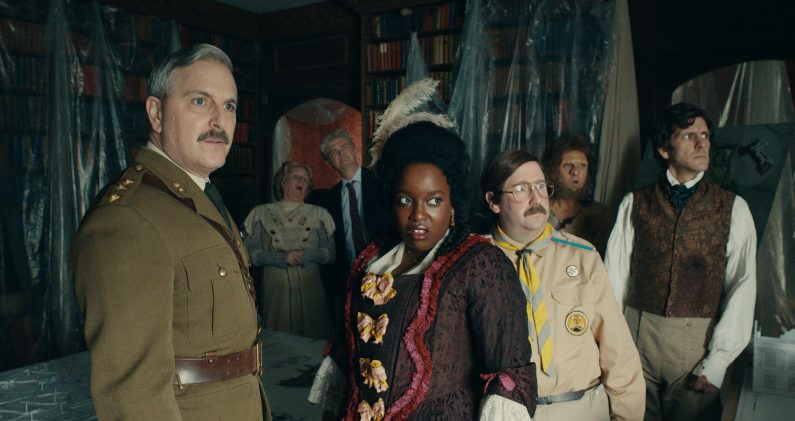
Adapted from Jim Crace’s novel by Tsangari and Joslyn Barnes, Harvest depicts the slow destruction of a secluded English village in the Middle Ages, unraveling over the course of a single week. The film begins with a clear enough premise: the settlement, overseen by Harry Melling’s well-meaning but ineffectual landowner, Master Kent, exists in a delicate balance, affording its inhabitants relative freedom. However, a series of increasingly disturbing crimes disrupts their quiet existence. The arrival of three outsiders provides the villagers with convenient—but wholly innocent—scapegoats, while the presence of Kent’s newly hired cartographer (Arinzé Kene) only further inflames tensions. As paranoia takes hold, Kent’s ruthless landowner cousin (Frank Dillane) arrives, intent on selling the land to the highest bidder. What begins as a small dispute soon spirals into something far darker, as fear, superstition, and greed threaten to consume the village.

Caleb Landry Jones, best known for playing offbeat, unsettling supporting characters, (in the likes of Three Billboards Outside Ebbing Missouri, and Get Out) and takes centre stage here – though his protagonist remains just as enigmatic as his past roles. His presence alone lends the film an eerie, off-kilter energy, but his character feels frustratingly passive. A childhood friend of Kent and married to a villager, in theory, he should serve as a compelling intermediary between the two factions, in practise though, he’s too much of a cypher for this to work. He’s shown to be discerning enough to identify the arsonists and recognise that the strangers are innocent, but chooses not to tell anyone about this. He never takes decisive action, even when the moment demands it, and by the film’s end, he has become a pariah. Yet his downfall feels frustratingly avoidable, not tragic. His internal conflict is hinted at but never fully explored, leaving him an untethered figure within the village – neither a hero nor a cautionary tale, but something more nebulous and, ultimately, less compelling.
There is, however, much to admire in Harvest. It is atmospheric, beautifully shot, and steeped in historical texture. The camerawork by Sean Price Williams is immersive and vital – shot in 4:3 with a grainy, tactile quality that enhances the film’s sense of time and place. One particular uninterrupted take, shot from overhead, is especially striking, and showcases Tsangari’s eye for composition. She captures the village as a world teetering on the edge of change—clinging to archaic traditions even as it faces an inevitable reckoning.

Melling delivers a strong performance as Kent, a man who tries to be kind but is ultimately powerless against the forces of progress. His relationship with the villagers is particularly fascinating: a fragile, uneasy alliance built on mutual benefit but constantly threatened by shifting power dynamics. Dillane, meanwhile, is pitch-perfect as the sneering English lord who arrives to impose brutal order. His sharply dressed, refined demeanor stands in stark contrast to the desperate, rough-hewn townsfolk, and his cold, calculated retribution provides some of the film’s most quietly brutal moments.
The film’s thematic ambitions are clear, particularly in its critique of capitalism as a ruthless, destructive force. The village, at first presented as an idyllic, self-sustaining community, is ultimately powerless in the face of economic and social change. Yet Tsangari takes care to highlight the darker undercurrents of this supposedly harmonious society—the immediate scapegoating of the outsiders and the racial undertones in the treatment of Kene’s cartographer expose the villagers’ insular, prejudiced worldview. The film does not romanticize the past so much as mourn its passing, even as it acknowledges its inherent flaws.

However, all this is hampered by its pacing. While Tsangari’s direction is visually stunning, with sprawling long shots that evoke a strong sense of place, the narrative lacks enough momentum to sustain its extended runtime. It never fully commits to being either a slow-burn thriller or an introspective character study, and the ending – more ambiguous than conclusive – offers little in the way of catharsis. Tsangari clearly intends Harvest as a kind of parable, but without a stronger emotional throughline or a compelling resolution, it risks feeling unsatisfying rather than thought-provoking.
Harvest begins with immense promise but loses momentum as it unfolds. There is much to appreciate—its rich atmosphere, compelling supporting performances, and underlying themes of change and destruction – but is weighed down by a frustratingly inert protagonist and a reluctance to fully explore its most intriguing ideas.







Leave a Reply