Following in the footsteps of Civil War, Alex Garland returns – this time in collaboration with Iraq War veteran Ray Mendoza – with Warfare, a blisteringly intense and technically immaculate war film rooted in the real-life experiences of Mendoza himself. Told in real time and set during the fallout from the 2006 Battle of Ramadi, Warfare is as immersive and gripping as war cinema gets—but whether it has anything to say about war is another matter entirely.
From the outset, the film draws you in with a deceptive sense of calm. A unit of young, fresh-faced Navy SEALS set up for a mission in a small Iraqi town. Things quickly go sideways when their position is compromised, and the remainder of the film unfolds entirely within the confines of this small house – an almost unbearably tense standoff, punctuated by sudden, harrowing bursts of violence.

From a technical perspective, A24’s Warfare is masterful. The sparse, minimal script perfectly captures the tedium of waiting for something to happen, the long, dull stretches of surveillance and waiting. And yet the film is never boring itself – the pacing is deliberate, the real-time narrative device adding an urgency to every request for back up. When the soldiers are told “two minutes” it feels like an eternity. The script also potently demonstrates just how rapidly volatile situations like this can escalate, and the deliberate pacing means that when the action finally bursts onto the screen, it’s as jarring and as shocking as a jump scare.
This is helped immeasurably by the incredible sound design, which makes seeing the film in IMAX feel almost essential. Gunshots are suitably loud, and explosions reverberate with stomach-churning realism, but it’s the aftermath of these moments – ringing ears, ragged breathing, shell-shocked stares – that truly stick with you.
The performances are uniformly strong, if the characters are underwritten. Each of the actors have the procedural stuff down pat, and handle their weapons and movements like a well-oiled machine. In the interview we attended ahead of this screening, Garland described his actors as “technicians” essentially facilitating the story that Mendoza is telling – and this rings true – on a technical level the actors bring a real authenticity to every scene, and every stunned reaction in the wake of the devastating violence wreaked upon them. But therein lies one of the film’s greatest weaknesses: we are shown procedure over personality. The cast play the situation perfectly, but there is next to no characterisation.
Any sense of personality comes more from the actors’ natural charisma than from the writing itself. There are little moments that feel drawn directly from the real events, and it’s these that stick in the memory, and give the film its personality – the interplay between Elliott and Ray, the muttered “Weak” when another soldier misses his opportunity to take the shot, and one character having a brief break from his screams of agony to incredulously ask “What the f*** is Frank doing?”
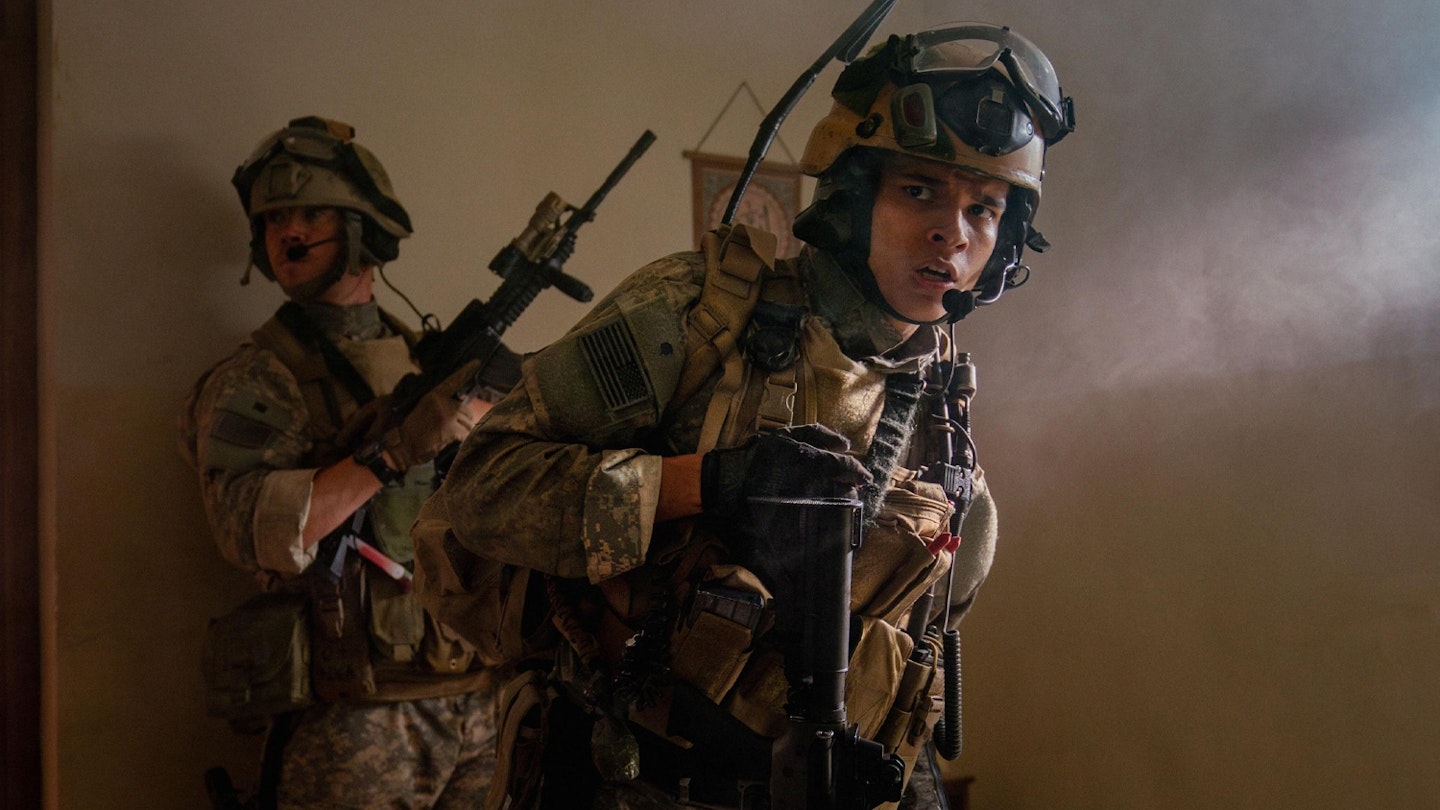
Most affecting of all is maybe Will Poulter’s portrayal of shell shock in the wake of the initial explosion. There are no hysterics, no breakdown, he’s just ever so slightly, off, until he finally admits that he can’t lead the platoon anymore. These slight moments humanise the characters more than grandstanding speeches ever could.
The unit is filled with up-and-coming actors, all of whom make a stamp on their roles despite the absence of any kind of exposition or background to their characters. With minimal dialogue we get a vivid idea of just who these guys are, from the laidback petty officer (Joseph Quinn) to the red-faced newbie (Kit Connor). D’Pharaoh Woon-A-Tai gives a low-key but quietly commanding turn as Mendoza himself – the closest the film comes to a protagonist. He doesn’t have a huge amount of dialogue but conveys an awful lot with just a look. Similarly, Cosmo Jarvis broods effectively as a laconic sniper, giving a taciturn turn that’s almost Tom Hardy-like.
Of course, a byproduct of setting the entire film in one location, and basing it on one persons experience, is that the perspective is necessarily limited. The film doesn’t glamourize combat, but neither does it contextualize it. We never learn exactly what the soldiers’ mission is, and the only Iraqi characters we meet are the occupants of the house who are seen as more of a hindrance than anything (despite it being, you know, *their* house that’s been decimated) and the translators seconded to the unit, who are depicted as cowardly if not overtly untrustworthy. The enemy is an unseen, amorphous threat, while the soldiers are uniformly heroic, patient, and reasonable – traits that feel a little at odds with the brutal reality of occupation.

There’s a temptation to excuse all this by pointing to the film’s grounding in Mendoza’s personal experience. After all, it’s his perspective, told with visceral authenticity and a real sense of verité, and besides, the goal isn’t political commentary but immersion. “Ours not to reason why” you might say, and fair enough I suppose. But immersion without context has its own implications. A film that invites us to spend nearly two hours embedded with U.S. troops in Iraq can’t help but be political—whether it wants to be or not. By excluding broader context, Warfare ends up reinforcing a familiar narrative: noble Americans saving the day from faceless enemies.
This dissonance becomes especially glaring in the film’s final moments, with a flag-waving tribute to “those who answer the call” that feels like tonal whiplash. After ninety minutes of visceral chaos and confusion, this sudden injection of patriotism rings hollow at best. None of this is to say the film should have necessarily taken a clear political stance. But the refusal to engage with the broader consequences of U.S. presence in Iraq – beyond the immediate danger to the soldiers – feels like a missed opportunity.
It might lack the introspection and wider context that would mark it as a truly important piece of cinema, but Warfare remains a immersive, often harrowing powder keg of a film. The real-time structure and astonishing sound design draws you inexorably into the chaos of war with unwavering intensity, never letting up until the credits roll. It has significant problems but it offers a nerve-shredding window into a particularly volatile period, and cinematically at least, it’s a real accomplishment.


![Unquiet Guests review – Edited by Dan Coxon [Dead Ink Books]](https://criticalpopcorn.com/wp-content/uploads/2025/10/ug-reddit-ad-e1761690427755.jpg?w=895)
![Martyrs 4K UHD review: Dir. Pascal Laugier [Masters Of Cinema]](https://criticalpopcorn.com/wp-content/uploads/2025/10/image-1-e1761586395456.png?w=895)
![Why I Love… Steve Martin’s Roxanne [1987]](https://criticalpopcorn.com/wp-content/uploads/2016/11/roxanne.jpg?w=460)

 Critical popcorn
Post your thoughts