
As we race towards next week’s season finale, it’s interesting to reflect on this season of Doctor Who as a whole. The Story & the Engine is definitely a favourite from this run, while The Well is a nice horror piece that works much better than it arguably should (given its sequel status). The season opened with The Robot Revolution and Lux: two fun adventures that felt a bit too familiar to really stand out. And while neither Lucky Day nor The Interstellar Song Contest were bad, the former was very messy and the latter quite tonally jarring throughout. There’s been a stronger overarching narrative to Season 2 than there was in Season 1 — even if the hook of getting Belinda home hasn’t had a satisfying pay-off so far — although last year’s series had such a strong run of episodes from The Devil’s Chord through to Rogue that hasn’t been repeated here. There’s a lot riding on this season finale, as much as anything because these may be the last Doctor Who episodes we get for a while. Will showrunner Russell T Davies give us a fantastic season finale, or will we be left wishing for a better reality?
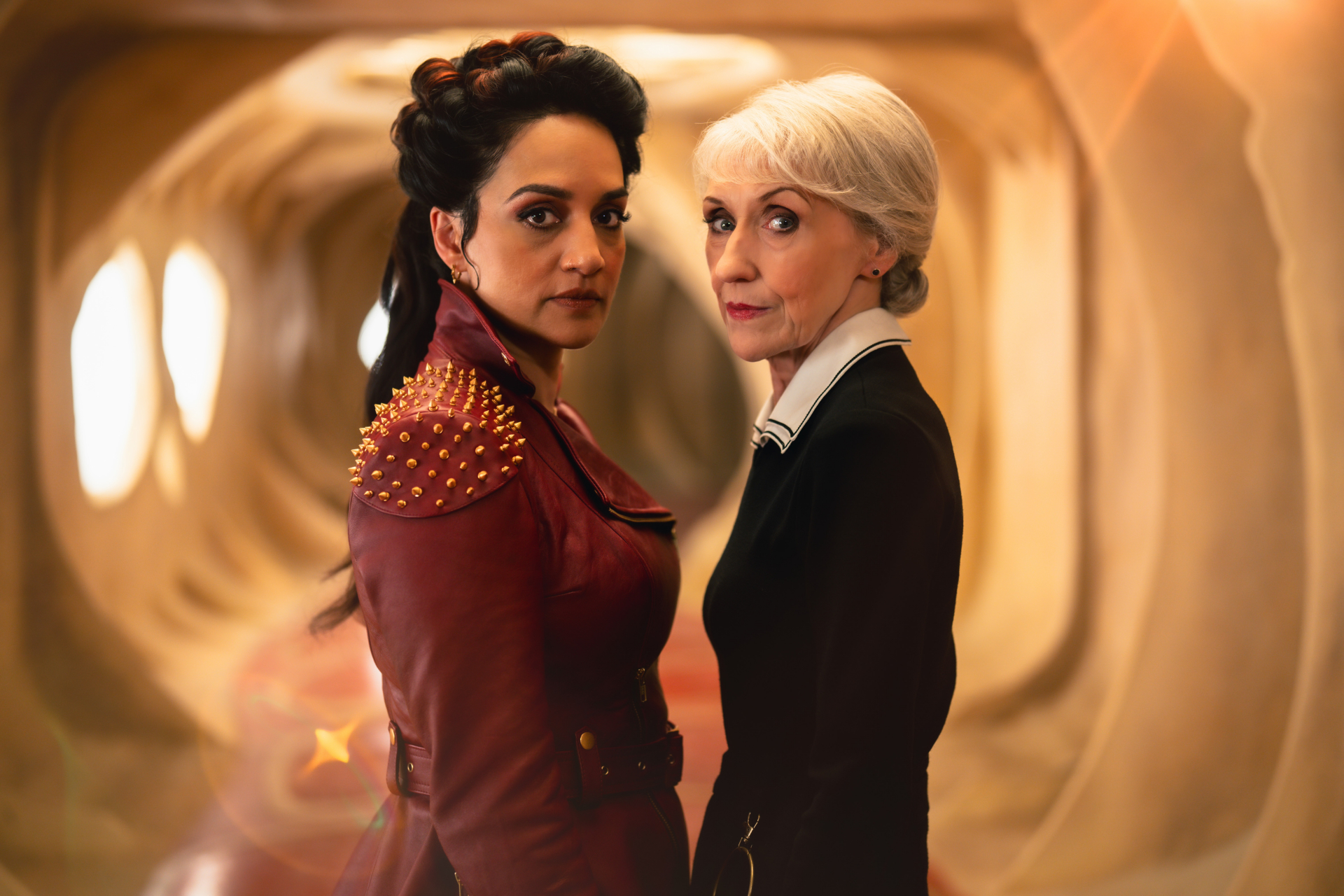
The twist reveal at the end of The Interstellar Song Contest was, of course, that Anita Dobson’s Mrs Flood was in fact the Rani (a 1980s Doctor Who villain originally played by Kate O’Mara), and bi-generated into Archie Panjabi as another incarnation of the Rani. It’s the sort of mad, twist-upon-a-twist that Russell T Davies loves, intended to get a big reaction from the audience, but what’s perhaps most surprising is the way Davies handled it. In his original stint on Doctor Who, Davies would bring back a variety of memorable villains from the series’ 20th century run and contextualise them for a new generation. When we first see a glimpse of a Cyberman in Dalek, it’s simply an old enemy of the Doctor’s from adventures in his mysterious history. It’s used as a character beat: the Doctor seeing his past confined to a museum (perhaps a metaphor for where the series was at in 2005). When the Dalek is unveiled in that same episode, the emphasis is on the Doctor’s sheer terror – again, focusing on character rather than simply fan service. When the Rani is revealed in The Interstellar Song Contest, it’s to two supporting characters with no clue what’s going on who will never appear again, resulting in the big reveal coming across simply as shallow fan service. Watching Wish World, it’s difficult not to wonder if Davies could have teased out the reveal of the Rani into this episode, saving it for her confrontation with the Doctor so that we can at least get a response from our main character to inform how an audience of non-fans (or simply those who don’t know about the Rani) should feel at this point.
Archie Panjabi is a strong choice for the new Rani, striding across the sets in a not entirely dissimilar way to Kate O’Mara whilst ensuring that the performance remains her own. The way Davies writes the character, however, feels like a caricature – an attempt to make the Rani more like the Master, turning her into a season ‘big bad’ in a way that feels at odds with the character from the ‘80s. Anita Dobson is relegated to a side-kick role in Wish World, and while this seems to be a set-up for something in next week’s season finale, it’s a shame to see her sidelined given how much her role has been built up since The Church on Ruby Road. The constant reminders of the bi-generation also raise a number of questions as to where David Tennant’s Fourteenth Doctor is during the events of this particular adventure, and whether two Doctors are needed to defeat two Ranis – but wouldn’t that overshadow our main Doctor?

Wish World ultimately feels like a collection of ideas without much of a driving focus. The eponymous wish world feels limited with so few locations to work with, the giant skeletal figures are a visual without any plot justification, there are a few fascist elements at play that feel half-baked and before any of it can be explored fully, it’s cliffhanger time and everything needs to be destroyed. The Doctor’s memory has been wiped (somehow), but his John Smith persona never feels fully developed (at least not compared with his similar alter ego in Human Nature), even if Ncuti Gatwa is giving every line a lot of emotional weight. Wish World boasts a huge ensemble cast but no one has anything to do. Varada Sethu and Millie Gibson work wonders with their limited roles, potentially setting up some strong character work next week but falling short in this specific instalment. Jonah Hauer-King is restricted to a less slimy, more benevolent villain role, Ruth Madeley has some nice moments, but Bonnie Langford, Susan Twist, Alexander Devrient and Jemma Redgrave have next to nothing to do. Given that last year’s season finale featured a huge cast who stood around, got killed and then resurrected at the end, it’s difficult not to wonder if we’re in a similar situation here, especially with the returns of Jonathan Groff’s Rogue and Carole Ann Ford’s Susan being teased here.
As it is, Wish World is the first instalment in a two-part season finale, and as such features a lot of set-up and virtually no pay-off. There are some promising ideas littered throughout, and the end reveal of Omega’s imminent return is sure to excite hardcore Doctor Who fans, but The Reality War has a real uphill battle if it wants to resolve all these plot-threads in a satisfying and coherent way.


![Unquiet Guests review – Edited by Dan Coxon [Dead Ink Books]](https://criticalpopcorn.com/wp-content/uploads/2025/10/ug-reddit-ad-e1761690427755.jpg?w=895)
![Martyrs 4K UHD review: Dir. Pascal Laugier [Masters Of Cinema]](https://criticalpopcorn.com/wp-content/uploads/2025/10/image-1-e1761586395456.png?w=895)

![Why I Love… Steve Martin’s Roxanne [1987]](https://criticalpopcorn.com/wp-content/uploads/2016/11/roxanne.jpg?w=460)


 Critical popcorn
Post your thoughts