
Adapted from the real-life 2018 nature memoir by Raynor Winn, with the screenplay by Rebecca Lenkiewicz, The Salt Path takes us along on the journey of Raynor (played by Gillian Anderson) and her husband, Moth (Jason Isaacs), who decide to walk the 630 miles of the South West Coast Path, from Minehead in Somerset to Poole in Dorset, as their only resort after they lose their home. While that distress is certainly a catalyst for the idea, it’s also fuelled by the reality that Moth has been diagnosed with a rare terminal illness called corticobasal degeneration, which is similar to Parkinson’s, and isn’t sure how long he’s got left to live.
With a shared trauma in place, that of being homeless and in fear of the final years of Moth’s life, this impulsive decision seems apt with the hope that time will give them the space to work out what to do next, beyond the miles ahead, because they’ve literally got nowhere else to go. Although, it’s not entirely clear how they’ve lost their home, with only a brief mention of a bad investment and a court case, so it lingers around ambiguous on whether this was Moth’s fault, or if something else occurred. While on the balance of the journey, I see why it’s quickly introduced, but this skipping over initial character initiations then took me longer to connect with the lead pair, as I didn’t know their truths.

From here, we join them with their heavy rucksacks at the start of the trek, plus Moth with a limp and visibly in pain related to his diagnosis. As they begin their walk along the SWCP, it’s clear they’re a little underprepared with not only what they’ve taken – although they do have a basic tents, sleeping bags, cooking implements and instant noodles – but also a lack of awareness of where is best to pitch their tent – a theme that’s repeated throughout The Salt Path. Depending on your knowledge of wild camping, this frustrate you because they don’t seem to learn from mile 30 to 430 that camping in open spaces, near a cliff, or too near the sea, isn’t ideal if you’re after decent shelter and a safe sleep. While this might play into dramatic effect, my own awareness – from growing up in Devon – meant this was slightly diverting, but I can let that go.
However, I also considered that The Salt Path isn’t necessarily about sensible choices, especially in the beginning, as they’re both in a desperate situation and unexpectedly forced towards just the essentials for survival, while being thrown into a world they never even considered. While I was a little mystified over their lack of outdoor knowledge, considering they lived in a farm, the story beyond focuses on re-learning what you thought you knew, reinventing yourself in the toughest of situations and rediscovering that you might be a different person to the one you thought you’d originally created. And in a positive sense.
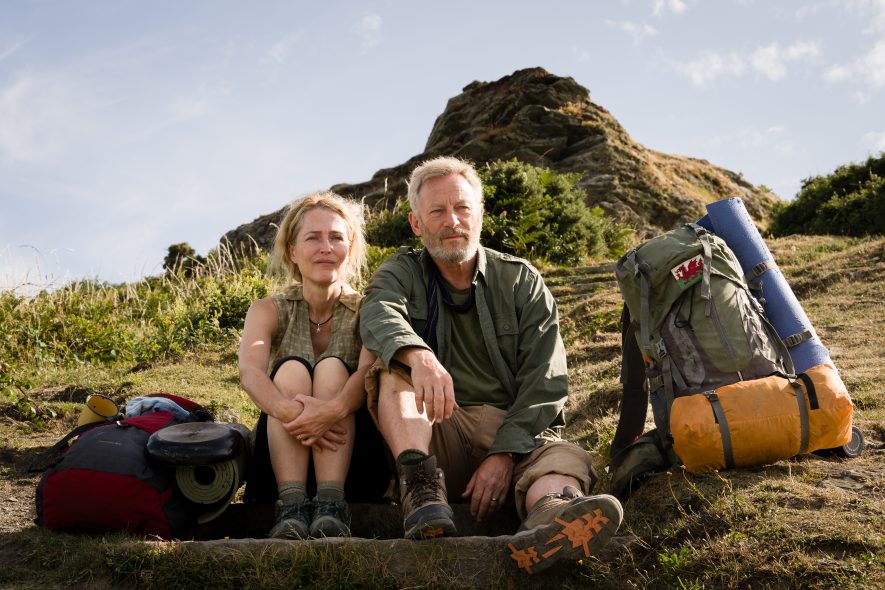
Gillian Anderson and Jason Isaacs offer convincing performances, as you would expect, to their characters, they feel real enough to go through it with them. While we’ll sleep, wake up and walk through multiple weather situations with them, director Marianne Elliott (this her feature debut) consistently endeavours to balance out the dark with the light, and a few comic moments are present – mostly from Moth. Stand out scenes include people mistaking him for poet laureate Simon Armitage – a joke that could be implemented more – and watching him take advantage when they’re incredibly low on funds, through to a posh house with James Lance’s Grant and maybe an entourage of ladies? We’ll never know! While The Salt Path also touches on the difficulty of getting government help, homelessness and being pushed out of the system, there’s also a brief British version of the stirring Nomadland highlighting the same issues for everyday people. These are fleeting but with a life to cover that’s so vast, you can appreciate it’s difficult to dedicate too much time to everything but it never gets into the real grittiness, like The Old Oak or I, Daniel Blake.
Shot in an earthy, emotive method by cinematographer Hélène Louvart that doesn’t conceal the brutality and beauty of the South-West, actively embracing the reality in-between the storm of life and the sunshine and freedom of the coast in equal measure, The Salt Path essentially highlights the truth that we don’t always make the right decisions, even with the best intentions, but whatever is thrown at us, most will fight to endure, in both a physical and psychological sense, and while the journey is rough, there’s the occasional break in the clouds to offer exquisiteness beyond the wilderness. With strong lead performances from Anderson and Isaacs, this is a modest tale, told in that fashion, and while I did occasionally feel like I didn’t quite know their deeper essence, I certainly see this finding its desired audience – in an affirming sense.






![Unquiet Guests review – Edited by Dan Coxon [Dead Ink Books]](https://criticalpopcorn.com/wp-content/uploads/2025/10/ug-reddit-ad-e1761690427755.jpg?w=895)
![Martyrs 4K UHD review: Dir. Pascal Laugier [Masters Of Cinema]](https://criticalpopcorn.com/wp-content/uploads/2025/10/image-1-e1761586395456.png?w=895)




![Why I Love… Steve Martin’s Roxanne [1987]](https://criticalpopcorn.com/wp-content/uploads/2016/11/roxanne.jpg?w=460)



 Critical popcorn
Post your thoughts