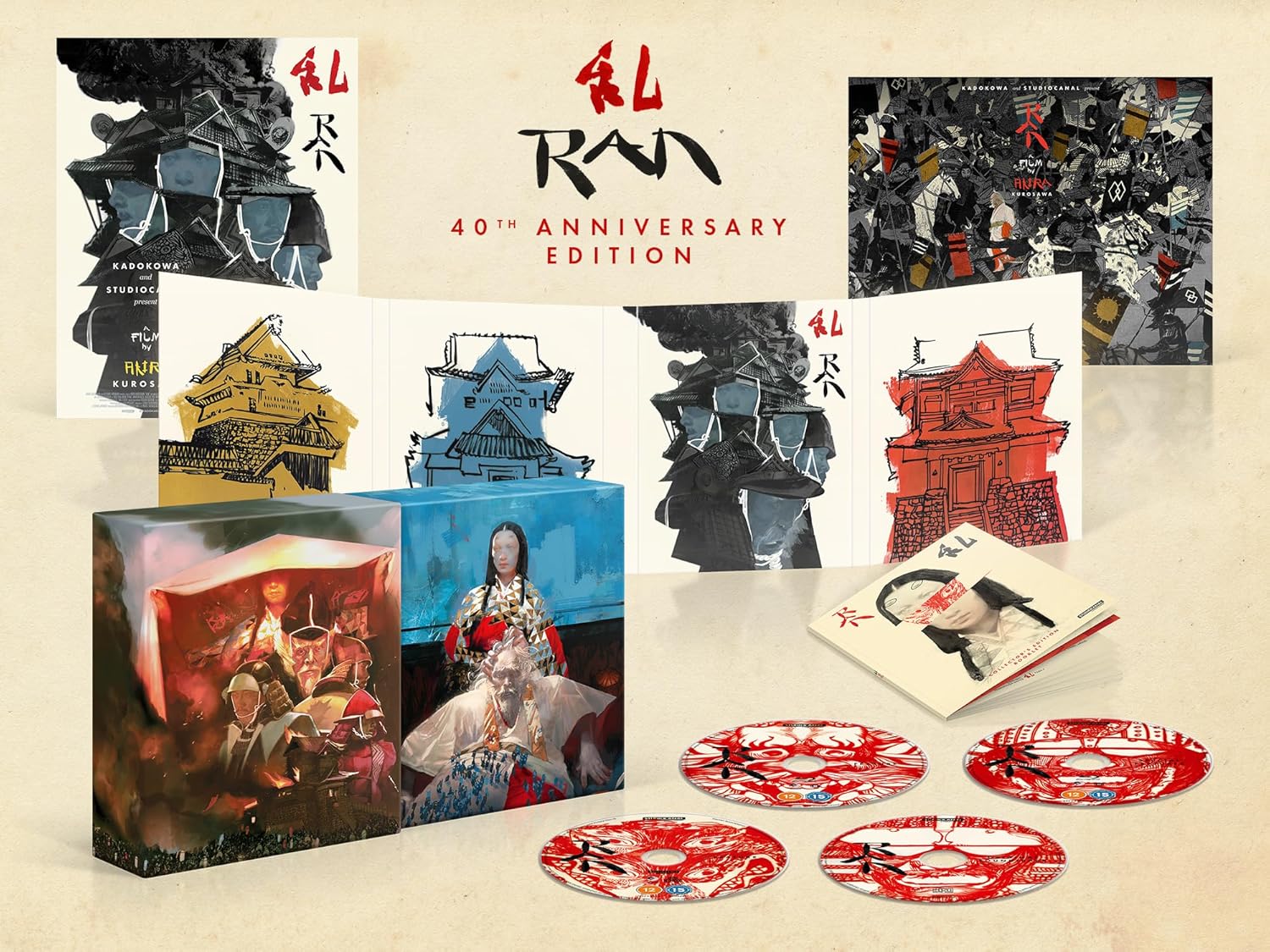
The epic to end all epics, Ran celebrates it’s 40th anniversary this year, and to mark the occasion Studiocanal have released a lush double disc edition of Akira Kurosawa’s sprawling Shakespearean masterpiece. It’s a film that is not only the greatest cinematic interpretation of King Lear, but also one of the most startling, viscerally cinematic experiences in world cinema.
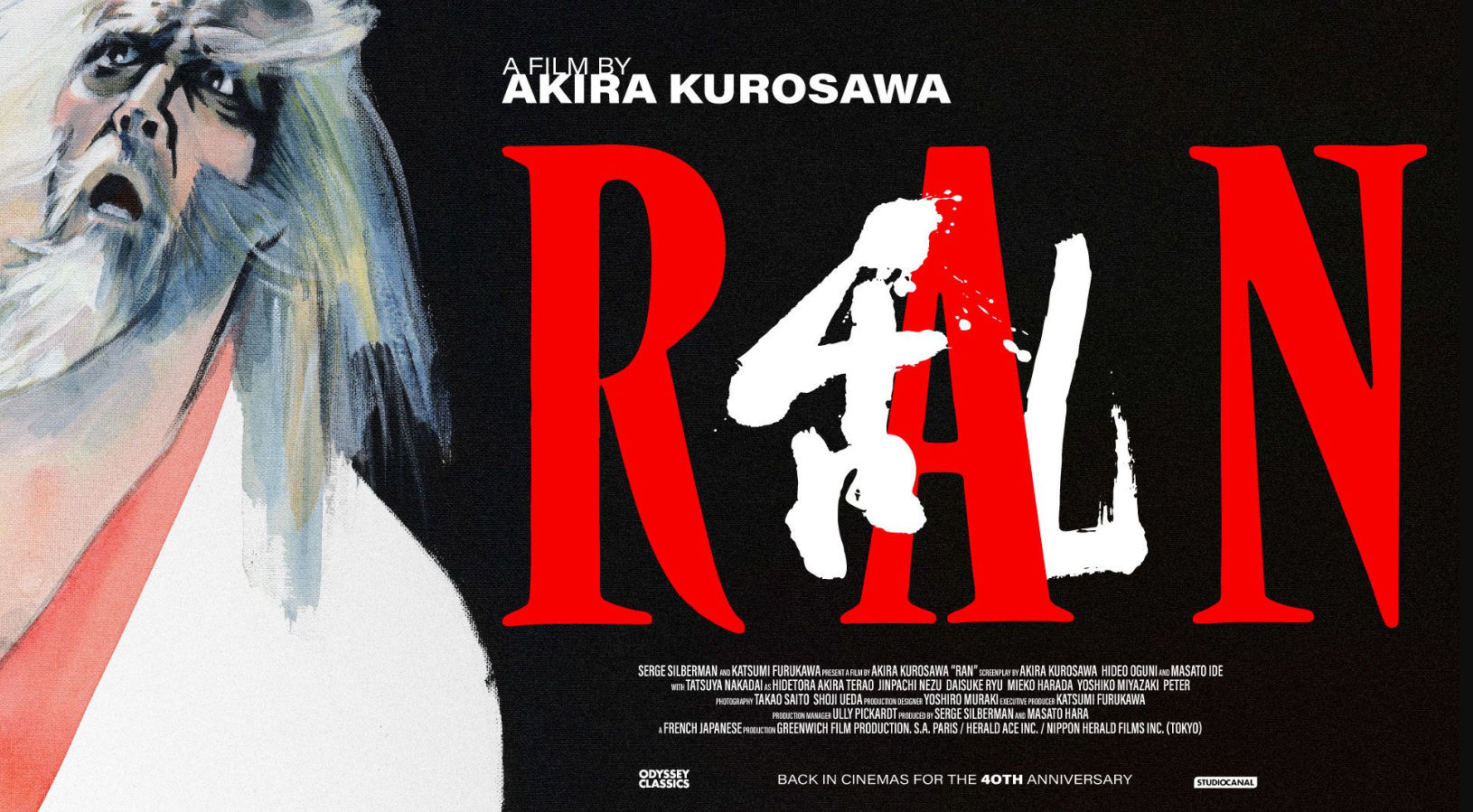
As with Throne Of Blood (Macbeth) and The Bad Sleep Well (Hamlet), this isn’t exactly a faithful Shakespeare adaptation – indeed, according to Kurosawa himself, he didn’t even intend the story to be King Lear until a fair way into pre-production. In any case Kurosawa just takes the elements that suit his narrative and discards a lot of the minor details. Here, Lear is now the Lord Hidetora (Tatsuya Nakadi), and rather than three daughters he has three sons; the imperious Taro (Akira Terao), the passive, opportunistic Jiro (Jinpachi Nezu), and the principled Saburo (Daisuke Ryu).
As with Lear though, Hidetora’s descent comes from his rigid sense of pride, leading him to hand his kingdom over to Taro and banish Saburo for his plain honesty. Rewarding sycophancy and blinding himself to harsh truths. Cast out and abandoned by his two eldest sons, he roams a barren landscape with only his Fool (played by the curiously named Peter) and the resolutely loyal warrior Tango (Masayuki Yui). Also in the mix is Taro’s calculating wife, Lady Kaeda (Mieko Hareda) – this film’s version of the villainous Edmund – who seeks revenge for the devastation Hidetora wrought on her own family years earlier, aligning herself with whoever can bring her retribution quickest.
I love this film. It’s not my favourite Kurosawa (that would be either Ikiru or Seven Samurai) but it’s his most ambitious, and the result is awe-inspiring. he was a master of both the epic and the intimate, but usually he could combine the two successfully. Here his focus is very much on the spectacle, with widescreen compositions that are breathtaking in scale. Kurosawa’s eyesight was deteriorating at this point, and he relied on vibrantly painted storyboards to help visualise the film, resulting in the now iconic bright colour palette. This necessity led to the director’s most visually striking film, with each shot feeling deliberate and considered in it’s composition. Take the use of vibrant primary colours (red, yellow, blue) representing each of Hidetora’s sons – Kurosawa needed this so he could keep track of the three armies, but a byproduct of this was that each of the sons was given a distinct visual identity, and there is a clarity to the battle scenes.
Kurosawa shoots almost the entire film almost exclusively in long shots – with characters often appear dwarfed by the vast natural world or crumbling architecture, seemingly demonstrating the ultimate futility of human ambition against time and fate.

Tatsuya Nakadai’s performance has been divisive, with many unfairly saying that he is essentially playing Toshiro Mifune playing Lear. I think this is unfair though – Nakadi brings his own distinct persona to the role, making him a lot more fragile and sensitive than I think Mifune would have done. Mifune would have excelled in the early scenes where Hidetora needs to seem powerful and authoritative, but I don’t know if his rapidly deteriorating mental state would have been as plausible. Nakadi’s perfomance, theatrical as it is, conveys a man not just broken by betrayal, but undone by the realization of his own past cruelties.
Lady Kaede is perhaps the most complex female character Kurosawa ever wrote, and played brilliantly by Mieko Harada, who exudes a cold fury in every scene. She is a poisonous creature, fuelled entirely by vengeance, and her scenes with the men she wraps around her finger are beautifully judged, frequently overshadowing the various men she interacts with.
Jinpachi Nezu, so great as the corrupt cop in Gonin , is excellent as the weak-willed, opportunistic Jiro. Watching with a critical eye today, the choice to film him increasingly from behind, or with his features obscured as the film goes on is a canny one – he becomes less and less relevant with each scene, essentially fading into the background as events overwhelm and destroy him. Tellingly, he doesn’t even get the dignity of a death scene.
Equallly impressive are the subordinate characters, who get the most vivid characterisation – Peter’s performance as Hidetora’s loyal fool is both jarring and touching in his sardonic devotion to his master, as is Tango for his down-to-earth loyalty. On the opposing side is Hisashi Agawa as the blunt general Kurogane, who both eggs on Jiro and is the only voice of reason in his camp – he’s not a nice guy, but an honourable one, and it’s a nice bit of shading on what could easily have been a stock henchman role.
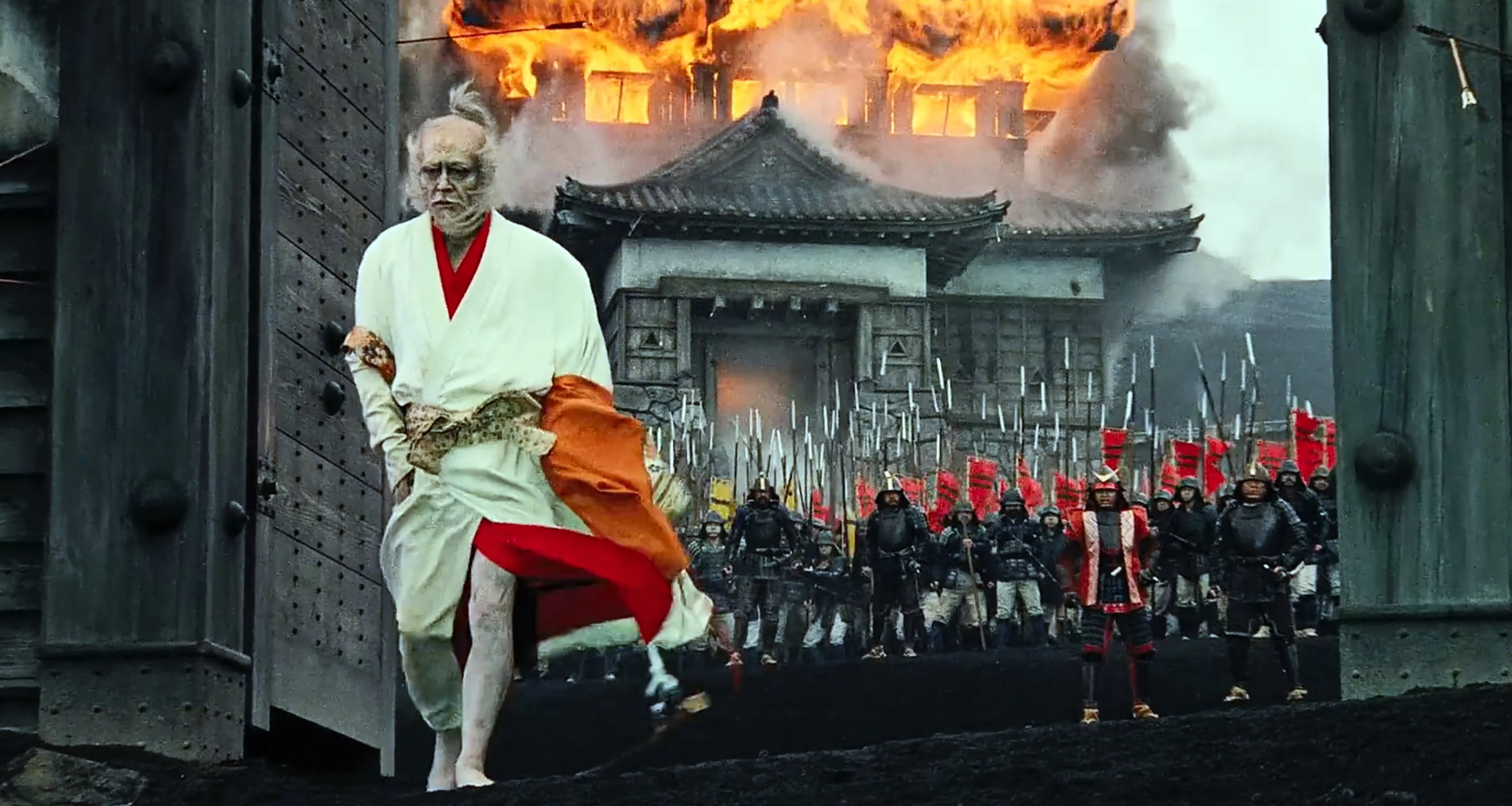
Perhaps most importantly, when compared to recent films in the genre, like 13 Assassins or Zatoichi, the action still stands up. The battle sequences in Ran remain among the most devastating ever filmed, calling to mind Orson Welles’ celebrated battle scenes in Chimes At Midnight. The attack on Hidetora’s castle is chaotic and suitably horrific, as limbs are hacked off and his men are massacred with arrows and swords alike. Kurosawa deploys his mastery of sound in this sequence too, utilizing an evocative, moving score for most of the action, until bringing us back to reality with a jolt as a key character is taken out with a jarring gunshot.
Ran wasn’t Kurosawa’s last film, but it was his last masterpiece. It distills a lifetime of cinematic mastery into a tragedy told on an operatic scale. It’s a timeless, sometimes nihilistic and unrelentingly beautiful meditation on ageing, loyalty, and the cyclical nature of violence. This new edition offers the perfect excuse to revisit – or discover – an elegiac mixture of beauty and brutality from one of cinema’s great visionaries.
Special Features
Since the print is the same as previous StudioCanal release of the film, the real treat of this release lies in the extras, which are incredible A.K. documentary – an intimate behind the scenes look at Kurosawa’s polite yet direct directorial style, and offering some memorable visuals of the fully costumed extras plodding past the crews cars. Curiously the rest of the features all have French credits and titles – presumably due to the French money that went into the original production. The remaining features include multiple featurettes on Kurosawa and Samurai films, along with interviews with the DOP Shoji Ueda, and actress Mieko Harada.


![Unquiet Guests review – Edited by Dan Coxon [Dead Ink Books]](https://criticalpopcorn.com/wp-content/uploads/2025/10/ug-reddit-ad-e1761690427755.jpg?w=895)
![Martyrs 4K UHD review: Dir. Pascal Laugier [Masters Of Cinema]](https://criticalpopcorn.com/wp-content/uploads/2025/10/image-1-e1761586395456.png?w=895)
![Why I Love… Steve Martin’s Roxanne [1987]](https://criticalpopcorn.com/wp-content/uploads/2016/11/roxanne.jpg?w=460)


 Critical popcorn
Post your thoughts