How do you examine great literature and compelling writing through a medium as visual as film? By dealing with the writers and the egos that drive them, and then seeing how far that hubris will drive them. Alice Troughton takes Alex MacKeith’s words and a set of well-delivered performances, with a typically magnetic contribution from Richard E. Grant, to examine the fragile nature of greatness in The Lesson.

Fittingly (or predictably, depending on your viewpoint), a film contemplating writing makes very clear that it’s adhering to the classic three act structure, with chapter cards indicating such. There’s a brief prologue and epilogue, and it’s in the former that we meet Liam (Daryl McCormack, his Irish brogue offering an air of relaxed confidence), attending a Q & A session about his debut novel. When asked how he came to this point, we flash back to his arrival at role as a live-in tutor. Bertie (Stephen McMillan) is facing the challenge of Oxford entrance exams, so his mother Hélène (Julie Delpy) recruits Liam to assist with his final preparations. Liam also has an ulterior motive for accepting the role, as his literary hero J.M. Sinclair (Grant) is also Bertie’s father.
Sinclair is dealing with writer’s block, which seems to have been in place since the suicide of Bertie’s elder sibling. Liam is desperate to gain Sinclair’s feedback and approval on his own work but finds the patriarch cold and unapproachable. Fractious exchanges over the dinner table about classical music don’t help, and Bertie resents rather than welcomes Liam’s interventions. But Liam is desperate to find a way to achieve his goals and puts together his own, near-photographic memory with some notetaking via a brainstorm of Post-It notes to try to piece together a successful strategy to ingratiate himself with Sinclair. His efforts may even be misplaced in attempting to craft something original, for as Sinclair tells him, “Great writers steal.”

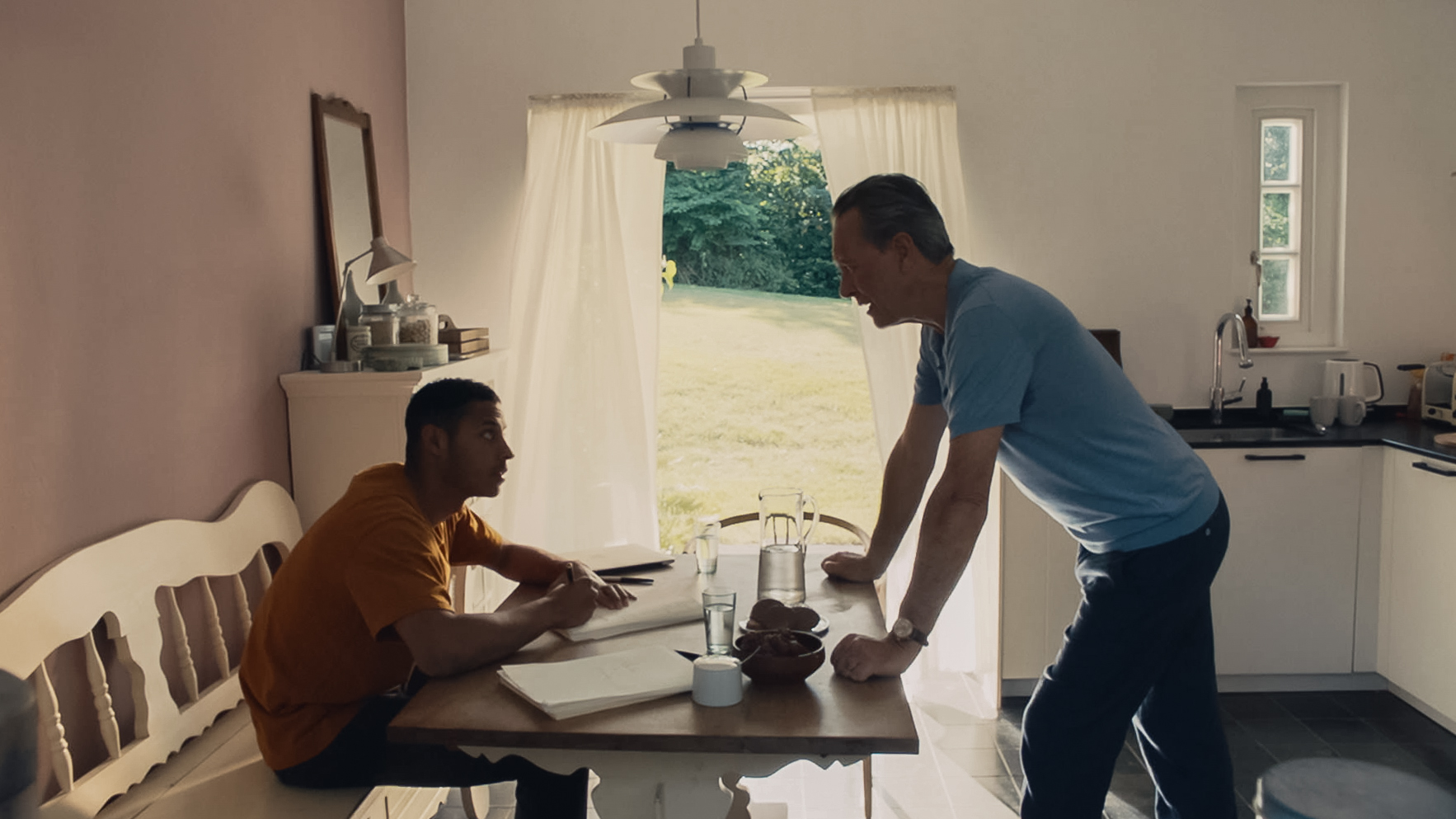
Apart from the occasional, generally terse interventions of the family butler (Crispin Letts), it’s a four-hander and MacKeith is keen to explore the dynamics between each of the possible pairings in that foursome. It helps that he’s loaded each of them with ulterior motives, some more immediately apparent and others less initially transparent, their respective agendas gradually being laid bare as their standoffs become increasingly abrasive.
Liam is the story’s centre, our eyes, and ears into this aloof, austere world that’s a melting pot of resentment and bitterness even before his arrival. McCormack has an easy charm that suggests a slight naivety on Liam’s part, but while he might not know his Rachmaninoff from his Beethoven, any gaps in his cultural education serve only to cause the others’ guards to drop. Hélène is the greatest mystery, her pragmatism for her son and her own career played no-nonsense by Julie Delpy, even as she then begins to elicit a reaction from Liam while he observes her and Sinclair from his bedroom window.
The star player here, and for far from the first time in his career, is Richard E. Grant. The role of Sinclair plays to all of his strengths: publicly, the famed writer is smug and superior, commanding the attention of the whole room even as he dismisses his own achievements. Privately he’s a recluse and a curmudgeon, holed up in his study with his hopes of finishing his novel and a few more secrets. Gradually, Liam chips away at his hero, giving Grant the opportunity to turn weaselly and dismissive of his young charge even as he seeks his help. It’s Grant’s gift to be simultaneously charismatic and repugnant, and he’s the magnetic presence at the heart of the film.

The other key relationship is that between Grant and Delpy, and it has the air of classic noir, even though Troughton shoots the vast majority of the film in stark daylight (Hamburg locations doubling for rural Oxfordshire, with DOP Anna Patarakina). But she does keep a simmering tension at all times, even as some slightly more ludicrous plot developments unfold. (Liam has a photographic memory? Sure. However, when he discovers a mysterious server running in a room next to Sinclair’s office, he doesn’t want to investigate immediately?)
Liam tells Sinclair at one point that his novel, as good as it is, has a weak final third that feels slightly forced. MacKeith’s script also descends into melodrama as we enter the third act, but the meta commentary on his own, self-imposed, and strictly signposted structure means it can’t be anything other than a conscious choice, with the hubris of each of the characters requiring a dramatic resolution. Isobel Waller-Bridge’s spiky score makes sure those nerves stay on edge throughout and, if you’re willing to forgive that on the nose structural commentary then what Troughton and MacKeith have served up is a delicious, claustrophobic slow-burn thriller with a performance from Grant worth the price of admission on its own.




![Unquiet Guests review – Edited by Dan Coxon [Dead Ink Books]](https://criticalpopcorn.com/wp-content/uploads/2025/10/ug-reddit-ad-e1761690427755.jpg?w=895)

![Martyrs 4K UHD review: Dir. Pascal Laugier [Masters Of Cinema]](https://criticalpopcorn.com/wp-content/uploads/2025/10/image-1-e1761586395456.png?w=895)

![Why I Love… Steve Martin’s Roxanne [1987]](https://criticalpopcorn.com/wp-content/uploads/2016/11/roxanne.jpg?w=460)


 Critical popcorn
Post your thoughts