
Wes Anderson’s latest film, Asteroid City, is perhaps his most ambitious film, and certainly most experimental. Taking the fourth wall breaking framing structure he established in The Grand Budapest Hotel and The French Dispatch and running with it, here his approach is positively Brechtian.
Narrated by a black-suited, Rod Serling type (Bryan Cranston), the film tells the story of a fictional playwright (Edward Norton) and the staging of his final play. The Asteroid City of the title is a fictional town in the middle of the desert, where the finalists in a science competition convene for an awards ceremony that coincides with an astral phenomenon. Before the winner can be announced, the audience has an unexpected encounter which leads to the town being isolated and thrown into quarantine.

While it’s true that on a superficial level, Anderson films have a similar aesthetic, this is apparent with any auteur director, with his style being more pronounced, and I’m not going to entertain the whole ‘style over substance‘ argument as Anderson has proven time and time again to understand human vulnerability and emotion, demonstrating a deep understanding of human frailty. And while this film suffers a little with a lack of focus when it comes to the more human moments, we still witness that ‘human’ touch, showing it through the use of detached understatement (Ben Stiller’s delivery of “I’ve had a rough year, Dad” springs to mind) as well as having an uncanny knack for moments that are inexplicably moving.
Jason Schwartzman might be the quintessential Anderson protagonist, completely understanding the assignment on every project they have collaborated on together, and making the often mannered dialogue flow naturally. Here he plays a dual role, as recently widowed photographer Augie Steenbeck and the actor playing him (seemingly channelling both Roman Coppola and Stanley Kubrick). It’s a remarkably introspective, multifaceted performance and Schwartzman nails every beat. Similarly, Scarlett Johannson fits right in as the disillusioned movie star. the pair have great chemistry, and bring a pathos and sadness to their two characters that is depicted in a characteristically disconnected way.

The cast are uniformly excellent, and all of them, whether seasoned Anderson veterans like Adrien Brody, Tilda Swinton and Willem Dafoe or newcomers to his style like Tom Hanks, Hope Davis, Matt Dillon and Steve Carell, feel instantly at home delivering his lilting dialogue. Every character gets a moment to shine, from Swinton’s enthusiastic astronomer to Dafoe’s acting teacher. Hanks is wonderful as Augie’s grouchy father-in-law, and Maya Hawke is endearing as the earnest schoolteacher trying to keep her students on track while simultaneously fending off the advances of a local cowpoke (Rupert Friend) and his band (which includes Seu Jorge and Jarvis Cocker!). Yet once again it’s Jeffrey Wright who steals the films for me as the buttoned down general with literary aspirations. His speech to the gathered crowd is beautifully observed, with a childish syntax that is nonetheless lent a kind of gravitas thanks to his sonorous delivery.
As someone who never really subscribed to the notion that “Wes Anderson doesn’t do emotion” I did find it a little frustrating just how little time is spent on the more poignant story elements. There are moments of emotional depth here, but the film is so busy that Anderson breezes past some moments that should be genuinely affecting – at one point we see Hanks’ character welling up, but then we are onto the next scene before we’ve even processed what we’ve just seen. The most touching plot elements happen in the margins of the film; the teen romance develops largely off-screen, and the most affecting moment concerns a fairly minor character dryly explaining his behaviour in a completely matter-of-fact way.
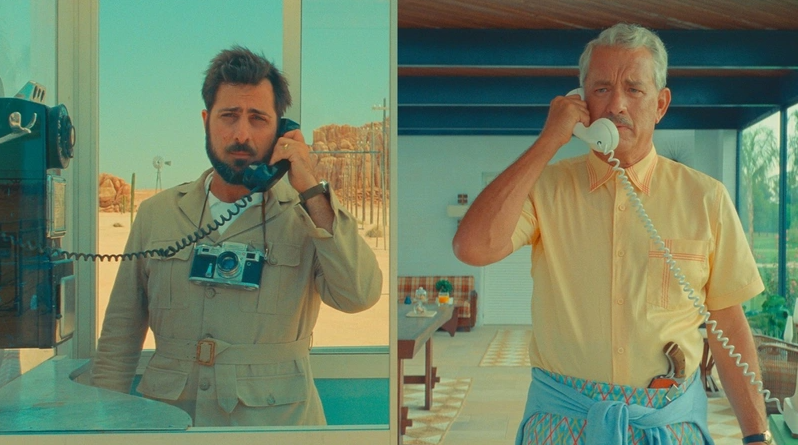
Where the film shines is in the structure. Anderson plays with ideas of artifice and reality throughout, with several nods to the fact that we are watching a play within a film, with actors playing actors playing characters. One laugh-out-loud joke positions Cranston’s narrator in the action, and there’s a meta joke about how the actor playing Schwartzman’s son (Jake Ryan) is only an understudy, which might explain why he is constantly glancing towards the camera.
I have a feeling Asteroid City will prove to be Anderson’s most divisive film, especially for the climactic, genre-breaking sequence. It’s a genuine departure for the director, and while it doesn’t have a single moment to contend with say, Wright’s speech in The French Dispatch, or the battle of wills between Herman and Max in Rushmore, it’s his most thought provoking film of late, which says a lot that for a film so vibrant, with such striking cinematography, and charming performances, that what lingers in my memory more than anything else is a single repeated line. As Paul Schrader put it, “It’s the most Wes Anderson film Wes Anderson has ever made.” It’s the director at his most abstract, and if nothing else it’s a solid rebuttal to those who think all his films are the same.
Extras includes the ‘Making Of’ documentary with a breakdown of Desert Town [Pop. 87], Doomsday Carnival, Montana and the Ranch Hand, and The Players, and at only 7 minutes, it seems unusual that more isn’t added – maybe we’ll see more on a future Criterion release to add to their already stellar WS collection.


![Unquiet Guests review – Edited by Dan Coxon [Dead Ink Books]](https://criticalpopcorn.com/wp-content/uploads/2025/10/ug-reddit-ad-e1761690427755.jpg?w=895)
![Martyrs 4K UHD review: Dir. Pascal Laugier [Masters Of Cinema]](https://criticalpopcorn.com/wp-content/uploads/2025/10/image-1-e1761586395456.png?w=895)



![Why I Love… Steve Martin’s Roxanne [1987]](https://criticalpopcorn.com/wp-content/uploads/2016/11/roxanne.jpg?w=460)


 Critical popcorn
Post your thoughts