
It’s a little cheeky to describe Gareth Edwards latest film as his first original film since his debut, Monsters. It’s true that unlike his previous couple of films, The Creator isn’t based on an existing franchise. However, by the director’s own admission the film is anything but original. In the same way George Lucas wore his influences on his sleeve to create Star Wars, Edwards cherry picks specific elements from a plethora of cinematic influences to create something that feels new, despite itself.
In the not too distant future, A.I. has been banned in the West after a nuclear bomb destroyed Los Angeles. The evolution of A.I. from the mechanical looking robots to the much more advanced “Simulants,” is shown in a newsreel sequence that concisely sets up the stakes of the ongoing conflict. Joshua (John David Washington) is a jaded American operative ordered to locate and destroy the robots’ ultimate weapon. Upon arrival though, Joshua discovers that the weapon is a child Simulant, named Alpha One (Madeleine Yuna Voyles) or “Alphie” for short.

Washington is a solid lead, but he takes a while to truly warm up in his role. He’s very clearly modelled after Rick Deckard in his early scenes as a pretty unsympathetic character. In an early scene (a witty nod to the famous lobotomy scene in 2001: A Space Odyssey), we see him callously frying the brain circuits of one robot as it begs him to stop in the most human terms possible.
Where Washington shines is in his interactions with Voyles. The two have a natural, easy chemistry that builds to some genuinely poignant moments. Voyles is an incredible discovery, conveying Alphie’s curiosity and wide-eyed wonder with a touching innocence. It’s a performance that provides a neat contrast with Haley Joel Osment’s seminal turn in A.I: Artificial Intelligence, but where Osment’s performance highlighted the unnatural, uncanny side of A.I., Voyles makes Alphie even more humane than the human characters.
The idea of the machines being “more human than human” (a phrase lifted wholesale from Blade Runner) is a fairly obvious one, but potently depicted throughout, as we see the gentle nature of the Simulants compared to the brutality of the imperialist American invaders. Unfortunately, aside from Voyles’ emotive performance, Edwards doesn’t really explore what makes Alphie more than just a robot. Indeed at some point in the film it seems like Edwards bypasses the ethical dilemma of the film’s first half in favour of an undeniably emotional final act.
This is where The Creator runs into problems, as the film both suffers and benefits from the prescience of its subject matter. The idea of Artificial Intelligence advancing to the point where it becomes self aware has perhaps never been more timely, but we are all so well versed in the conflict between humanity and A.I. now that we need more than the simplistic narrative that The Creator has to offer.

Edwards humanizes his robot cast with a beautiful economy. The most humane moment of the film comes from a robot who barely has any facial features at all, through the simple act of allowing himself to be destroyed rather than putting a group of children in harm’s way.
Another particularly striking scene shows a robot reacting with disgust at the plan to send Alphie to her death in order to end the war. The problem is Edwards doesn’t explore these moments beyond the initial premise. The idea of a robot having moral qualms about sending another robot to die is an interesting one, but it’s immediately abandoned in favour of a breathtaking action set-piece.
Edwards clearly has a great eye for framing and scene composition, as well as a truly breathtaking sense of scale. His world-building is also spectacular, and it feels tangibly lived-in, thanks to shooting on location in some beautifully evocative settings, from the Himalayas to floating villages in Thailand.
He also makes effective use of non-linear editing, dropping memories into the main narrative without any clear signposting, which conveys Joshua’s mindset. Edwards also clearly has a ball with the poppy soundtrack, paying homage to the use of contemporary music in the likes of Apocalypse Now and Platoon (The use of Radiohead’s Everything In It’s Right Place in particular is really effective) along with a particularly understated score from Hans Zimmer and the repeated leitmotif of DeBussy’s Claire de Lune.
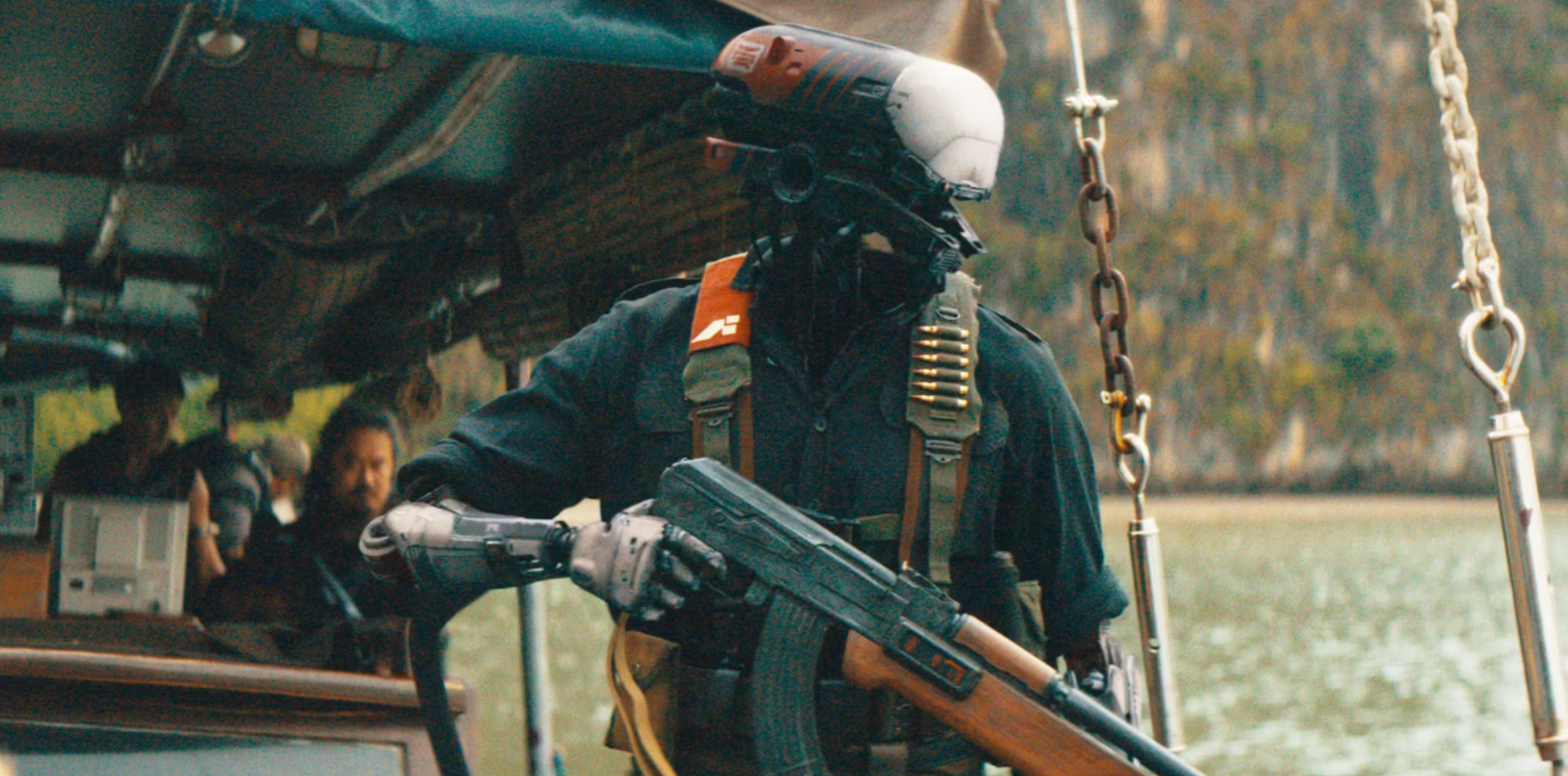
I was never one of the people who derided the characterisation in Rogue One. For me, the characters were all clearly defined instantly, and I felt for them as the body count rose. Unfortunately the same isn’t true of The Creator. Supporting characters turn up to divulge a crucial bit of exposition, and then are killed offhand with barely a backward glance once they have served their purpose. Any depth to the characters is largely due to the natural charisma of the actors playing them rather than anything in the script – Ken Watanabe and Allison Janney give strong renditions of well worn genre archetypes, but they are working within the confines of their characters, never really breaking the mould.
Aside from any issues I have with the story, it’s refreshing to see a film that is so clearly the vision of one person, even if that vision is a blend of influences such as Blade Runner, Apocalypse Now, Ex Machina, and Lone Wolf & Cub. It’s the combination that makes the film unique, and the result is one of the most visually distinct science fiction films I’ve seen in a while.
The Creator isn’t a perfect film; the plot is a little too conventional, with some thought-provoking ideas that aren’t explored in any real depth. That being said, I found a lot to admire in the sheer ambition of Edwards’ vision, and the wonderfully retro aesthetic. The central relationship is genuinely touching, but it’s a definite case of the spectacle overwhelming the characterisation and story.


![Unquiet Guests review – Edited by Dan Coxon [Dead Ink Books]](https://criticalpopcorn.com/wp-content/uploads/2025/10/ug-reddit-ad-e1761690427755.jpg?w=895)
![Martyrs 4K UHD review: Dir. Pascal Laugier [Masters Of Cinema]](https://criticalpopcorn.com/wp-content/uploads/2025/10/image-1-e1761586395456.png?w=895)
![Why I Love… Steve Martin’s Roxanne [1987]](https://criticalpopcorn.com/wp-content/uploads/2016/11/roxanne.jpg?w=460)


 Critical popcorn
Post your thoughts