After the huge commercial success and awards buzz surrounding the first Joker, it’s not surprising to see the creative team return for a sequel. Joker: Folie à Deux feels like a response to audience reaction to Joker, framing the polarised response to the first film as a trial for its lead protagonist Arthur Fleck (with Joaquin Phoenix returning to the role which garnered him an Oscar in 2020). Co-writer and director Todd Phillips seems determined to use this follow-up as a chance to reconcile with the controversies surrounding the first film, even if the resulting story struggles to justify continuing the narrative at all.
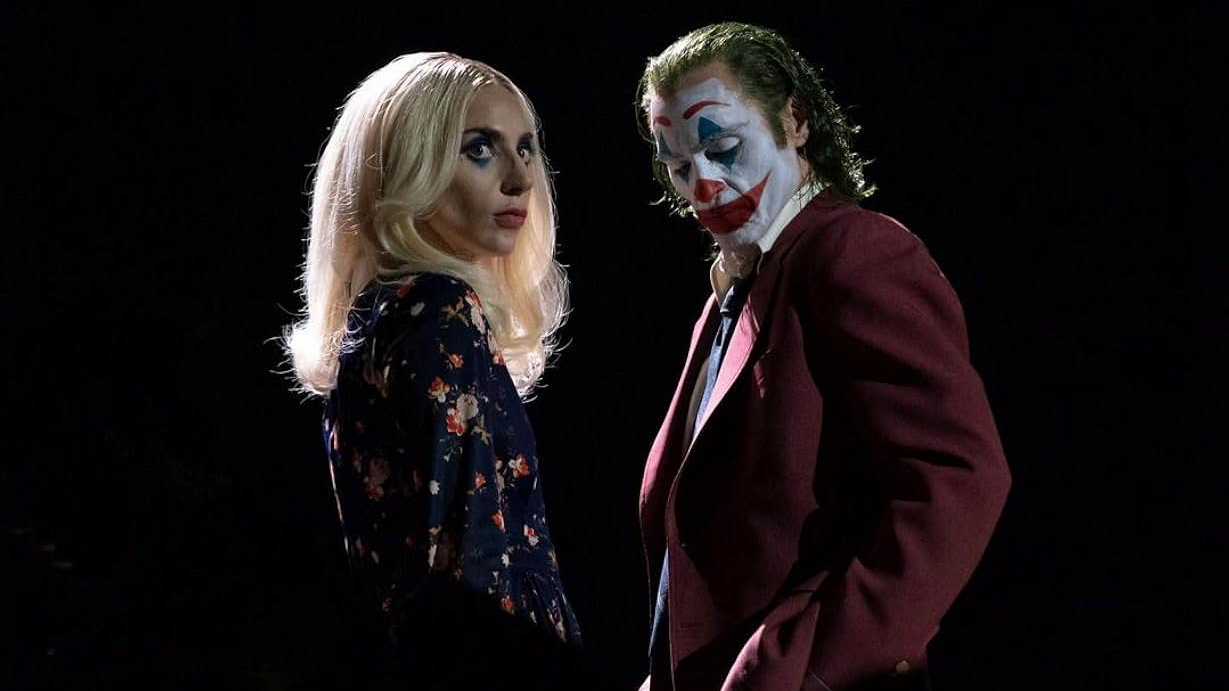
Folie à Deux starts strong with the opening act set in Arkham State Hospital, where Arthur has been imprisoned since his Joker rampage. It’s through a music club that he meets and falls in love with Lee (a new take on Harley Quinn, from Lady Gaga), who is obsessed with his Joker persona. While Arthur’s lawyer wants his Joker side to be treated as a separate personality, Lee believes that Joker is the ‘real’ him, prompting an internal conflict over the course of the narrative. As Arthur’s prison romance with Lee blossoms through Hollywood musical-style dream sequences, he must also contend with thuggish and abusive guard Jackie Sullivan (Brendan Gleeson, on fine form as ever). It’s by far the most engaging section of the film, before the narrative shifts focus onto Arthur’s trial. The courtroom drama aspect can’t help but feel a bit rote, failing to delve into the character further and simply reiterating exposition from the previous film. Any opportunity to examine what the people of Gotham think about Joker is ignored in order to keep the emphasis firmly on Arthur’s point-of-view, which makes sense – even if this claustrophobic approach makes the huge $200 million budget feel somewhat wasted. With a running time stretching 138 minutes, Folie à Deux limps to the finish line without managing to decide what point it wants to make.
Returning to the role after 5 years, Joaquin Phoenix brings a mournful tragedy to Arthur, a man desperate for love and adoration, turning his whirlwind romance with Lee into sequences of rare, pure joy for the character. There’s very little Joker in Joker: Folie à Deux, but when that side of Arthur does emerge, there’s a sense that Phoenix is holding back in his performance. Even the big musical sequences feel lacklustre, featuring some wonderfully dynamic lighting and production design but a distinct lack of energy in the choreography and camerawork, as if the creative team weren’t willing to fully commit to the big Hollywood musical angle. A vintage animated prologue opens the film on a neat stylistic flourish, feeling more Joker-esque than anything else in either of Phillips’ feature films, even if it feels separate from the rest of the piece.
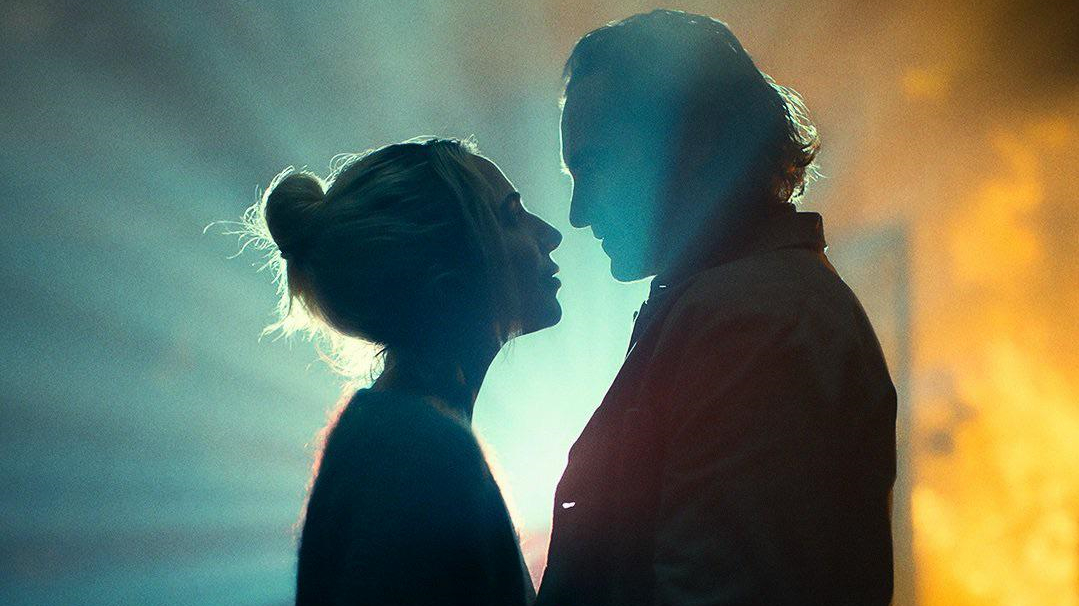
While Phoenix’s Arthur is still very much the lead, it’s Lady Gaga who walks away from the film as his mad love interest Lee. Unsurprisingly, Gaga’s singing brings a lot to the musical sequences, although perhaps the most interesting touch is the way Lee’s vocals differ between her ‘real’ singing and her singing in Arthur’s imagination, creating a subtle disparity between the two versions of her. There’s an argument to be had that Gaga’s Lee should have been the film’s lead, providing a new audience point of view for this sequel. Nevertheless, Lee’s role in Folie à Deux is seemingly to service Arthur’s character as opposed to feeling like her own individual character.
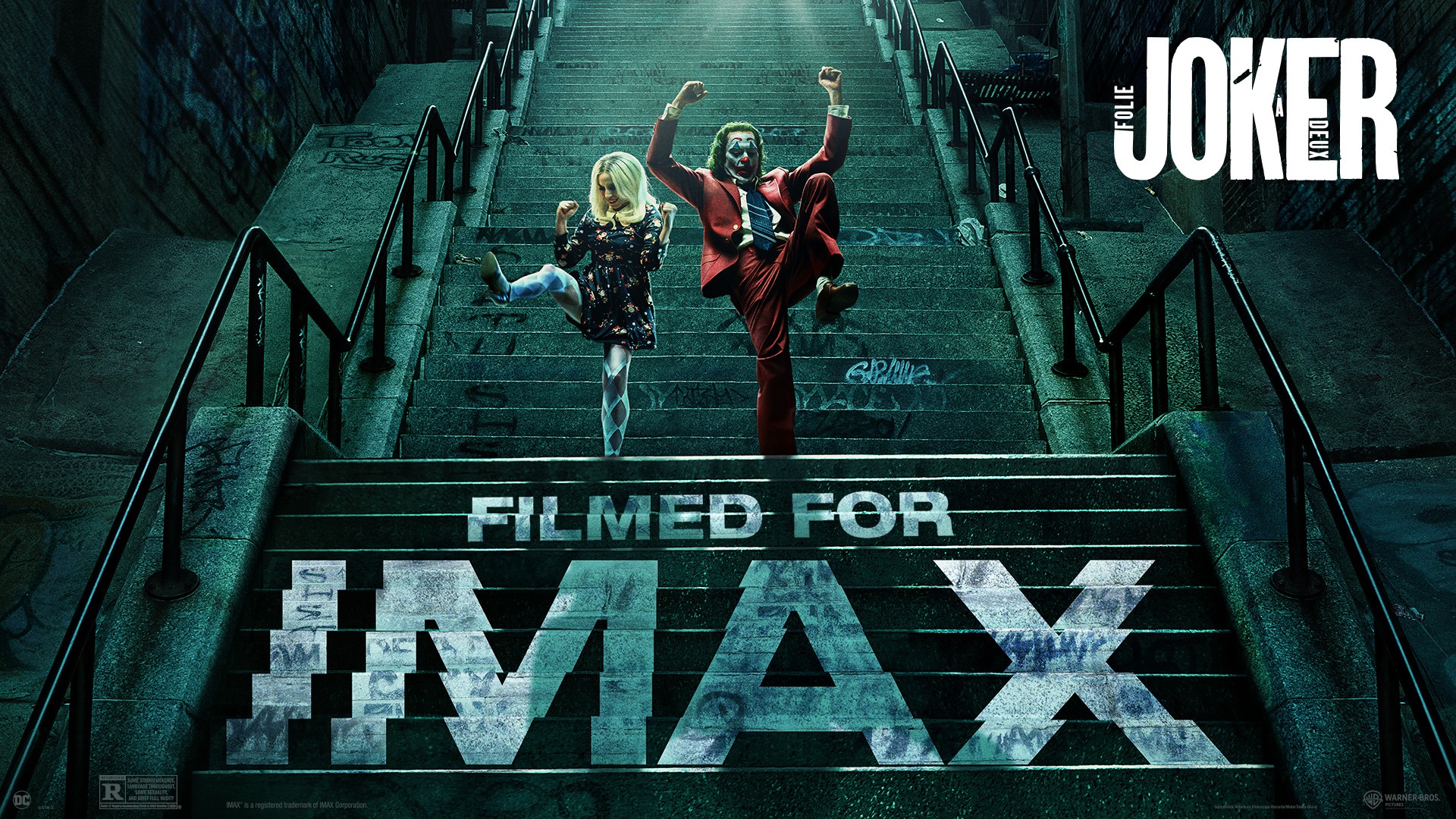
As with the first Joker, Folie à Deux is beautifully shot by Oscar and BAFTA-winning cinematographer Lawrence Sher. Filmed with IMAX-certified digital cameras, the way Sher uses vibrant primary colours and deep shadows results in some truly stunning visuals. Watching the 70mm IMAX print of the film (during which select sequences are presented in the full 1.43:1 IMAX aspect ratio, with the rest in the expanded IMAX 1.90:1) really shows off not only the cinematography but also the various nuances in the actors’ performances. While most big IMAX films utilise the format for spectacle, it’s great to see films like Joker: Folie à Deux and last year’s Oppenheimer use the large-format technology to get audiences closer to the characters and see every subtlety in Phoenix and Gaga’s faces as Arthur and Lee. The IMAX sound system further serves to immerse you into Joker‘s Gotham, showcasing the brilliant sound design as well as Hildur Guðnadóttir‘s moody score (following on from her multi-award-winning score to the first film). It’s also well worth experiencing in IMAX if you can, and if you’re able to see a 70mm IMAX print, it’s truly a sight to behold.
All in all, Joker: Folie à Deux has a lot of promise but fall short. The musical aspect may be divisive amongst audiences, although as it never fully commits this aspect, those who like it won’t be impressed with that half-hearted approach. The trial aspect is particularly lacklustre, and the ending inevitably underwhelming because of this, after the interesting Arkham-centric first hour of Folie à Deux. Saying this, it looks and sounds great with some terrific performances, yet even Phillips’ desire for striking images overwhelms any sense of ‘logic’ or character motivation. Joker: Folie à Deux threatens to be a bold counterpoint to the first Joker, but never fully commits on what it wants to be.




![Unquiet Guests review – Edited by Dan Coxon [Dead Ink Books]](https://criticalpopcorn.com/wp-content/uploads/2025/10/ug-reddit-ad-e1761690427755.jpg?w=895)

![Martyrs 4K UHD review: Dir. Pascal Laugier [Masters Of Cinema]](https://criticalpopcorn.com/wp-content/uploads/2025/10/image-1-e1761586395456.png?w=895)
![Why I Love… Steve Martin’s Roxanne [1987]](https://criticalpopcorn.com/wp-content/uploads/2016/11/roxanne.jpg?w=460)

 Critical popcorn
Post your thoughts