
Directed by Phil Lord and Christopher Miller, Project Hail Mary is adapted from Andy Weir’s fan favourite novel with a screenplay from Drew Goddard, who also brought to the big screen another of Weir’s novels, The Martian, starring Matt Damon. As with that film, we’re heading off into space for a new heroic escapade; one that’s character-led and filled with moments of awe and self-discovery, but this time the protagonist is Ryan Gosling as schoolteacher/molecular biologist Ryland Grace.
Told in a non-linear fashion, we join Grace as he wakes up alone (with two other crew members already long dead) on an interstellar spaceship light-years from Earth, and seemingly no knowledge of why he’s there. His mission is to save the Earth from dying, as our sun is being drained by a line of unknown alien microbes reaching out through space, sucking away the energy. His job is to travel to the only known star system that scientists have found where their sun isn’t dying and send back his findings as to why.

Project Hail Mary is vast in its intentions, both in storytelling and visual undertakings. While the wider framework is about saving the Earth from extinction, it’s also clear this is a tale of humanity, and positively. A world where self-belief, intelligence and taking actions for the greater good will not only be rewarded, but where those elements can celebrate humankind. Director’s Lord and Miller are behind the likes of The LEGO Movie, and the epic animated Spider-Man ‘Verse’ films, and you can undeniably sense their comic touch throughout Project Hail Mary, entwined with touching moments of individuality, often found in the most unexpected places. It feels natural, smart, and funny, and Ryan Gosling has been given free reign to charm us from start to finish; and it works.
And those aforementioned unexpected places of joy are particularly found after Grace arrives at the star system where he needs to be and meets an alien spaceship with its only crew member (echoing his situation), and they eventually learn to communicate. To do this, as well as a series of taps (as you might on a door) and physical movements, a translation system is built with the help of the extra terrestrial. This being can only really be described as a rock creature – and is accordingly named Rocky. Rocky doesn’t have a face but can make synth-like noises and move its body, and from this they learn from each other. Also, importantly, Rocky is always enclosed in a biome-like spacesuit so he can breathe and join Grace on his spaceship.


Rocky has a child-like simplicity to how he deals with Grace, but he’s also hyper-intelligent and can solve issues quite quickly. In many ways, for me, he’s puppy-like and perfectly voiced by James Ortiz, who puppeteered his character during the filming. In many points, this straightforward personality reminded me of Dug from Pixar’s UP (and a touch of TARS from Interstellar), yet not negatively, more of a joyous, eager to learn type of way. Over time, they’ll discover everything they need to between them, via a wealth of buddy-movie goodness, silly comedy, huge stakes of survival and grand visual creations of space and planets.
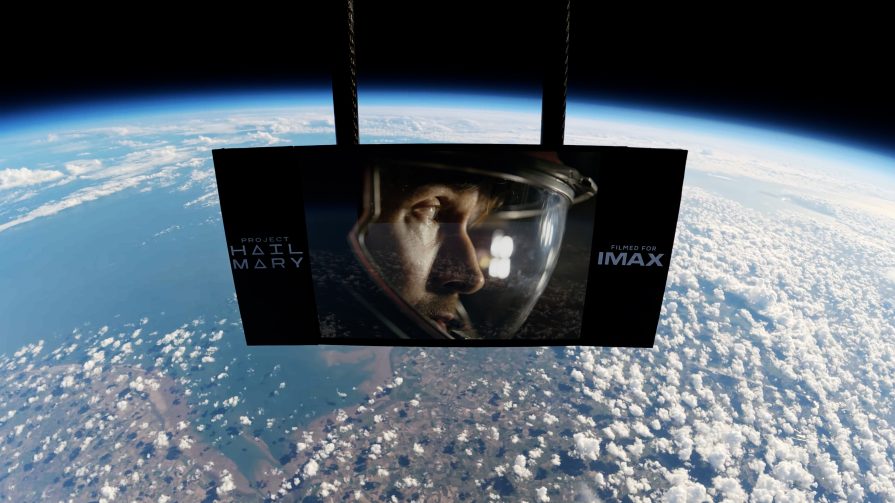
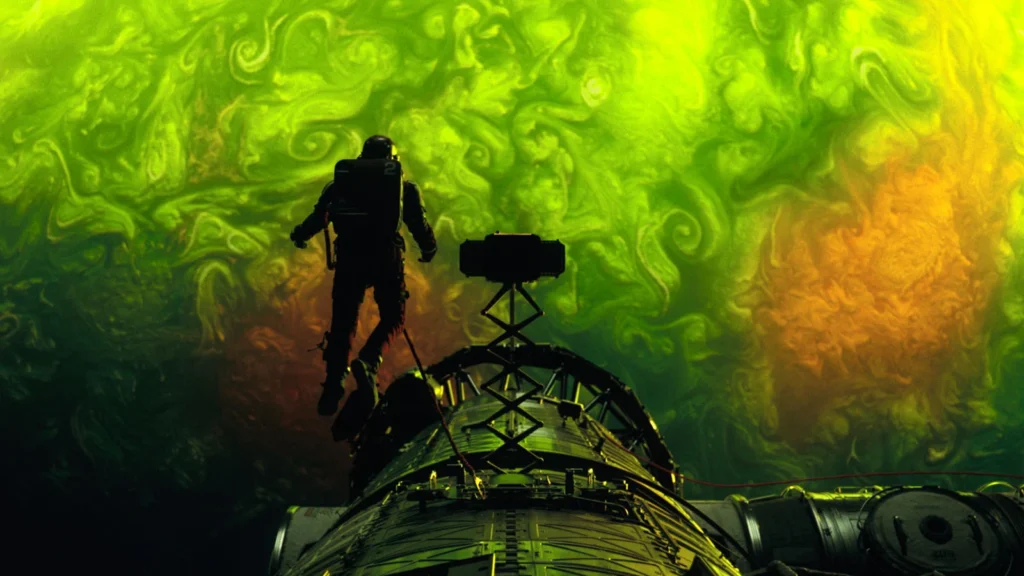
In IMAX, these remarkable moments are particularly assured. It’s the pure wonder and spectacular film production that emphasizes the best of Project Hail Mary; this is a gorgeously crafted movie unafraid to show off its scale. Much like Christopher Nolan’s Interstellar (and there’s certainly influence in flashes, as well as Kubrick’s 2001: A Space Odyssey), Lord and Miller’s film – with the talented cinematographer Greig Fraser – excels when it plays with light and timely reminders of both the emptiness and beauty of space itself. Shot on IMAX digital cameras (and there are 70mm screenings out there as well), the film includes around two hours of expanded aspect ratio which, in every day terms, means you’re beholding the biggest image in the world right there in front of you, at a towering 1.43:1 for those who love the technical, accompanied by a space-worthy score from Daniel Pemberton, booming out through those IMAX speakers, to aid you seeing and feeling every outcome.


What I also found exciting about utilising this technology, is that the small things hit home, even when we’re lost in the cosmos with Grace and Rocky, there’s a clever amalgamation of human story alongside the adventure, where the relationship between the pair is everything. Gosling gives a charismatic performance, keeping it relatable and funny. Also, as his ‘Earth’ story is revealed through flashback, there has to be praise for Sandra Hüller. Her role is vital in how he ends up light-years from home and while this role could be a side note with a less-knowing actor, she’s grounded and strong without ever becoming clichéd. In fact, one of the most emotive moments came surprisingly when Hüller performs a karaoke version of Harry Styles’ Sign of the Times that juxtaposes a scene celebrating the vastness of space in a banquet of colour, and the result is an exquisite on-screen spectacle.
Does Project Hail Mary hit every emotional beat? Not quite. But is it a celebration of life? Absolutely. Watching it in IMAX also helps you devour the epic visuals, and I was more than happy to be taken into the depths of the cosmos. This has mass appeal, yet it’s also smart with those intentions and you can immerse in the heart-warming journey, as well as allowing yourself to be pulled into its human essentials and the loving need for emotive, natural connection. A sign of the times, indeed.

Project Hail Mary is out now in cinemas and IMAX across the UK
For a feature on Project Hail Mary being broadcast in the stratosphere, head here!








Leave a Reply