
Proof if need be that Paul Thomas Anderson can do action cinema, One Battle After Another combines the laidback, counter-cultural haze of Inherent Vice with the relentless forward momentum of Uncut Gems, with a dash of Buster Keaton. The result is perhaps the most vital, thrilling film of Anderson’s career.
Anderson’s second adaptation of a Thomas Pynchon novel after the aforementioned Inherent Vice, the story of One Battle after Another is similarly convoluted. Bob Ferguson (Leonardo DiCaprio) and his partner, the improbably named Perfidia Beverly Hills (Teanna Taylor), are members of a revolutionary group named The French 75, who execute a string of acts of sabotage on government facilities. Monitoring them is the fanatical Colonel Lockjaw (Sean Penn) who quickly sets his sights on Perfidia. When she is arrested shortly after giving birth, Lockjaw coerces her into informing on her comrades.
Sixteen years later, Bob lives in isolation with his daughter Willa (Chase Infiniti). While he still maintains the vigilance that has kept them safe in the interim, Bob has grown complacent – spending his days smoking weed and watching old movies. But when Lockjaw resurfaces, Bob is forced back into the life he left behind, and the film shifts into a non-stop fight to keep his daughter safe.
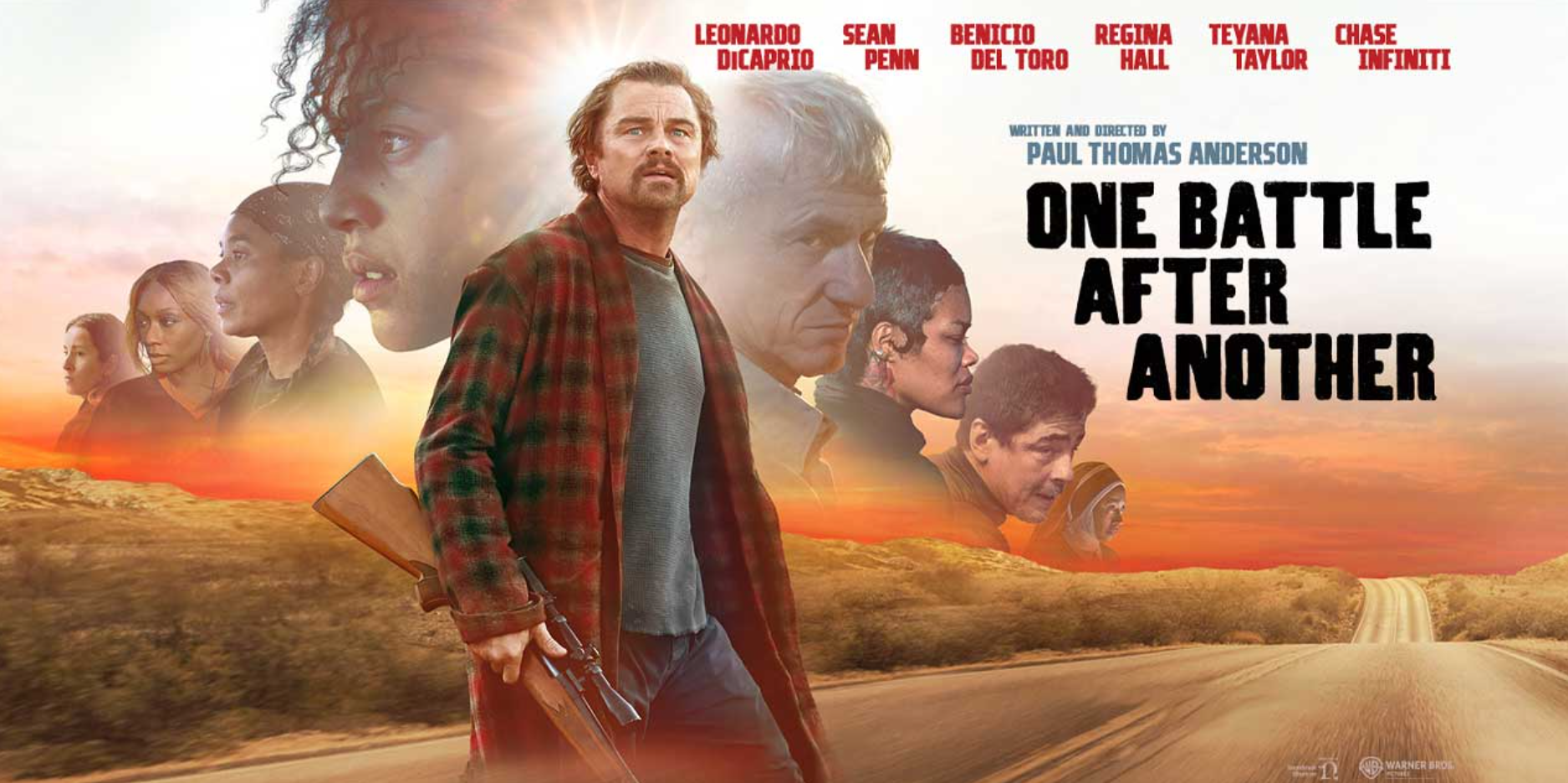
DiCaprio is at his frantic best, giving his finest performance since Once Upon a Time in Hollywood. He is perfect playing a burnt out revolutionary, his stoned demeanour repeatedly contrasted with the various powder kegs he wanders into (while dressed in a filthy dressing gown – a visual gag that keeps on giving). He’s hilarious, but there’s also a pathos to his character, and DiCaprio’s performances is astute enough to reconcile Bob’s contradictory traits. He’s at once dynamic and lazy, sardonic and deeply sincere, especially when it comes to the palpable love he holds for his daughter.
The politics of the film are nebulous and worryingly familiar. It’s a world of surveillance, authoritarian control, and citizens who can be “disappeared” without a trace, grounding Anderson’s absurdist humour in a frightening, increasingly recognizable reality.
Nowhere is this more apparent than in the characterisation of Colonel Lockjaw, the living embodiment of that oft-quoted line from Yeats’ The Second Coming:
“The best lack all conviction, while the worst / Are full of passionate intensity.”
Lockjaw is absurd and terrifying in equal measure, but Penn’s performance threatens to lapse into self-indulgence too often for my liking. It works best in small doses – unfortunately though, he gets a lot of screentime. Where Bob is a lapsed revolutionary, unable to remember the passwords he once lived by, Lockjaw is consumed by obsession, his every action driven by a need for domination. He is most chilling when his control begins to slip, exposing the emptiness that lies beneath the rules and structure he adheres to. If Penn sometimes feels cartoonish, the contrast with DiCaprio’s shambling earnestness makes the dynamic work.

Much more chilling , in his only scene, is Kevin Tighe as the leader of the sinister organisation Penn is seeking admittance to (hilariously named The Christmas Adventurers). Tighe is a malevolent, repellant presence with a leering grin, and despite being in a wheelchair, is just as formidable here as his villainous turn in Matewan.
The entire ensemble is a mix of performance styles, going from the eccentric to the natural, to ones others that can’t help but look a little ordinary by comparison. Benicio Del Toro’s implacable karate instructor is so comically unphased by the chaos erupting all around him that it seems like he has arrived from a Wes Anderson film, while Regina Hall gives an achingly humane, yet stoic performance as Bob’s longtime associate. Most impressive is Chase Infiniti in her film debut. She gives a stunning, self-assured performance, more than holding her own against acting heavyweights like DiCaprio and Penn in action and dialogue scenes alike, and essentially serving as a co-protagonist in the film’s final act.
There are scenes that are hilarious, scenes that are thrilling, and some that are supremely tense, and yet it never feels jarring. Anderson balances shocking violence with comic scenes like DiCaprio bickering over a long-forgotten password, combining sincerity and irreverence with a dexterity that makes it look effortless. Elsewhere Anderson’s characteristic offbeat humour rears it’s head in several throwaway lines of dialogue – Jim Downey’s mild-mannered white supremacist feels like he walked straight out of Burn After Reading, and his offhand delivery of “Semen Demon” is just perfection.

Complimenting this eclectic tonal mix is Jonny Greenwood’s urgent, atonal score – alternating between percussion and piano, but lending the film a constant sense of momentum. It recalls Uncut Gems, The Grand Budapest Hotel, and even The Battle Of Algiers in the way it both accompanies the action and propels the story forward, connecting scenes together and keeping the film’s breakneck pace ticking over. Also helping with the film’s overall feel is Anderson’s decision to shoot in VistaVision, a choice that makes the film feel both timeless and modern. Anderson makes striking use of closeups, silhouettes, and focus pulls, with standout imagery including a rooftop chase backlit by riots and a Keaton-esque fall into an alley by DiCaprio.
Anderson is a director known for vibrant, emotional, wryly subversive films – any one of his films would be a contender for best film in almost any other filmmaker’s catalogue – but if you think of a standout sequence in his filmography and you’re invariably going to pick the “Wise Up” sequence from Magnolia, or the climax of There Will Be Blood, or any number of emotionally charged dialogue scenes. He isn’t exactly known for directing action set-pieces. And yet he directs each of the numerous chase scenes here with precision. The climactic car chase is shot with a hypnotic elegance, ending with a beautifully executed jolt to the senses.
Balancing absurdity with pathos and genuine thrills is a tough needle to thread, but Anderson nails it. I won’t say that One Battle After Another is his best film, but it’s a fascinating change of pace. A blistering, incendiary thriller infused with a dark sense of humour, means the director is at his most playful for the most exciting film of the year.



![Unquiet Guests review – Edited by Dan Coxon [Dead Ink Books]](https://criticalpopcorn.com/wp-content/uploads/2025/10/ug-reddit-ad-e1761690427755.jpg?w=895)





 Critical popcorn
Leave a reply to Review and trailer for Paul Thomas Anderson’s One Battle after Another starring Leonardo DiCaprio and Teyana Taylor – Critical popcorn Cancel reply