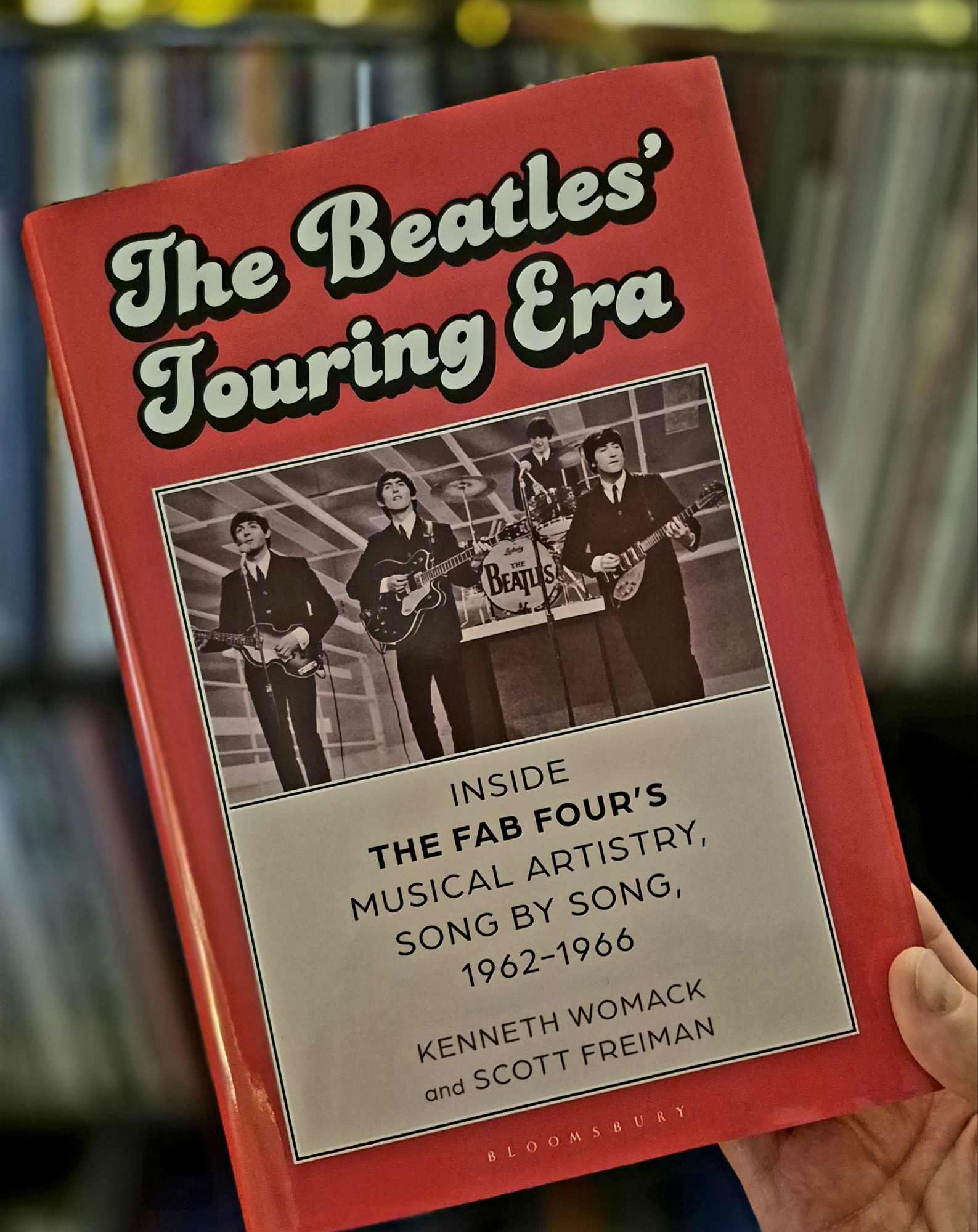
In an age that gravitates your attention towards quick hits and instant information, which can last for mere seconds before you scroll onto the next ‘must see,’ there’s something to be said for a deep dive into a subject, and The Beatles’ Touring Era is a prime example of stellar research, astonishing attention to detail as well as being an pleasing representation of a pure passion for a subject.
Compiled, collated, and presented by Kenneth Womack and Scott Freiman, two world renowned Beatles experts, their new offering took me some moments to appreciate the scale, after initially being overwhelmed (in a positive way) by the vividness of what’s included. This book offers consistently unambiguous evidence of their knowledge of a band that, for me, changed the world, both musically and culturally. As a complete package, this release sub-titled ‘Inside the Fab Four’s Musical Artistry, Song by Song, 1962-1966’ is exactly that, as it explores every known insight they can gathering, including instruments used, or reasons for song choices or recording decision that The Beatles made over that period of time.

This may feel like a soundbite but whether you’re already a fan or have recently leaned into their back catalogue, The Beatles’ Touring Era covers so much. This level of detail, in one place, is refreshing and I found myself consistently in awe of the dissection of their invention, and also the bands’ dog headedness to have their set ideas, even in their younger years, and where they wanted to go with their music. I do speculate, and it’s alluded to here, if their extensive touring between Hamburg and Liverpool enabled that confidence. This wasn’t an arrogance, well maybe in a youthful way, it was a sharp idea of who they wanted to be, as this led to the boys becoming exactly who they were, both as people and musically.
From the Please Please Me era, where the now notorious Decca audition took place and how the record company turned down the band, we’re taken through that process with precision. Eventually, a shift in management and record company led to a subtle change in tempo and then the launch of Love Me Do, which included a harmonica – which was rare at the time, and something they fought for – became their first single release and, with it, history started its Beatles clock ticking. This, coupled with a realisation from George Martin of the harmonies that Lennon and McCartney could create, well, that was placed into time itself.


Whether you’ve loved the band, or dismissed their impact – I am aware I may repeat myself – this forensically unpicks the process of what The Beatles did for not just the music industry in the 1960s, but modern pop culture as it stands. There’s even more examples of this impact in Paul McCartney’s ‘Eyes of the Storm’ photography book – read my review of that here and the exhibition here – as it covers their first US tour in 1964 when the Beatlemania fuse was freshly lit and ready to explode like never before.
But, back to the matter at hand, this compendium covers the albums Please Please Me and With the Beatles (1963), A Hard Day’s Night and Beatles for Sale (1964), Help! and Rubber Soul (1965) to Revolver in 1966, as Womack and Freiman not only track the Fab Four’s creative development, but provide a fascinating guide which gives you a close insight into the songs, based on a wealth of research with everyone involved. As well as exploring the origins of the tunes, how they changed during the studio recordings and how every instrument they used was a specific choice, especially to make sure they were always evolving, even in the initial – let’s say – more directly pop-friendly era.

With a book like The Beatles’ Touring Era, it’s never just going to be one of those you read through and don’t pick up again, it’s technically a testament to the ingenuity of John Lennon, Paul McCartney, George Harrison, and Ringo Starr – and all who moved in their circle at the time. When we hit 1966’s Revolver release, especially after the defining shift of their identity with 1965’s Rubber Soul, the band has morphed and musically developed so dramatically that it focuses all of that previous energy into one behemoth of an album.
Both Lennon and McCartney were desperate to not retrace the steps of where they’ve previously walked, in a sense of modern music, it reminds me of how Radiohead were after recording and touring OK Computer, it may remain a huge influence and threw them into the stratosphere, but they were sick of it, which eventually led to the shift into Kid A and everything that followed. In the book, it’s clear that Revolver was prime for experimentation even before it was into the recording phase.

Helped by the young talents of Geoff Emerick, an engineer both eager and with a creative, more radical ear, Revolver was a revolution for what it would eventually become but also with its recording methods. As this book explains, ADT would be a key factor in what would be created:
“Artificial Double-Tracking (ADT), devised by EMI engineer Ken Townshend (from a request from Lennon), [was created because] Lennon hated laborious manual double-tracking; ADT used two tape machines and the mixing desk to duplicate a signal, then slightly delay or manipulate the second feed by milliseconds for a widening, shimmering texture.”
And you can feel it in the album, concluding with Tomorrow Never Knows, a song that if you heard it today for the first time could easily be mistaken as brand new, it’s such a tremendous, historic creation that not only helped the band at the time, and their engineers (including Norman Smith and Emerick), but also influenced countless bands through every generation that followed.
The Beatles’ Touring Era: Inside the Fab Four’s Musical Artistry, Song by Song, 1962-1966, is a brilliant representative of dedicated, avid research and insight. It’s also important to mention that Kenneth Womack and Scott Freiman share their respect for all the people, historians and scholars who they collaborated with to bring this guide to life. It is an incredible anthology, and one that any fan of music or The Beatles would absolutely adore.













Please leave a Reply!