It may not be the first Hammer horror, but Terence Fisher‘s Dracula is arguably the most important in the Hammer Films canon. Resurrecting Bram Stoker‘s vampiric Count for a new decade and generation, after the Universal incarnation had faded from cinema screens, Dracula (or Horror of Dracula, as it was titled in the USA) menaced 1958 audiences in glorious Technicolor.
After the success of the 1957’s The Curse of Frankenstein, this saw stars Peter Cushing and Christopher Lee team up again, this time as Dr. Van Helsing and the dreaded Count Dracula, respectively, under the direction of Fisher as Hammer’s go-to auteur. It may have been branded with an ‘X’ rating at the time but even Dracula was trimmed for its violence and sexual content, with the footage seemingly lost to time. Of course, when one is dealing with vampires, death is never the end, and for the first time can now see Dracula as it was originally intended in glorious 4K Ultra HD with Dolby Vision, courtesy of a beautiful new restoration from Hammer Films, packed in a spectacular 7-disc limited collector’s edition set!

The story of Dracula sees Jonathan Harker arrive at Castle Dracula to meet with the undead Count (and his seemingly innocent Bride) before meeting a suitably bloody end. On the search for his friend, Dr. Van Helsing discovers that Count Dracula has left his castle in pursuit of Harker’s fiancé Lucy and rushes to save her before she suffers a fate worse than death…
What’s immediately interesting about Dracula is its self-awareness: the film knows that the audience knows that the Count is an evil vampire, and makes little effort to conceal this fact (one of the first shots is bright red blood dripping on Dracula’s coffin). Even in 1958, audiences would have been familiar with Bram Stoker‘s 1897 novel, or the 1931 Universal film version starring the iconic Bela Lugosi, so Jimmy Sangster‘s script subverts our expectations by having the usually hapless and blissfully ignorant Harker already aware of the Count’s true nature and in league with Van Helsing.

At a brisk 82-minute duration, very little time is wasted before revealing Christopher Lee as Dracula in an introduction very close to his book counterpart. Lee is clearly famous for the role today, and he slips into it so easily, providing an initial charm before revealing his true colours (mainly blood-red, with some fang-tastic teeth) as he confronts his vampire bride. Stoker’s novel describes the Count’s eyes in this moment “as if the flames of hell-fire blazed behind them”, and Lee’s expression sells this perfectly.
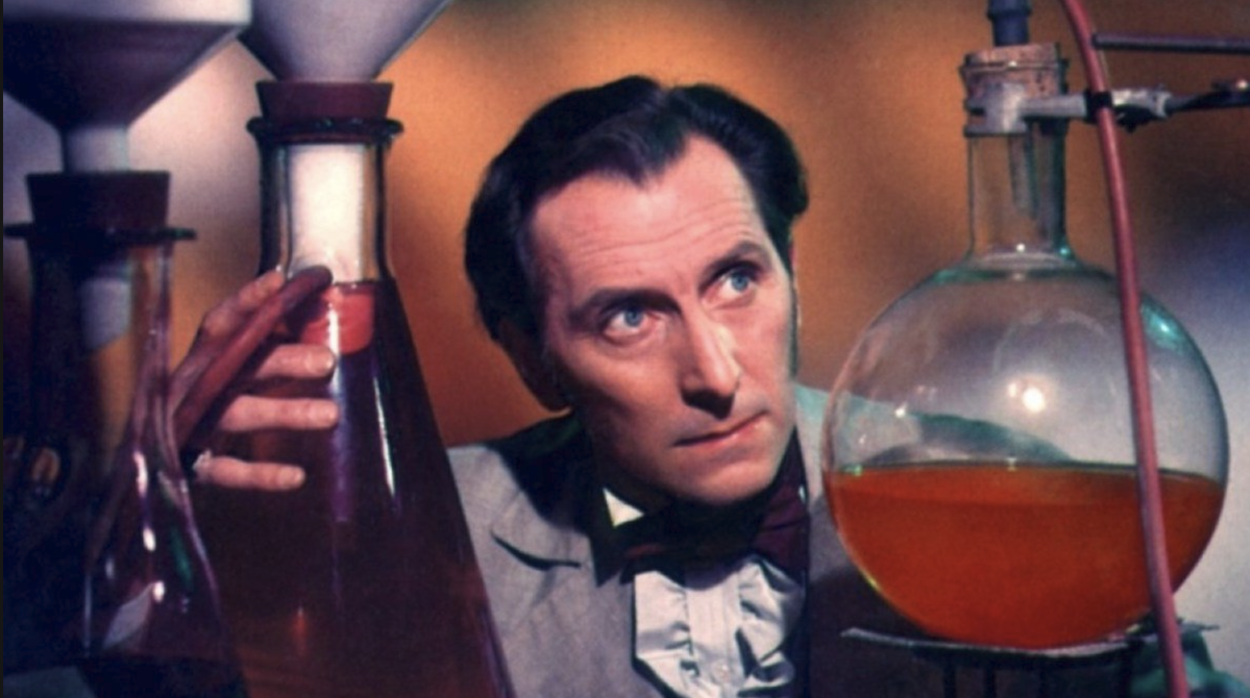
Of course, the real star of the show (with his name even above the title) is Peter Cushing as Van Helsing, who brings a grave sincerity to the character in a way few other actors have matched. Cushing was always Hammer’s secret weapon: an actor able to bring gravitas and stoicism to any part whilst ensuring that his dialogue – not matter how ridiculous on the page – remained utterly convincing. An underrated moment is when Van Helsing comforts Tania; the character wrapping the little girl in his big cloak and reassuring her makes for sweet and tender moment that’s rarely found in other Hammer films. It’s a pity that Michael Gough – an actor excellent in his own right, and remembered in later years for playing Alfred in the Batman films – is a little flat as Arthur Holmwood. Melissa Stribling‘s performance as Mina wonderfully encapsulates the duality between humanity and vampirism, while Valerie Gaunt brings an eerie mix of innocence, seduction and animalism in her brief but memorable role as ‘Vampire Woman’ (clearly intended as one of the Brides of Dracula, who became the focus of this film’s sequel).

Jack Asher‘s Technicolor cinematography is astonishing (especially in this new remaster), providing a wonderful atmosphere to Bernard Robinson‘s beautifully-constructed sets, and working well along with James Bernard‘s score, which may not be subtle but works like a charm every time. Screenwriter Jimmy Sangster comments in one of the extras that most of the differences between Stoker’s novel and the screenplay came down to a lack of money, and while this may be a smaller-scale version of the tale, it’s clear that the limited budget didn’t impede the creativity. I’d argue that Dracula is the finest production of Hammer’s early years, a fairly solid adaptation of the book, and a must-watch for horror fans across the globe.
Presentation
This new 4K restoration of Dracula is derived from a new scan courtesy of Warner Bros in the USA with the bulk of the restoration work conducted by Silver Salt in the UK. Put simply: the results are spectacular. This is a very sharp and detailed 4K presentation, albeit still retaining the grain and texture one would expect from a 35mm film print. There are no obvious signs of scratches or marks on the film, and likewise there’s no indication of any unnecessary noise reduction or artificial sharpening.
The new HDR grade (available in Dolby Vision and HDR10) is far more vibrant and nuanced when compared with the older 2K restoration, with the blood looking more red than before. Jack Asher‘s cinematography has never looked better. The original mono sound mix is excellent, and while a 5.1 surround sound mix is included (and opens up the soundstage nicely), my personal recommendation would be to stick with the mono option. Even if you do own the older 2013 Blu-ray, it’s well worth upgrading for this beautiful new restoration.

Included in this new 4K set is the uncut version (or director’s cut, as its labelled in the discs), which reinstates previously lost footage of three scenes censored for the film’s theatrical release: Lucy being staked by Van Helsing, Dracula’s seduction of Mina and Dracula’s ultimate fate at the end of the film. This director’s cut is similar to the version found on the earlier 2013 Blu-ray, albeit with much more consistent picture quality. While the older version sourced the additional footage from a lower-quality 16mm Japanese film print, this new version is derived from a 35mm source and looks far sharper and clearer. There appears to be an ever-so-slight loss in picture quality between the theatrical cut footage and the reinstated director’s cut footage but I doubt most audiences will notice unless they’re looking for it. While the UK theatrical cut runs at 01:21:49, the UK director’s cut runs only slightly longer at 01:22:20, but these extra seconds do add to the film’s horror.
Special Features
Disc 1 (UHD) contains the Dracula Director’s Cut (in the 1.66:1 aspect ratio) with a 2026 introduction from John Gore, CEO of Hammer, alongside a 2026 commentary featuring Lucy Bolton and Jonathan Rigby and a 2012 commentary featuring Rigby and Marcus Hearn. Also included is the Dracula UK Theatrical Version (in its correct 1.66:1 aspect ratio) with a 2026 commentary featuring Lizbeth Myles and Paul Cornell, alongside the censor card, clapperboards, textless titles, a UK trailer (with and without text, and seemingly newly-restored); alternative Italian and Spanish titles; and a 8-minute long 8mm colour film cutdown version of the film, focused predominantly on the sequence from Dracula biting Mina through to the end. Proving Them Wrong is a 38-minute discussion between Dame Harriet Walter (actor and Lee’s niece) and Lee’s biographer Rigby, talking about the side of Lee not seen on screen in an feature that’s sure to delight fans.
Disc 2 (UHD) contains the Horror of Dracula US Theatrical Version (in its alternative 1.85:1 aspect ratio) with a 2026 commentary featuring Heidi Honeycutt and Toby Roan and a 2012 commentary featuring Rigby and Marcus Hearn, as well as an alternative Director’s Cut (with the alternative title and aspect ratio), with a 2026 commentary featuring Constantine Nasr and Dr Steve Haberman. Also included on this disc are The Road to Dracula, a 59-minute documentary examining director Terence Fisher‘s life and work leading up to Dracula; Gothic for Christians, a new 25-minute video essay detailing Fisher’s exploration of the spiritual themes from Stoker’s original novel; the US and German trailers (both with and without text); and a Black and White 8mm film cutdown, which is similar to the colour version, albeit at a longer running time of 11 minutes.
While Discs 3 and 4 duplicate the UHD content of the first 2 discs across Blu-ray copies, Disc 5 (Blu-ray) contains the workprint of Dracula, sourced from a Black and White 35mm print. Despite various marks and imperfections in the image, it is a surprisingly high-quality scan of the film. This runs at 01:21:49, so it’s the same duration as the UK theatrical version. It’s a neat curio for fans to enjoy, especially as it includes a new 2026 commentary featuring Lauren Barnett and John Hamilton. Also included on this disc are You Look Like a Teddy Bear Now, a 90-minute interview with Tania actor Janina Faye; Janina Faye Reads Stoker, a 12-minute long reading of the Dracula novel by the actor, which is carried over from the 2013 Blu-ray release; Bram, Dacre and Dracula, a 23-minute feature in which Dacre Stoker offers his unique insight on his great uncle Bram Stoker‘s novel, the changes made for Hammer’s film adaptation and his appreciation of both Dracula and its 1970 sequel Scars of Dracula; The Sound of Dracula, a 58-minute feature on the music associated with the vampiric count presented by James Bernard‘s biographer David Huckvale; a 17-minute 1994 interview with composer James Bernard which offers insights from the man himself (despite the lacklustre picture quality, the sound is good, making the feature a nice one to simply listen to); and an Image Gallery.
Disc 6 (Blu-ray) includes Victim of His Imagination, a 55-minute dramatised reading of a script treatment by Hammer scribe Don Houghton for a film about Bram Stoker, performed by James Swanton; Liberated After Dark?, a 55-minute feature on the women of Dracula with contributions from Lucy Bolton, Pamela Hutchinson and Stacey Abbot; Of Mod(els) and Monsters, a 39-minute documentary about the career of special effects wizard Sydney Pearson; The Measure of a Hero, a 31-minute video essay focused on Peter Cushing‘s Van Helsing; Blood, Bites and Boundaries, a 30-minute feature on the BBFC and film censorship with regards to Hammer films; Park, Watch and Scream, a 23-minute feature about drive-in movies, where many American audiences watched Dracula; Dracula Jr., an 11-minute interview with actor Paul Cole who played the “lad” in Dracula; The Eagle Has Landed, a 9-minute featuring detailing what happened to Castle Dracula’s iconic eagle statue (seen prominently in the opening titles) after filming; and Resurrecting Dracula, which details the extensive restoration work from Silver Salt. It’s a fascinating watch, running longer than Hammer’s usual restoration features at 19 minutes, but what’s clear is that despite the technological advances in film restoration, there is always the need for constant human supervision and involvement to ensure that the remaster is as good as it can be.
Disc 7 (Blu-ray) includes Lords of Darkness, a discussion about Dracula’s film adaptations between Jonathan Rigby and James Swanton (available to play all or as Part 1: The Road to Hammer, 51 mins and Part 2: Hammer and Beyond, 69 mins); and Sidebar: Dracula. Also featured on this disc are World of Hammer: Dracula and the Undead, a 26-minute clip series looking at Hammer’s vampire films narrated by Oliver Reed; Dracula Reborn, an excellent half-hour 2012 documentary about the making of the film, featuring screenwriter Jimmy Sangster, Tania actor Janina Faye, Mark Gatiss and Kim Newman; The Demon Lover, a 29-minute overview feature on Dracula adaptations, Jimmy Sangster‘s script and the response; and Censoring Dracula, a 9-minute feature looking at the BBFC’s notes on Dracula. The latter 4 extras were all included on the older 2013 Blu-ray but very much welcome here. The 2013 Blu-ray feature detailing the older restoration of Dracula (called Resurrecting Dracula, but not to be confused with the new extra on Disc 6) is understandably absent, as are the 4 surviving reels from the Japanese copy of Dracula‘s extended cut.
All in all, the special features on this limited collector’s edition release of Dracula are a little eclectic. The highlights of the set for this reviewer are definitely the alternative versions of the main feature, Resurrecting Dracula, Bram, Dacre and Dracula and the previously-released Dracula Reborn documentary, but with an extras package this varied, there is sure to be something for everyone.
Packaging
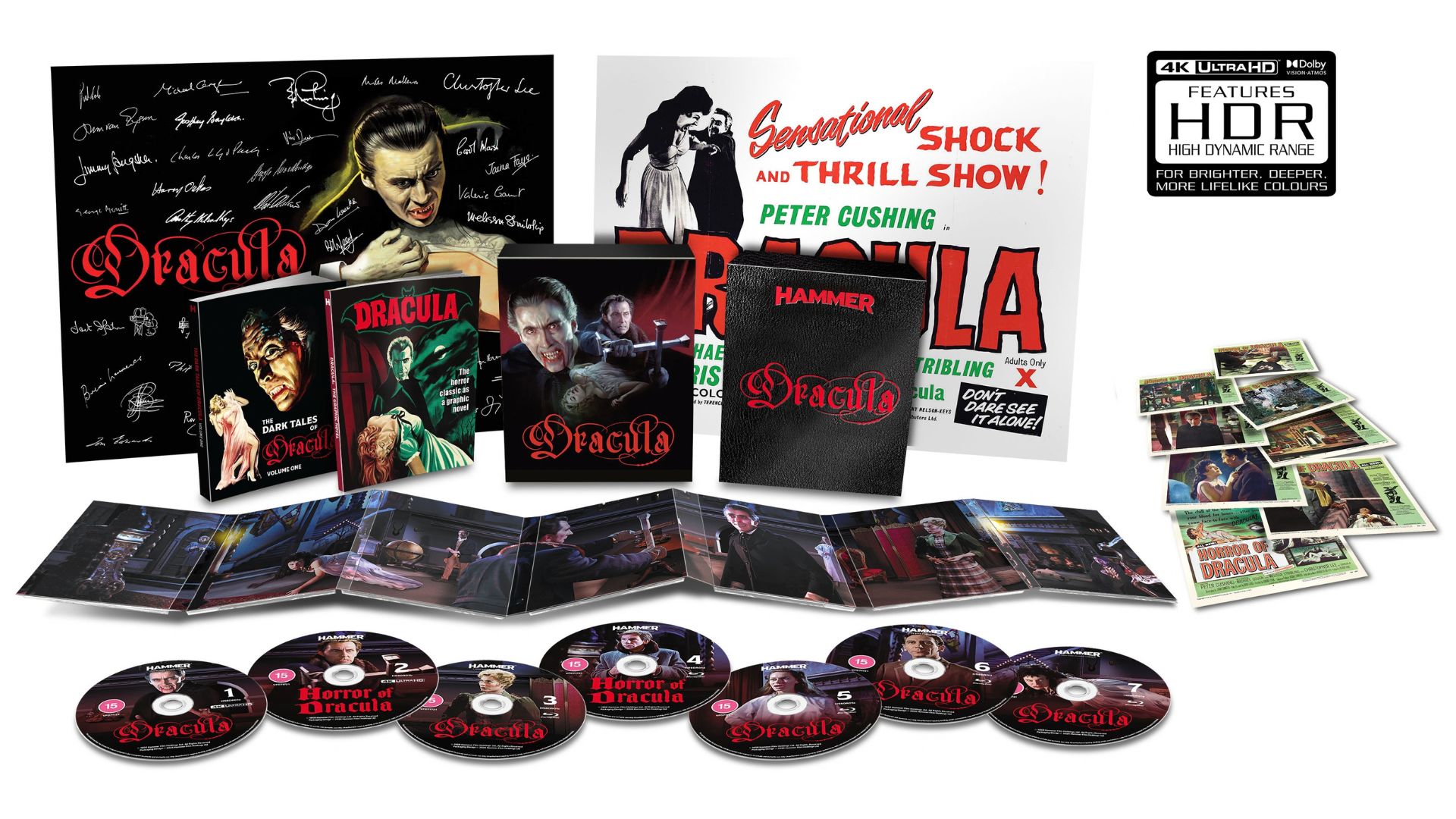
Housed in a premium slipcase, the limited collector’s edition set also includes a 200-page book, 60-page House of Hammer comic reprint, double-sided poster and eight replica cinema lobby cards. The extensive 200-page book includes articles from Bruce G. Hallenbeck, James Swanton, Wayne Kinsey, Andy Murray, Barry Forshaw, Gayle Sequeira, Miriam Balanescu, Sarah Morgan, Ramsey Campbell; and an archive Melissa Stribling interview from 1978. Some very lucky fans may have already pre-ordered the Blood Edition: limited to just 1000 individually numbered sets, which wraps the release in a striking red leather-feel outer slipcase with black debossed foil titling and exclusive alternate cover art from Sam Hadley. For reference, only the discs were provided for this but based on Hammer’s previous collector’s edition sets, this is sure to be a premium package.
If you’re after something a bit smaller, a standard edition of this release is available on Blu-ray and 4K UHD, including the four main iterations of Dracula (the UK theatrical version, US theatrical version and director’s cuts of both versions) alongside their respective commentaries and some of the other special features including Proving Them Wrong; The Road to Dracula; Gothic for Christians; the Censor Card; Clapperboards; the Titles, Trailers and 8mm Cutdowns; and the Image Gallery. Considering the price difference between the standard and limited edition releases, it’s easy to see why the former has fewer extras. Retailing at £65.00, the limited collector’s edition may look expensive but it works out at less than £10 per disc.
Summary
Following on from Hammer Films’ spectacular 4K Limited Collector’s Edition releases for Captain Kronos: Vampire Hunter, The Quatermass Xperiment, Quatermass 2 and The Curse of Frankenstein, fans can be assured that this is truly the definitive home media release of Dracula. The brand-new 4K picture and sound restoration is sublime, the inclusion of multiple cuts (all told there are 7 versions of the film, including the workprint and 8mm variations) ensures that all fans will be satisfied and the special features package (while understandably limited given the film’s age) is incredibly impressive. If you’re only after the new restoration, the standard edition makes for a more affordable option, but if you are a dedicated Hammer fan, the 7-disc Limited Collector’s Edition has to be the way to go.













Leave a Reply