While I enjoy big film productions, that regularly head our collective way, I do believe it’s important to come back down to earth with smaller scale, but important, stories just as much. If they resonate on a genuinely human level, or offer a deeper look into a subject that highlights something you may only know on a surface level, as well as being raw and educational, then even better and Amazing Grace certainly sits within this bracket.
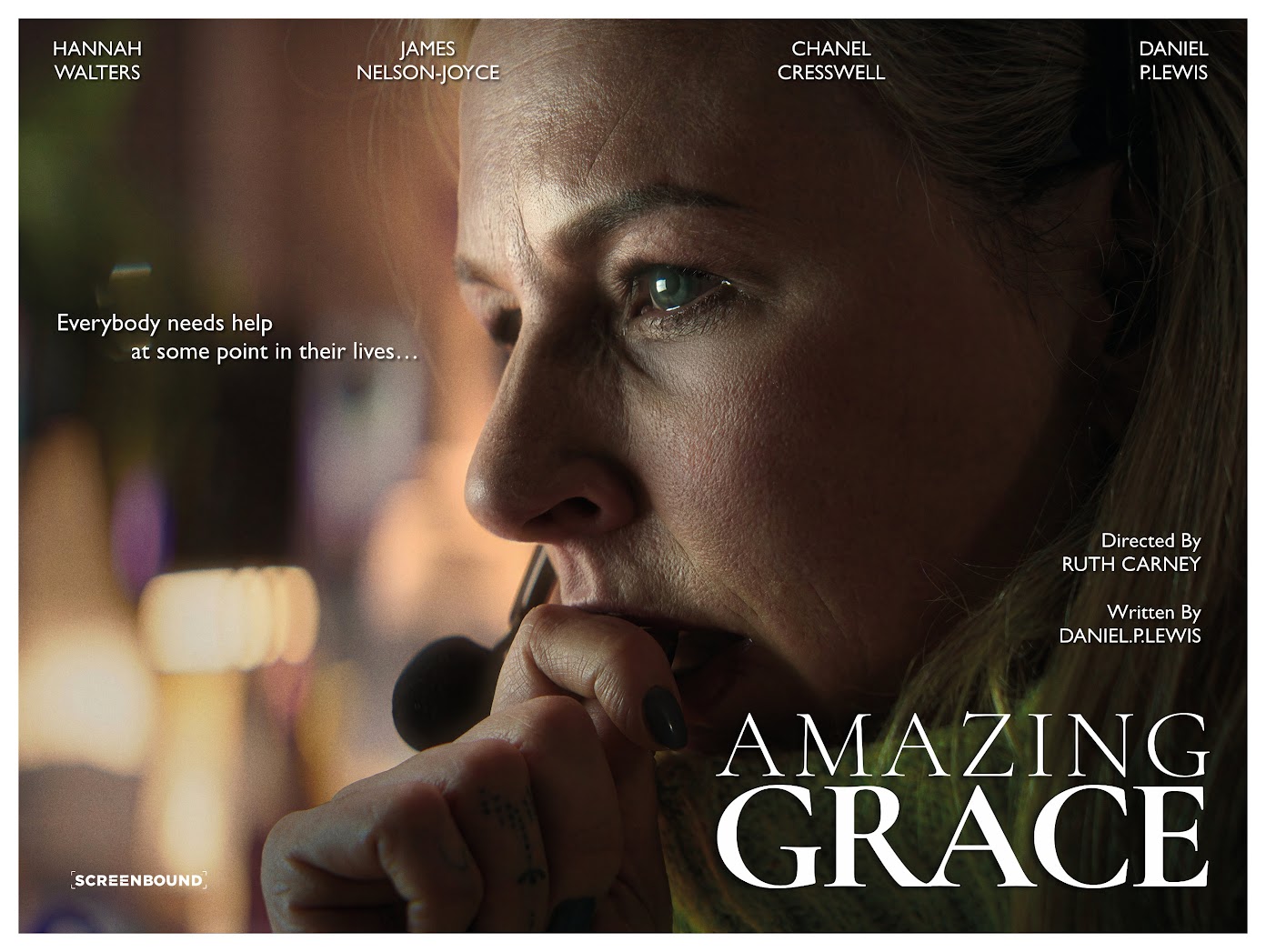
Directed by Ruth Carney, in her first-time feature, Amazing Grace stars Hannah Walters as Grace, a volunteer crisis helpline worker – the Hope Helpline – who emulate a setup similar to the Samaritans, essentially a place people can call whatever state of mind they’re in, and what might be their most desperate life moment. When Walter (played astonishingly by Daniel P. Lewis, who also wrote the film that’s certainly a personal story) phones in and Grace picks up the call, it’s clear he’s in a distressed mental state and, yet, he has reached out so maybe there’s a slight slither of light.

We’re introduced to Walter in his flat, this is home but clearly one that’s become a prison for both his day-to-day life and his mind. Rubbish fills almost every surface, plates and cups sit unclean in the sinks, and he wanders the hallways like a caged animal, trying to deal with whatever nightmare is going on that day. It’s also suggested, and revealed, that the space was once shared, but now he’s alone. Walter has added extra locks on the doors and paces from room to room; the only moments of brief calm and solace are when he focuses in on his fish tank and a single goldfish called Frank. He can talk to Frank; he can find momentary peace without being questioned.
Depending on your experience with mental health conditions, which can range from small events to major breakdowns, you may not be aware of the gradual build of habits, of a desire so strong to follow a certain routine, that it can eventually become completely debilitating and overwhelming in equal measure. Amazing Grace displays this through Walter’s absolute need to follow certain patterns in his house, which are mainly only leading to him losing a sense of reality, one that we may take for granted in the day-to-day. And from what we witness, Walter is falling into a deep pit towards an all-encompassing mental health breakdown.


The tics and habits shown may be triggering for some, they’re not portrayed in a clichéd way either, I can say that my experiences made it difficult to watch in some moments. But, in retrospect, I think it’s important to show a true version as often such subjects can be watered down or appear surface level in some media representations. There’s no doubt of the raw realism, alongside a gritty cinematography from Daniel Patrick Vaughan, and in the lead role, Daniel P. Lewis’ performance is devastating. To say he puts everything into the role is not an understatement, he’s brutally real in a reflective and sorrowful way. To show such things, from both Walter and Grace’s perspectives, reminds us that every day there are people trying to help others in what might be the worst day of their life, and what these volunteers endeavour to do is astonishing.
In terms of narrative, it is quite simple but it works for this scenario. We initially see a little of Walter’s Grace in her office, singing happy birthday to a colleague and being bright and positive, before instantly switching into her empathy and listening to the caller with intent. Over the 85 minutes of runtime, we’re taken through Walter’s life as tries to find peace in his adult life, as he and Grace discuss childhood trauma, addiction and the shame of something terrible that happened to him. While we’re linked by their phone call, both actors offer all kinds of genuine, touching human emotions, you do feel what they’re going through, and they’ll both reveal their own truths as the story progresses. Although, I did wonder if some storytelling would work without visual flashbacks, but I can see why it were utilised.

Amazing Grace holds onto its hopefulness as much as it can, even in moments of extreme lows, and its final message is to look towards highlighting something that’s, sadly, all too real and this aims to be a brief spark of light out of the darkness. Carney and Lewis’ film hopes that sharing a story like this will mean that someone, somewhere, doesn’t need to suffer the same downfall alone, and that’s an important lesson.

Amazing Grace is out now in cinemas from Screenbound Pictures
If you’re going through something and need any help, please visit or call: https://www.samaritans.org/
There have been some events with screenings around the UK, and one is coming up in Newcastle: Sun 22nd Nov | Tyneside Cinema, Newcastle upon Tyne | 5:30PM
💬 Q&A with director Ruth Carney, actors Hannah Walters, Chanel Cresswell and Angela Lonsdale alongside producer Carley Armstrong and actor/writer/producer Daniel P. Lewis
🎟️ https://tynesidecinema.co.uk/event/amazing-grace-film/













Leave a Reply