A film about a man trapped inside a whale sounds like it should be insane. You would think that at the very least, it would be difficult to make a boring film out of such a ridiculous premise. And yet Whalefall, Brian Duffield‘s adaptation of the novel by Daniel Kraus comes perilously close.
Austin Abrams plays Jay, the grieving son of a diver (Josh Brolin) who died a year earlier. The opening scene sees Brolin take his fishing boat out with his best friend (David Ortiz), only to slip overboard to his watery grave. It’s a brilliantly intriguing beginning, establishing an atmosphere of mystery and melancholy that suggests something considerably more interesting than what follows. Sadly, the rest of the film struggles to live up to it.

The central problem is that Whalefall takes itself far too seriously. In flashback, we see Brolin’s largely absent father dispensing pseudo-philosophical wisdom while simultaneously mocking his son’s interests and in the same sentence laments his reluctance to follow in his footsteps. It’s a contradictory characterisation that could have been explored, had the film any interest in examining the damage this relationship has caused. Instead, Jay ends the film at peace with his father, which feels like a step backwards, suggesting that all the resentment and hurt can be neatly resolved by a few belated lessons in paternal wisdom. Don’t even get me started on that letter. It’s smug, self-satisfied and convinced it’s so much cleverer than it is.
The risible dialogue is so on-the-nose that it’s almost laughable. When Jay arrives home on the subtext of spending time with his family, nobody buys it, but as he drives away from the house one morning, the narration explicitly tells us exactly where he’s going. There is zero subtext here. For all the action that takes place thousands of feet beneath the ocean, the film’s themes are permanently stuck at the surface.

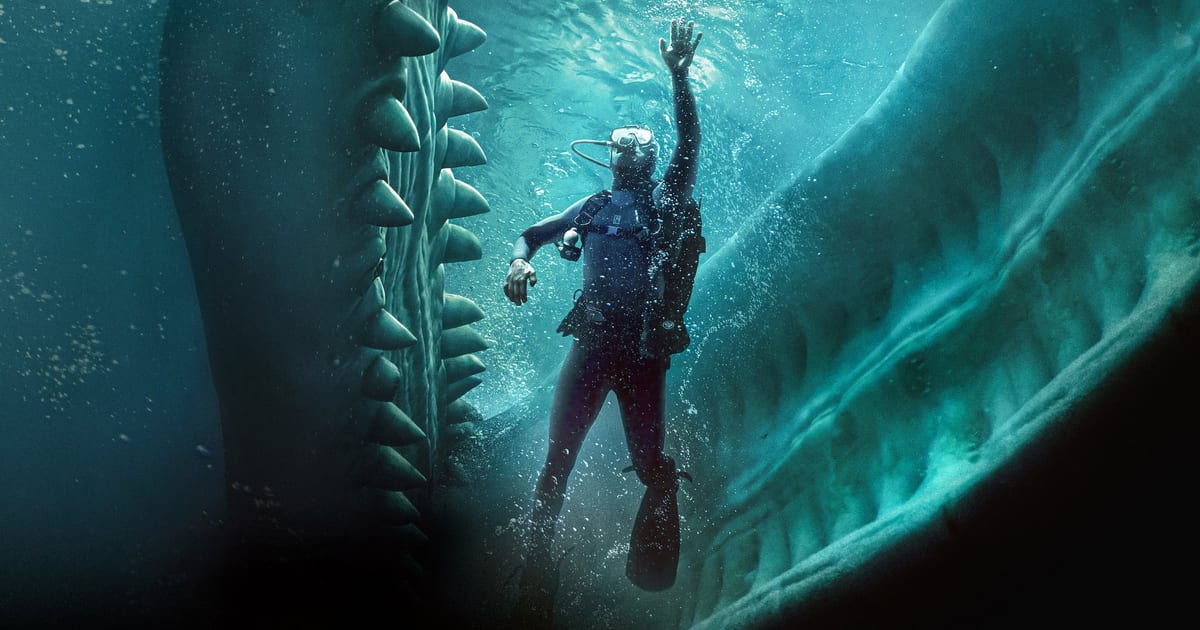
To its credit, the moment where Jay is caught up in the whale’s mouth is convincingly executed, and all the scenes showing the practicalities of escaping a whale’s stomach provide some suitably grisly moments. The special effects, both practical and digital, are incredible, and the scenes of Abrams actually surviving in the whale’s stomach are appropriately nasty. Any scene involving stomach acid and dissolving flesh is going to be nasty, and these moments, along with a particularly sharp squid’s beak have a visceral unpleasantness that makes for stomach churning viewing.
But as someone who suffers from both claustrophobia and thalassophobia, (a fear of huge bodies of water) I should have found this a nightmare. Instead, it didn’t really make me feel anything, which might be the most damning statement of all. The most uncomfortable I got in the entire film is early on when Jay steps off the reef into the abyss, and sees a giant squid emerging out of the darkness. That is terrifying to me.
Once Jay is inside the whale, the tension dissipates. Perhaps it’s Abrams’s surprisingly calm performance, or that the whale’s throat looks oddly comfortable, but aside from one particularly nasty moment when the squid is crushed and digested, Jay rarely seems to be in genuine mortal danger, and yes I am aware of what a bananas statement that is, but here we are.
Abrams, having a great year following his lead role in Resident Evil, is the film’s one saving grace, but even he struggles to make his character likeable. Not for nothing, the best moment in the film is also the only time he shows any personality, when Jay, having crawled all the way up the Whale’s throat, shrieks to a nearby fishing boat: “I’m in the f***ing whale!!“

The film’s survival narrative eventually becomes a bizarre mixture of 127 Hours and Slumdog Millionaire, (except, you know, in a whale.) Every time Jay needs to work out an extra detail of his escape, there is a convenient flashback to his father explaining exactly what he needs to do. Then the paternal voiceover kicks in, and things reach a new level of absurdity. Jay begins associating the whale with his father. There’s an idea here about confronting grief and making peace with the past, but the execution is so clumsy that it feels less like emotional revelation than a screenwriter desperately underlining the theme. The little jellyfish Jay befriends is similarly unconvincing, feeling like the result of a studio note demanding a “cute” character to wring some emotion out of the story, and the affection Jay develops for it never feels earned.
Unfortunately Whalefall is neither fun or unhinged enough to be a Sharknado-style exploitation action thriller, nor profound enough to warrant its sense of self-importance. Overly sentimental in its exploration of the father-son dynamic, Whalefall is at it’s best when dealing with the nitty gritty of escaping a whale’s stomach because as a survival thriller, it works, but the attempts at profundity fall flat.















Leave a Reply