Anyone who has read any of my reviews on this site will likely already be aware of my love for Carol Reed’s The Third Man. It’s my favourite film of all time, to the extent that I never pass up the opportunity to write about it, whether I’m writing a review of its re-release, or picking the final scene as my favourite farewell in cinema!
While preparing for the release of John Walsh‘s upcoming book on the making of The Texas Chainsaw Massacre, I looked into his previous work and, to my delight, discovered he’d also written a book on the making of this cinematic masterpiece.

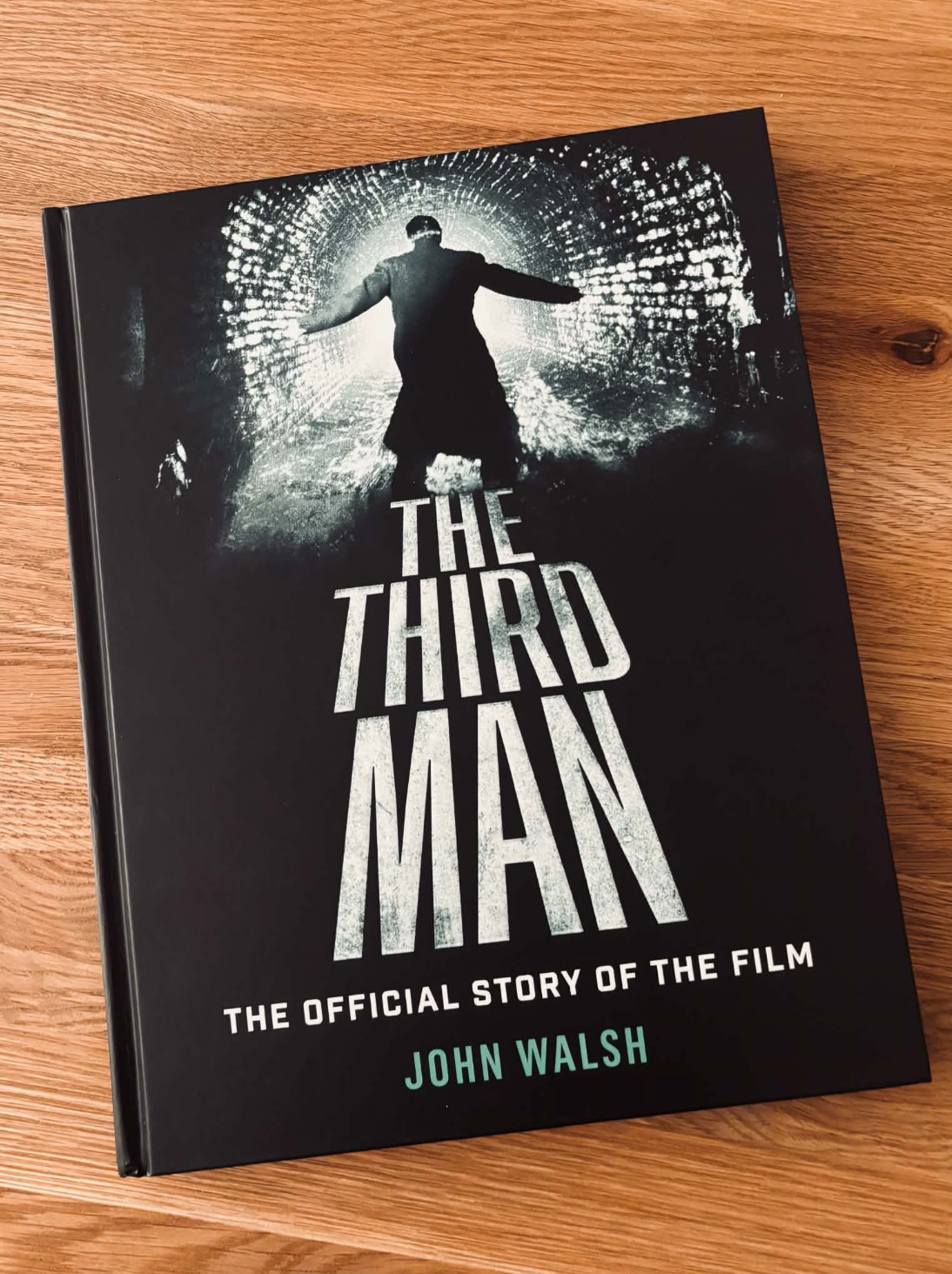
The Third Man: The Official Story of the Film is a bit of a stealth classic, a methodical, comprehensive guide to every facet of the film disguised as a beautifully produced coffee table book. Rather than the light, superficial overview that format often implies, Walsh delivers a genuinely insightful and impressively detailed history of the production.
As a fan, I wasn’t sure how many surprises the book could hold – with an older film, you’d assume the background stories would be exhausted by now. Thankfully, I needn’t have worried as Walsh’s book is incredibly in-depth, with contributions from a wide range of participants, from crew members such as script supervisor Angela Allen to the family of the key figures, like Graham Greene‘s nephew Nicholas Dennys, offering fresh production perspectives.
I knew for instance that the film was an intensely collaborative production. Rather than being adapted from Graham Greene’s novella, the book and the film had an almost symbiotic relationship, with the novella serving as a treatment for the film. The screenplay itself was developed by Greene and Reed together, with each contributing ideas.

What I didn’t realise was how far this extended. Today, we are constantly told that great films are the vision of one voice, one auteur, but Walsh’s book makes a compelling case for the creative power of collaboration. Peter Bogdanovich famously called The Third Man “the greatest non-auteur film ever made,” and while that’s a little dismissive of Reed’s talents as a director as The Fallen Idol and Odd Man Out clearly demonstrate a distinctive visual style, but it does underline just how many voices shaped this finished film. Walsh gives full credit not only to Reed and Greene, but also to producers Alexander Korda and David O. Selznick, as well as cast and crew for contributing ideas to the final product. The closing quote from Reed perfectly captures his philosophy: “I don’t think a director should stand out. The audience should be unconscious that the damned thing’s been directed at all.”
What the book highlights is just how unlikely the finished film actually was. With many contributed ideas, rewrites and suggestions incorporated, had any one of those people been absent, the film might have turned out entirely differently. Much is made of Orson Welles improvising Harry Lime’s famous cuckoo clock scene, but Walsh shows that many of the film’s most memorable moments came from different people. It was Selznick who insisted on developing Alida Valli’s character, and both the producer and Reed were steadfast on the classic, downbeat ending. Greene himself admitted he had initially doubted it, later writing, “I had not given enough credit to the mastery of Reed’s direction, and he was proved triumphantly right.”

The book further reveals that other iconic moments were thought up on location; It was Trevor Howard who discovered Anton Karas for the now-iconic zither score; Reed himself provided the hands for the shot of Lime’s fingers clutching the sewer grating; even Anna’s cat only liking Harry was an on-set improvisation. It’s remarkable that a production shaped by so many feels so perfectly unified.
What emerges is an appreciation not only of the stars but of the breadth of talent behind the camera. As a fan, I was already familiar with Reed, Greene, and the cast themselves, all of whom are perfectly cast, but Walsh offers compelling attention to figures such as Korda—”the closest thing the United Kingdom had to a Hollywood mogul”—along with Selznick, cinematographer Robert Krasker and composer Anton Karas, all of whom receive chapters of their own, with concise, yet comprehensive biographies of their careers.
There are plenty of other fascinating anecdotes that vividly bring the production to life. Selznick, in particular, emerges as a formidable and often overbearing presence, to the point where his portrayal occasionally recalls the larger-than-life Hollywood moguls immortalised in films like Barton Fink. Yet Walsh never reduces anyone to caricature, giving even-handed accounts of the strengths and shortcomings each contributor brought to the production.


It’s definitely a book to be read in instalments. There are a few repeated anecdotes here and there, but they largely stem from the book’s structure, where events are recontextualised or revisited from different contributors’ perspectives. And, of course, the book is a beautiful object in its own right, filled with stunning production stills, promotional photographs, candid behind-the-scenes images and memorabilia from the Third Man Museum in Vienna (3mpc.net).
John Walsh’s The Third Man: The Official Story Of The Film is that rare thing, a coffee table book that’s as informative as any musty old tome of the production history. The author’s account of the production is well-informed, in-depth and incisive, beautifully packaged and a must-have for any fan.


![10 Overlooked Horrors Worth Rediscovering: Hammer Studio and Its Shadows [Part 1]](https://criticalpopcorn.com/wp-content/uploads/2026/09/Screenshot-2026-09-13-at-22.01.34-e1789420867213.png)


![Blood Simple 4K UHD review: Dir: Joel and Ethan Coen [StudioCanal]](https://criticalpopcorn.com/wp-content/uploads/2026/09/91x9UbMrQtL._AC_SL1500_.jpg)



![Marco Beltrami’s Scream – Original Motion Picture Score review [30th Anniversary Edition]](https://criticalpopcorn.com/wp-content/uploads/2026/08/wp-17877596958015858266935465229300.jpg)
![Peaky Blinders Underworld review [Immersive Experience @ London Bridge]](https://criticalpopcorn.com/wp-content/uploads/2026/08/wp-17877596959334400112344533578537.jpg)
![Inside Llewyn Davis 4K UHD review: Dir: Joel and Ethan Coen [StudioCanal]](https://criticalpopcorn.com/wp-content/uploads/2026/10/816Z4numuIL._AC_SL1500_.jpg)

![Bunker review: Dir. Florian Zeller [LFF 2026]](https://criticalpopcorn.com/wp-content/uploads/2026/10/Screenshot-2026-10-14-192319.png)
![Ray Gunn review: Dir. Brad Bird [LFF 2026]](https://criticalpopcorn.com/wp-content/uploads/2026/10/ray-gunn-first-look-image-376172749.jpg)

Leave a Reply