The other week, I was fortunate to get an early sneak peek into the new The Big Bang Theory spin-off series, Stuart Fails to Save the Universe, as well as attending a press conference with all the main cast: that’s Kevin Sussman, Lauren Lapkus, Brian Posehn, and John Ross Bowie, as well as exec producers Zach Penn, Bill Prady and – of course – sitcom legend Chuck Lorre himself, with this latter trio being co-creators of the show.
Before we delve into that Q&A collective, and I can tell you don’t mind waiting, the first teaser trailer for this series arrived quite swiftly into my world but was highly enjoyable and offered intrigue with all the right tone intentions. So, for this preview I won’t spoil anything major, I’ve never understood the fun in that, but I am keen to share that my flickers of hope from that aforementioned trailer were rewarded, with a snappy series that expands boundlessly beyond expectations.

Stuart Fails to Save the Universe, and that title phrasing was contemplated by Lorre and co, takes us into fresh, unknown adventures of Stuart Bloom (Sussman), alongside [not a spoiler] ex-girlfriend Denise (Lapkus), geologist friend Bert (Posehn), and quantum physicist/absolute trouble Barry Kripke (Bowie). As a whole, it’s a proper joy of random comical chaos with additional unpredictably violent deaths and perfectly timed late-night swearing – although in the UK we don’t mind profanity at any time, and if I’m being truthful, we expect and encourage it.
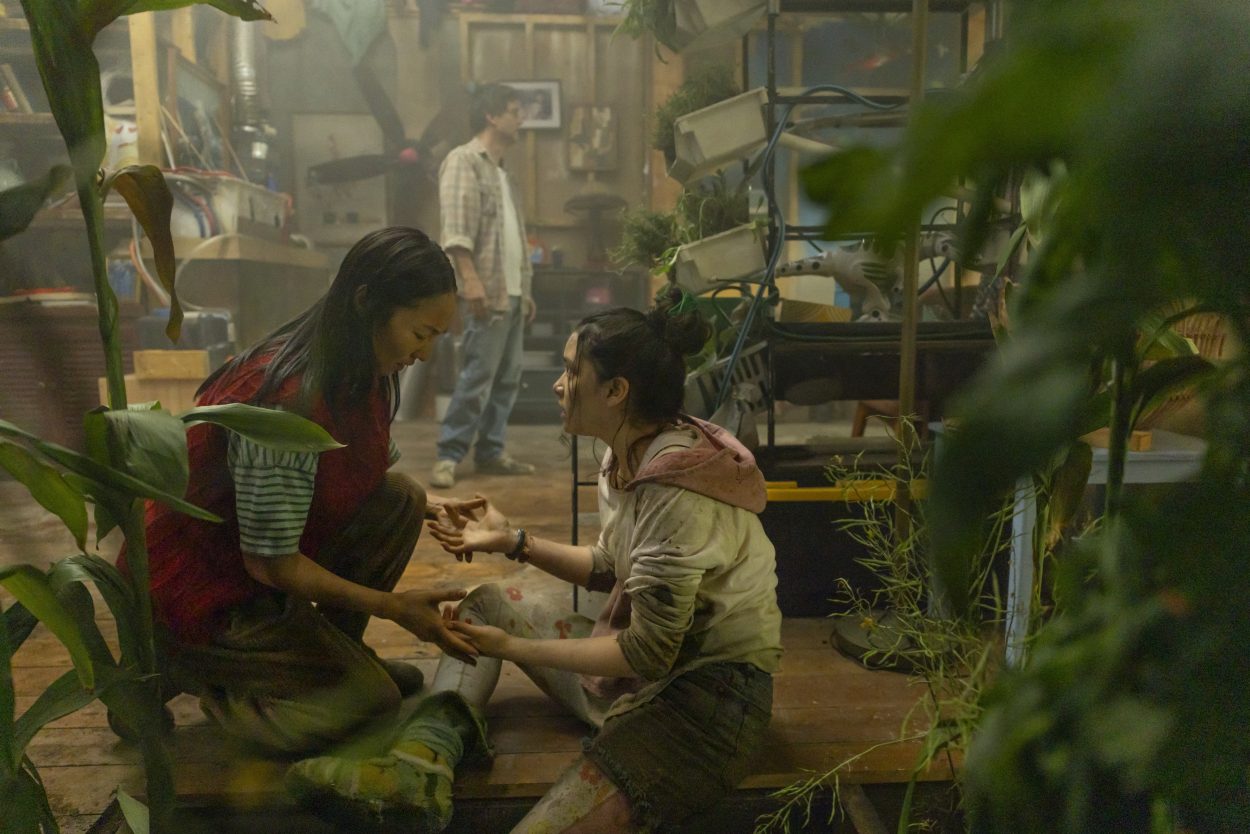
Anyhow, in this series, comic bookstore owner Stuart must try and restore reality, after he unintentionally breaks a device, he finds that was created by Sheldon and Leonard which, in turn, creates a multiverse Armageddon. With all the best intentions, Stuart and his three acquaintances find a way to make the device work but each time they think they’ve found a way back home, they’re actually thrown into another version of the world they know. And on this journey, they’ll meet alternate versions of characters you may, or may not, have seen before but – as the title of the show clearly points out – things don’t ever quite go to plan.

In terms of episode length, they range between 20 and 25 minutes, yet within those little worlds there’s a mass of material going on, enough for each character to go on a personal journey – with all of them having many motivations to test their mettle and mind. The opening episode wastes no time in setting the scene of what’s going on, and I will say it felt strange to begin with, as it’s a distinct lean on the comedy style, but stay with the gang, because it gets stronger after the opening episode, as it’s got that ‘pilot’ vibe but is all about getting us up to date.
I think it’s important to say that this isn’t The Big Bang Theory, and that works for me. While this quartet are essentially TBBT side characters, in the nicest way possible, the base of that series behemoth is merely a stepping stone to now. While any fan will know the central premise of the show they’re from, I believe you could watch and enjoy this as its own entity, as you learn about everyone as you go along, and its own madcap format bridges an amalgamation of sci-fi and comedy, floating in space and time that’s sometimes like an adult Doctor Who, with certain sparks of Red Dwarf, additional Mel Brooks-esque quips and maybe even a little Quantum Leap.


In terms of episode specifics, I’ll continue to steer clear of spoilers because part of the fun is the fundamental mystery, even if you think you know that you’re heading into. But you’ll keep interested because the connection, even with completely different episodes, is all down to the central characters, and embracing their growth, intentions and desires, which plays to an older audience. This element is particularly interesting in relation to Kripke, as he fits into it effortlessly, with that darker sense of humour and John Ross Bowie having a blast.
While Stuart Fails to Save the Universe is clearly comedic, with a good hit of multiverse escapism, the stories could be real, like an away mission on Star Trek. Each character must find a way to survive a chaotic situation, and continue to be themselves through it, which raises the question of whether every day people do actually remain the same, no matter the madness of the situation they’re stuck in. It’s the joy of ridiculousness in the seriousness, whereas a character doesn’t know they’re in a deathly situation, but can they utilise their individual skill set through it – even against their own expectations?


And how did the series come to be? Creator Chuck Lorre initially reveals, in one of those classic credit stings, that he needed to get up off the sofa and out in the sphere of possibilities. In the Q&A hosted by Kate Hahn he elaborated:
“It began about, I’d say around 10, 12 years ago. I remember it as the last season of Big Bang, “he continued “I had this idea that Stuart, in the comic bookstore, there was a portal in the back room to other universes. And I’ve always wanted to work in a bigger genre than what we were doing in front of an audience. I loved what we did in front an audience, but the idea of working with visual effects and computer graphics and the things you can do.”
Lorre then detailed more, focusing on his lead character:
“I’ve been a longtime fan of Mr. Sussman and I just thought he’d be the perfect lead for this kind of a comedy. As far as the melding of it with comedy is concerned; something’s funny or it’s not. And all the special effects and computer graphics cannot make something that’s not funny, funny. So, we just had to remain honest with ourselves as we wrote these things that we were telling the truth. We think this is truly funny. We hope you agree.”
The Q&A itself was very good natured, as you’d hope, with Sussman and Lapkus discussing their changed relationship (you’ll discover how/why speedily enough), with Lapkus particularly enjoying working with Sussman in a different way to TBBT, commenting:
“I loved it because I felt like we were able to get to another level that, you know, you wouldn’t get to on a multi-cam sitcom, like it was, there was some depth to the relationship and they of course are going through such extreme situations that their relationship grows through that,” with Sussman adding “Yeah, at the end of Big Bang, Stuart has this new relationship, this good relationship… and then, of course, the show stopped, and it’s like, ‘that’s so Stuart.’ But actually, [with] the format of this show, because it could be so much more intimate, because it’s a single camera and everything, there’s more dimension to their relationship that was really nice to do.”

The group were also asked if this was the type of show that Sheldon and Leonard would like, as it’s developed from that world, Bill Prady commented “They would argue about it. We talked about this. This is the kind of show that they would watch and argue about. I think they would like the science fiction puzzle aspect of it. They would probably focus on the mythology of it,” with Lorre adding “But they’d pick it apart…” and Prady agreeing before delving into the ethos a little more, by breaking down the show’s nature, saying “In fact, you know, there are times where the show veers away from fully making sense and the characters in the show are aware of it, and they talk about it,” which is something you’ll get to enjoy when the moments occur.
I also wanted to highlight from the Q&A, because some people might take for granted how any show comes to life, some insightful experience from the creators, which came via a question from a professor at USC who asked for writers and her USC students “How do you evolve one idea on a set nine years ago into a show?”, with Lorre explaining that “You grow accustomed to failure. Because it’s not going anywhere. No-one is interested in helping you pursue this. And then the company gets sold three, four times and somebody comes along and says, ‘you know what? Do that. And that was the process. It was really a question of time, how to pass by, and a different perspective on what this could possibly be.” which I think, in a roundabout sense, is a good way to remind anyone to keep going, especially in the creative arts!
I really recommend Stuart Fails to Save the Universe as your new, pleasurable escapism show. You know how Mork & Mindy came to be, after Mork’s singular Happy Days episode? Well, I guess these once ‘side’ characters are now in a world of their own, and it’s easy to love what the creative team are doing here. It’s a lot of fun, it’s wild and packed with surprises galore, which are well worth the multiverse trips and – yes, there’s more – it’s even got an original Danny Elfman theme tune that changes with every episode because every opening title sequence is different, so please do not skip them.
Why?
Well, you’ll have to find out…



![Marco Beltrami’s Scream – Original Motion Picture Score review [30th Anniversary Edition]](https://criticalpopcorn.com/wp-content/uploads/2026/08/wp-17877596958015858266935465229300.jpg)
![Peaky Blinders Underworld review [Immersive Experience @ London Bridge]](https://criticalpopcorn.com/wp-content/uploads/2026/08/wp-17877596959334400112344533578537.jpg)
![Ludwig Göransson’s The Odyssey – Original Motion Picture Soundtrack review [Gold 3x 140gm Mutant]](https://criticalpopcorn.com/wp-content/uploads/2026/08/wp-17877464150273393585814630638108.jpg)







Leave a Reply