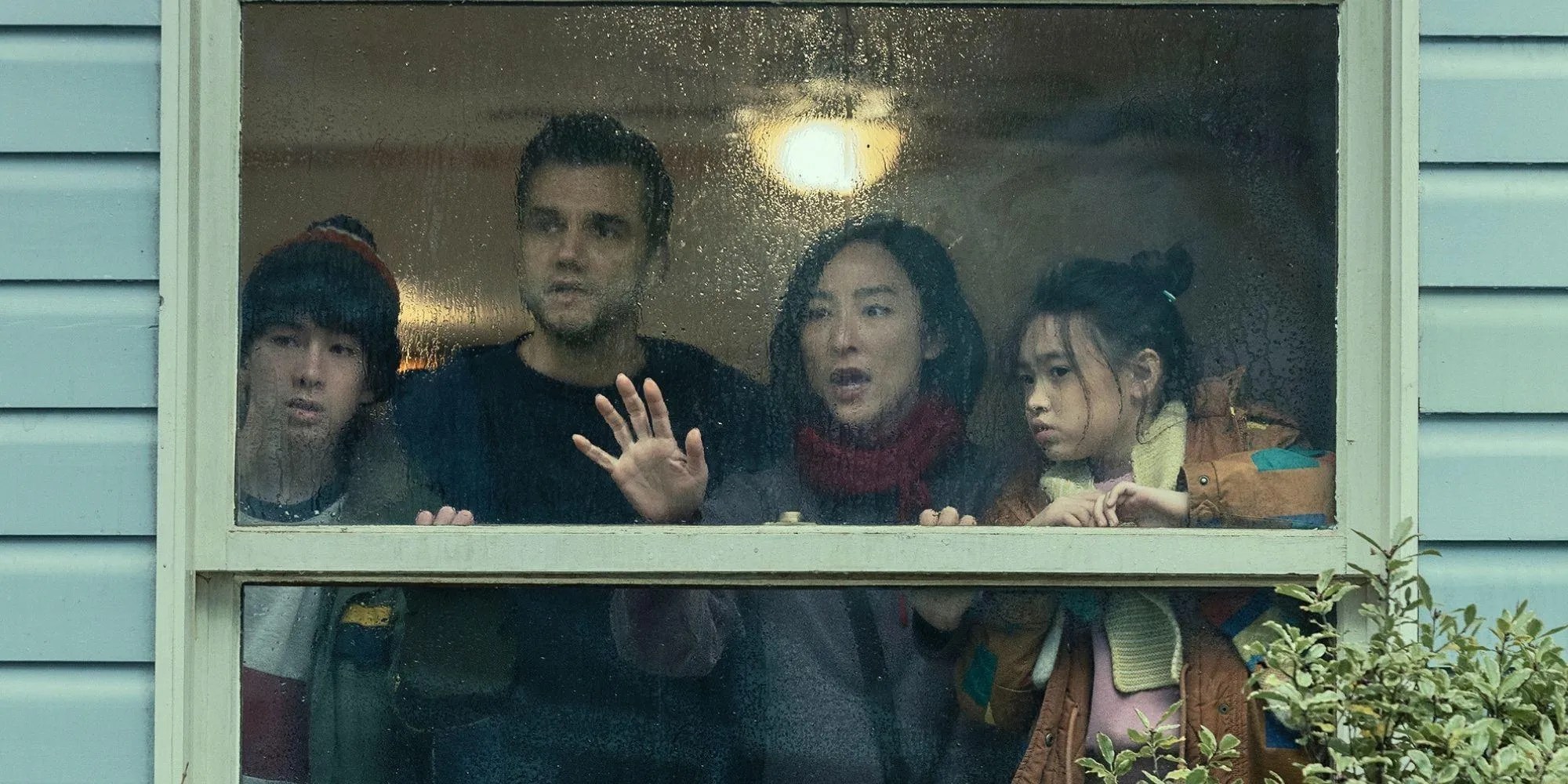
Directed by Louis Leterrier, and written by Matthew Robinson, The Last House follows a family of four who are literally trapped inside their own house by an unknown and mysterious force. Parents Jason (Wagner Moura) and Ann (Greta Lee), with kids Ruth and Graham (initially played by Riley Chung and Noah Alexander Sosnowski, and then Emma Ho and Gabriel Barbosa due to a narrative time shift), must work together to survive as their unusual plight moves from days, to weeks, and then years inside their residence.
**Spoiler Heavy**
The first trailer, and anticipated premise, certainly held exciting intentions but sometimes it can be quite the drop to reality when the final film comes out, and you realise the best part was the marketing. While I do think The Last House contains moments of earnest allure and potential, the actual experience is a soggy mess that unsubtly applies ideas from many other films and tries to merge them, it also forgets to stick to a narrative that credibly explains a curious situation and, instead, throws its concepts around wildly and hopes for the best.
Act One, in a classic sense, is by far the most connectable sequence as the family find themselves locked inside their house by a strange, watery force field. Oh, they do have electricity and water though, but no internet or mobile phone reception – it’s never really clear why we only get some perks of modern living. In the early stages, it echoes the Covid19-era, but you do question whether it’s still too early for us to go back and ‘enjoy’ those memories. Here it’s sold as ‘productive family time’ and while that may have happened, we all know the reality was something else entirely, and it’s not an easy lie to sell positively. Our family can share messages on chalk boards through their front windows to other neighbours and while, at first, it’s time for them to learn about each other (and we’re reminded about this with one of many clumsy lines that Lee and Moura try their best with), it’s not long before that perfection breaks down and people elsewhere start to, well, die, due to the lack of food or medicine, or maybe internet connection. For a UK viewer, it’s also slightly distracting as this street isn’t American; it looks very British and doesn’t help embed you as it’s intended to be near Seattle.

After the first few days of a technical lockdown, real time turns into years and eventually they’ve learned to grow plants inside their house (you really can grow tomatoes anywhere, trust me), discovered how to trap wild animals to eat, and got the basics covered. Lots of this makes sense but I did take issue with how many animal deaths we’re witness to. I was sold on Jason creating a trap that they could somehow get faultlessly out of their chimney and into the garden, to snare wild animals, but we’re shown it repeatedly and this is where editing, and smarter filmmaking choices should come to the fore. I didn’t need to see [insert any garden animal you know] trapped and dragged up a roof with the accompanying dying sounds on multiple occasions. I got the plan; you’d shown us originally. How does this help the story?
What lets a lot of The Last House down is any consistent or intelligent character building. We’re often thrown into heavy drama out of the blue, and while you could be impressed by the intensity, sometimes it doesn’t match the scene. Often Ann and Jason will violently veer from emotion to emotion, and while I can appreciate ‘keeping my family alive!’, it’s pushed too randomly to ever take that seriously. In retrospect, maybe it was Greta Lee and Wagner Moura realising what they’d got into and decided to go all in, and the hyper-jump mood swings are borne out of frustration and, if so, I think I get it.

Oddly, despite this, I didn’t completely dislike The Last House, I just wish it’d played more into the insanity of the situation. Often, it tries to be A Quiet Place and takes itself too seriously in-between odd tonal switches from family games and watching Annie, to capturing animals and ‘dealing’ with an old, very ill family pet – but never deciding what story it wants to tell. There’s a strong B-movie here, yet it ends up creating an almost endless array of questions, which include:
What’s the idea behind the barely used voiceover; Why only use a half-implemented clumsy climate suggestion that’s not really followed up; how do the sea creatures (Cthulhuesque) create rainstorms and have a strong influence on satellites in space connected to mobile phone service; how did one house remain sealed but, also, how does that same house have escapable holes; why do they accept the situation and also ignore their daughter who’s offering helpful insight without a second of contemplation and, a big one, were the creatures that she saw early on the same as the ones later? Because they certainly didn’t look the same from what we were shown, either visually or in the literal drawings she was making.
The Last House becomes part-Signs, part-The Happening, with a little hit of Spielberg’s War of the Worlds – particularly when they’re stuck in the basement of Tim Robbin’s creepy house. It also contains an occasion element of Roland Emmerich’s The Day After Tomorrow but without the skill, and while director Louis Leterrier is endeavouring to lead a high concept, it’s so heavy-handed that often it’s not even fun. I believe they implemented 35mm filmmaking and practical effects but I’m not completely sure where, as the biggest moments feel deeply CGI when they don’t have to be. There’s a mid-film scene where the parents lie on their bed and chat about their sex drawer and share a spliff, which then made me wonder if the film began to break down after that because they were (very softly) tripping, or if that was insinuation but, even if this was the case, the result is a disappointing film and, ultimately, that’s a confusing comedown.

The Last House is streaming now on Netflix



![Blood Simple 4K UHD review: Dir: Joel and Ethan Coen [StudioCanal]](https://criticalpopcorn.com/wp-content/uploads/2026/09/91x9UbMrQtL._AC_SL1500_.jpg)
![Marco Beltrami’s Scream – Original Motion Picture Score review [30th Anniversary Edition]](https://criticalpopcorn.com/wp-content/uploads/2026/08/wp-17877596958015858266935465229300.jpg)
![Peaky Blinders Underworld review [Immersive Experience @ London Bridge]](https://criticalpopcorn.com/wp-content/uploads/2026/08/wp-17877596959334400112344533578537.jpg)



Leave a Reply